RESEARCH

LPL Research’s Sustainable Investing Year in Review

Sustainable investing hit several milestones in 2021, but continued to attract its critics. Below we look at how sustainable investing fits within the broader concept of sustainability, its growth during 2021, and an implementation framework that has been helpful for many. A well diversified sustainable investing portfolio doesn’t mean that an investor has to make a choice between achieving market-like returns and being an aware social and environmental steward. Market volatility has been the dominant story for many investors in early 2022, but even as we focus on near term events it’s important to continue to track important market trends. Sustainable investing has become a significant theme in how many investors choose to direct some or all of their capital, choosing to emphasize businesses that show they’re in it for the long term. The space has been evolving as it continues to meet its critics and address the challenges that come with growth, with several important developments in 2021.
What is Sustainability?

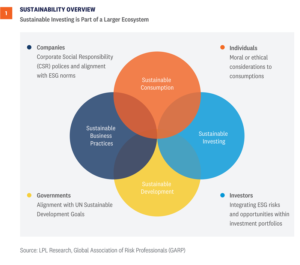
The concept of sustainability can easily get bogged down in confusing definitions and minutia. Most simply, sustainability is humanity meeting its current needs without overburdening the natural environment or future generations. Environmental sustainability refers to maintaining the balance of natural systems and that natural resources are consumed at a rate that can be replenished. Social sustainability refers to a minimum standard of basic necessities and that human rights is afforded to all people. As shown below, sustainability includes action by individuals, companies, governments, and increasingly investors. Environmental, social, and governance (ESG) issues fit within sustainability, but in its broadest sense ESG is a grading system for firms. ESG criteria are used by investors to gauge companies (and increasingly governments) on their ESG performance relative to their peers. Environmental metrics may include a company’s carbon dioxide emissions, water usage, or impact on deforestation. Social metrics may include a company’s employee engagement, diversity and inclusion, and employee health and safety. Governance metrics may include a company’s board composition, executive compensation, and other internal procedures. Sustainable investing incorporates ESG metrics into the investment process to provide greater transparency and help manage ESG risks and opportunities. As illustrated in [Figure 1], sustainable investing is part of a larger effort to provide social and environmental awareness and stewardship.

Growth of Sustainable Investing

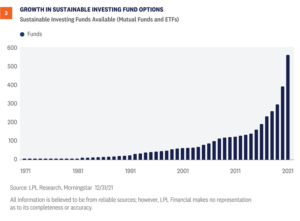
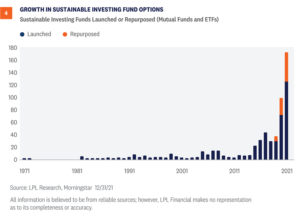
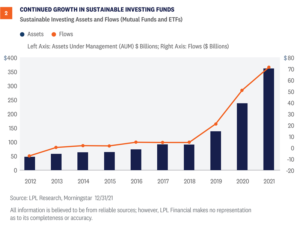
Sustainable investing mutual funds and exchange-traded funds (ETFs) continue to attract record flows from investors [Figure 2]. Determining this universe involves the identification of funds that demonstrate a commitment to ESG considerations in their investment process (disclosed in the principal investment strategies section of their prospectus). As of December 31, 2021, assets grew 52% from the year before to $362 billion. The universe of sustainable investing mutual funds and ETFs has also continued to grow since the first fund was launched in 1971 [Figure 3]. The growth in available options provides investors with a spectrum of choices, from being able to build a diversified stock and bond portfolio, to selecting a specialized strategy to supplement a traditional diversified portfolio. In 2021, the number of available choices grew 44% to 560. As a wider range of investors continue to incorporate sustainable investing in their investment process, there’s been a growing trend of traditional investment strategies being repurposed as sustainable investing strategies [Figure 4]. During 2021, 45 funds were repurposed while 125 funds were launched. The implication for investors is the need to thoroughly vet strategies to ensure the investment is delivering on the claims made in its supporting literature.

How to Implement Sustainable Investing Strategies

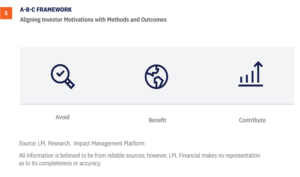
Sustainable investing is not a one-size-fits-all approach as interest varies by investor. For investors, the place to start is to understand their own motivations for their interest in sustainable investing. Motivations for sustainable investing are often grouped into values alignment, financial performance, and impact. Once motivations are clear, they can then be mapped to one or all of the outcomes described below. Finding a strategy or two, becoming more aware of various approaches, and slowly increasing one’s exposure to sustainable investing is a common way to get started.

Act to Avoid Harm: Values Alignment

Example: investors can signal that responsible corporate behavior matters.
  • “I don’t want to support companies that harm the environment, violate human rights, or engage in unfair labor practices.”
Motivation: some investors are motivated by the awareness that their investments should be transparent and align with responsible behavior, consistent with their approach to consumption. Investing method: negative/exclusionary screening – a process that excludes investment in companies, industries, or countries based on moral values and other specific standards. Outcome: periodic review to confirm investment portfolio does not contain previously agreed upon companies, industries, or countries.

Benefit Stakeholders: Financial Performance

Example: investors can engage actively to improve ESG performance of companies.
  • “I want companies to have a positive effect on society.”
Motivation: some investors see sustainable investing as a way to unlock commercial value, such as backing companies with strong ESG practices that are better positioned to adapt to a changing world. Investing method: ESG integration – intentionally consider the role of ESG factors in building a strong business alongside traditional financial analysis to identify ESG risks and opportunities. Outcome: periodic review to confirm investment portfolio has lower exposure to certain ESG risks, such as greenhouse gas emissions, or higher exposure to certain ESG opportunities, such as alternative energy solutions.

Contribute to Solutions: Impact

Example: investors can supply capital to underserved communities.
  • “I want to help tackle the affordable housing gap.”
Motivation: some investors are motivated to create positive change. Investing method: impact investing – investments made with the intention to generate social and environmental impact alongside a financial return. Outcome: periodic review to confirm assets channeled to underserved community are leading to tangible impacts. The above process is known as the A-B-C Framework (avoid, benefit, contribute), which may help align investors’ motivations, investment methods, and expected outcomes. Jason Hoody, CFA, Head of Investment Manager Research & Sustainable Investing Research, LPL Financial ______________________________________________________________________________________________ IMPORTANT DISCLOSURES This material is for general information only and is not intended to provide specific advice or recommendations for any individual. There is no assurance that the views or strategies discussed are suitable for all investors or will yield positive outcomes. Investing involves risks including possible loss of principal. Any economic forecasts set forth may not develop as predicted and are subject to change. References to markets, asset classes, and sectors are generally regarding the corresponding market index. Indexes are unmanaged statistical composites and cannot be invested into directly. Index performance is not indicative of the performance of any investment and does not reflect fees, expenses, or sales charges. All performance referenced is historical and is no guarantee of future results. Any company names noted herein are for educational purposes only and not an indication of trading intent or a solicitation of their products or services. LPL Financial doesn’t provide research on individual equities. All information is believed to be from reliable sources; however, LPL Financial makes no representation as to its completeness or accuracy. An Environmental, Social and Governance (ESG) fund’s policy could cause it to perform differently compared to funds that do not have such a policy. The application of social and environmental standards may affect a fund’s exposure to certain issuers, industries, sectors, and factors that may impact relative financial performance — positively or negatively — depending on whether such investments are in or out of favor. U.S. Treasuries may be considered “safe haven” investments but do carry some degree of risk including interest rate, credit, and market risk. Bonds are subject to market and interest rate risk if sold prior to maturity. Bond values will decline as interest rates rise and bonds are subject to availability and change in price. The Standard & Poor’s 500 Index (S&P500) is a capitalization-weighted index of 500 stocks designed to measure performance of the broad domestic economy through changes in the aggregate market value of 500 stocks representing all major industries. The PE ratio (price-to-earnings ratio) is a measure of the price paid for a share relative to the annual net income or profit earned by the firm per share. It is a financial ratio used for valuation: a higher PE ratio means that investors are paying more for each unit of net income, so the stock is more expensive compared to one with lower PE ratio. Earnings per share (EPS) is the portion of a company’s profit allocated to each outstanding share of common stock. EPS serves as an indicator of a company’s profitability. Earnings per share is generally considered to be the single most important variable in determining a share’s price. It is also a major component used to calculate the price-to-earnings valuation ratio. All index data from FactSet. This research material has been prepared by LPL Financial LLC. Securities and advisory services offered through LPL Financial (LPL), a registered investment advisor and broker-dealer (member FINRA/SIPC). Insurance products are offered through LPL or its licensed affiliates. To the extent you are receiving investment advice from a separately registered independent investment advisor that is not an LPL affiliate, please note LPL makes no representation with respect to such entity. Not Insured by FDIC/NCUA or Any Other Government Agency | Not Bank/Credit Union Guaranteed | Not Bank/Credit Union Deposits or Obligations | May Lose Value RES-1023100-0122 | For Public Use | Tracking # 1-05238004 (Exp. 1/23)
Can Corporate America Keep it Rolling?

Corporate America has been on quite a run. Coming into 2021, S&P 500 Index companies were expected to generate less than $170 in earnings per share. As 2022 begins, it looks like that number may end up higher than the latest LPL Research estimate of $205, one of the biggest earnings upside surprises ever and a big reason why stocks did so well last year. But 2021 earnings are not yet fully in the books. We have one more quarter to go, which we preview here.

Big banks kick us off

Fourth quarter earnings season kicks off this week with earnings from several big financials, including BlackRock, Citigroup, JPMorgan Chase, and Wells Fargo reporting on Friday, January 14. This week just seven S&P 500 constituents report, but another 40 will announce results the following week (January 17-21) and 99 the week after that (January 24-28). We welcome the shift from the macro to the micro where companies can continue to showcase their ability to effectively manage through the pandemic challenges, notably the supply chain disruptions and labor and materials shortages that are pushing costs higher.

What to expect

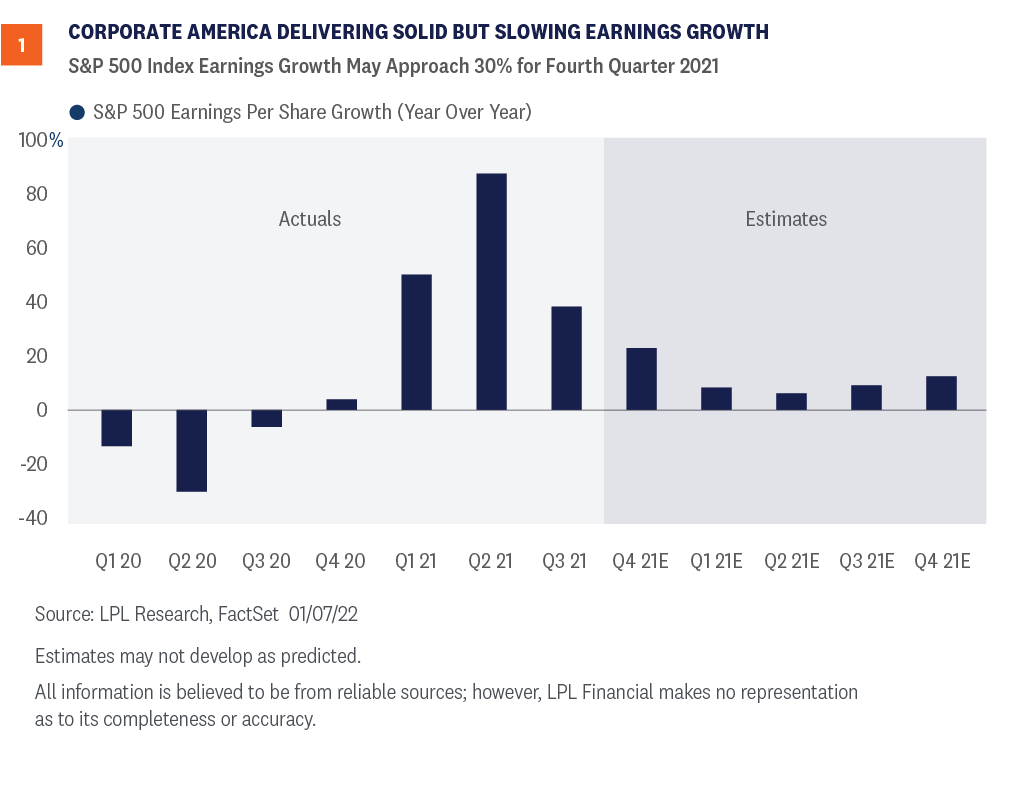
We expect another good earnings season overall in which companies continue to beat expectations in aggregate and produce solid growth. Consensus estimates are calling for a year-over-year increase in S&P 500 earnings in the fourth quarter of about 22% [Figure 1]. The long-term average upside surprise of around five percentage points makes 27% a reasonable target, but given earnings beat estimates by 12 percentage points last quarter, the number could be higher. Earnings growth approaching 30%, though slower than the third quarter’s nearly 40% clip, would be impressive given the challenging operating environment. We see several reasons to remain optimistic for this earnings season. First, estimates have been rising. Since the end of October 2021, the consensus estimate for fourth quarter S&P 500 EPS has increased 3.3%. Second, manufacturing activity has remained healthy based on purchasing managers’ surveys—the U.S. Institute for Supply Management (ISM) manufacturing index averaged a very strong 60.2 in the fourth quarter— in both the headline number and the new orders component. Additionally, in the December report there were signs of lower input prices and some easing of supply chain disruptions. Third, we expect the COVID-19 Omicron variant to have limited impact on demand, i.e., revenue, in the quarter. The Bloomberg-tracked consensus forecast for gross domestic product (GDP) growth in the fourth quarter is 5.2% year over year. Add a consumer price index (CPI) increase of over 6% year over year and it’s easy to see how 12.7% revenue growth, the current consensus, is possible. Remember, higher prices end up as more revenue for someone, as higher costs are passed along to customers. That’s why equities have preserved their value through inflationary periods over time. At the same time, there are some reasons to be concerned about less upside and more shortfalls. The Omicron variant did slow economic activity in December. And the ratio of negative pre-announcements to positives (1.7) has been more negative than the prior quarter’s ratio of 0.8, according to Refinitiv data.

What we’re watching

Margins, margins, margins. We will continue to watch for signs of pressure on profit margins from rising costs of labor, materials, and transportation. We came away from third quarter earnings season with the impression that most supply chain issues would be resolved by midyear. Any information contrary to that could influence the market’s response to results and direction of analysts’ earnings estimates for 2022. Wages are key. Wages are the single biggest component of companies’ costs, so we will be looking for confidence from companies that wage pressures are manageable. We anticipate higher wages will soon start to eat into profit margins, as productivity gains from technology investments (i.e., doing more with less) can only go so far. We would like to see more workers enter the labor force to help contain wage increases, which are already running above 4% annualized. Ability to pass on higher costs. We’ll also be interested to hear companies’ comments on the stickiness of price increases. If customers are starting to balk at higher prices, we may see some impact on demand and therefore revenue in coming quarters.

Earnings outlook for 2022

As we discussed in Outlook 2022: Passing the Baton, we expect a very favorable revenue environment in the coming year, with potential above-average economic growth and price increases. Revenue growth has historically been closely tied to nominal GDP growth (real “inflation–adjusted” GDP growth plus inflation). Our 4–4.5% real GDP growth forecast for next year, plus at least a few percentage points of inflation, puts 7% revenue growth in play, which is where consensus is currently. But margins are the tricky part. If they are stable—no small task—then a double-digit percentage increase in S&P 500 earnings per share (EPS) is possible. That would put S&P 500 EPS near $230 in 2022 and well above our current forecast of $220 [Figure 2]. But higher costs from COVID-19-related supply chain disruptions and materials and labor shortages are unfortunately not going away anytime soon. Wages are on the rise (average hourly earnings in Friday’s employment report rose 4.7% year over year, well above the 4.2% that was expected). And COVID-19 is still slowing economic activity. So, we prefer to be a bit more cautious for now and keep our S&P 500 EPS below-consensus forecast at $220, about 7% above our already conservative 2021 estimate of $205. We believe a continued economic expansion in 2023 as the impacts of COVID-19 fade, along with only a small potential hit from tax increases, will get us to $235 in S&P 500 EPS next year. That assumes a scaled-down version of Build Back Better with some tax increases passes. If it doesn’t, which we see as less likely, there won’t be any tax drag, introducing some upside potential to earnings next year.

Look for 5,000 on the S&P 500 in 2022

Despite the Fed’s accelerated tightening timetable, we continue to believe the S&P 500 will reach 5,000 in 2022. Earnings will have to do the heavy lifting to get us there with valuations elevated, though we believe a price-to-earnings ratio (P/E) in the 21–22 range is fair even if interest rates move modestly higher—that gets us to 5,000+ by year-end 2022. As the market continues to adjust to tighter monetary policy and factors in the still uncertain path of COVID-19, more volatility is likely. But that doesn’t change our enthusiasm for stocks here, especially relative to bonds, powered by solid earnings gains, the likelihood that COVID-19 risks fade as the year progresses, and our belief that inflation will be manageable in the latter part of this year.       Jeffrey Buchbinder, CFA, Equity Strategist, LPL Financial Ryan Detrick, CMT, Chief Market Strategist, LPL Financial ______________________________________________________________________________________________ IMPORTANT DISCLOSURES This material is for general information only and is not intended to provide specific advice or recommendations for any individual. There is no assurance that the views or strategies discussed are suitable for all investors or will yield positive outcomes. Investing involves risks including possible loss of principal. Any economic forecasts set forth may not develop as predicted and are subject to change. References to markets, asset classes, and sectors are generally regarding the corresponding market index. Indexes are unmanaged statistical composites and cannot be invested into directly. Index performance is not indicative of the performance of any investment and does not reflect fees, expenses, or sales charges. All performance referenced is historical and is no guarantee of future results. Any company names noted herein are for educational purposes only and not an indication of trading intent or a solicitation of their products or services. LPL Financial doesn’t provide research on individual equities. All information is believed to be from reliable sources; however, LPL Financial makes no representation as to its completeness or accuracy. U.S. Treasuries may be considered “safe haven” investments but do carry some degree of risk including interest rate, credit, and market risk. Bonds are subject to market and interest rate risk if sold prior to maturity. Bond values will decline as interest rates rise and bonds are subject to availability and change in price. The Standard & Poor’s 500 Index (S&P500) is a capitalization-weighted index of 500 stocks designed to measure performance of the broad domestic economy through changes in the aggregate market value of 500 stocks representing all major industries. The PE ratio (price-to-earnings ratio) is a measure of the price paid for a share relative to the annual net income or profit earned by the firm per share. It is a financial ratio used for valuation: a higher PE ratio means that investors are paying more for each unit of net income, so the stock is more expensive compared to one with lower PE ratio. Earnings per share (EPS) is the portion of a company’s profit allocated to each outstanding share of common stock. EPS serves as an indicator of a company’s profitability. Earnings per share is generally considered to be the single most important variable in determining a share’s price. It is also a major component used to calculate the price-to-earnings valuation ratio. All index data from FactSet. This research material has been prepared by LPL Financial LLC. Securities and advisory services offered through LPL Financial (LPL), a registered investment advisor and broker-dealer (member FINRA/SIPC). Insurance products are offered through LPL or its licensed affiliates. To the extent you are receiving investment advice from a separately registered independent investment advisor that is not an LPL affiliate, please note LPL makes no representation with respect to such entity. Not Insured by FDIC/NCUA or Any Other Government Agency | Not Bank/Credit Union Guaranteed | Not Bank/Credit Union Deposits or Obligations | May Lose Value RES-1000900-0122 | For Public Use | Tracking # 1-05229974 (Exp. 1/23)    

Stock Market Outlook 2022: Another good year?

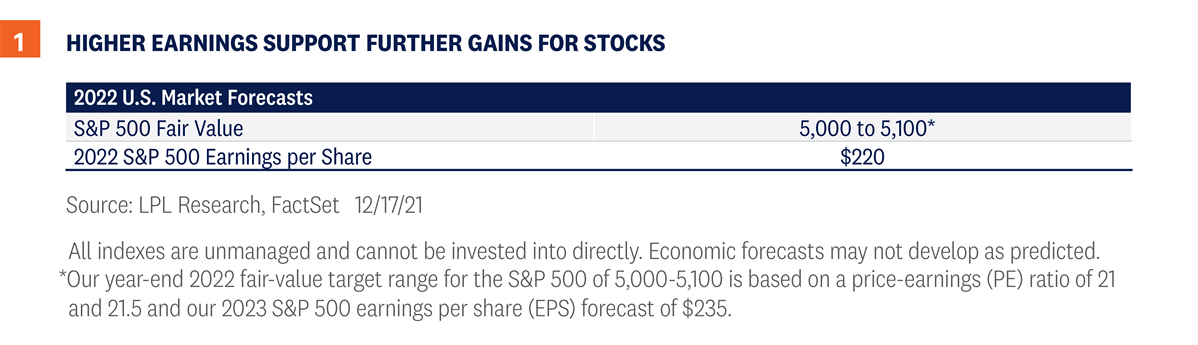
We expect solid economic and earnings growth in 2022 to help U.S. stocks deliver additional gains next year. If we are approaching—or are already in—the middle of an economic cycle with at least a few more years left (our view), then we believe the chances of another good year for stocks in 2022 are quite high. We believe the S&P 500 could be fairly valued at 5,000–5,100 at the end of 2022, based on an EPS estimate of $235 for 2023 and an index P/E between 21 and 21.5. Most of this content was taken from Outlook 2022: Passing the Baton We expect solid economic and earnings growth to help stocks deliver gains in 2022. When forecasting stock market performance, we start with the economic cycle. We believe we are currently approaching—or are already in—the middle of an economic cycle with at least a few more years left. Historically, if this holds true, then we believe the chances of another good year for stocks in 2022 are quite high, which is an important added factor for our positive outlook for stocks next year [Figure 1].

The Mid-Cycle Push

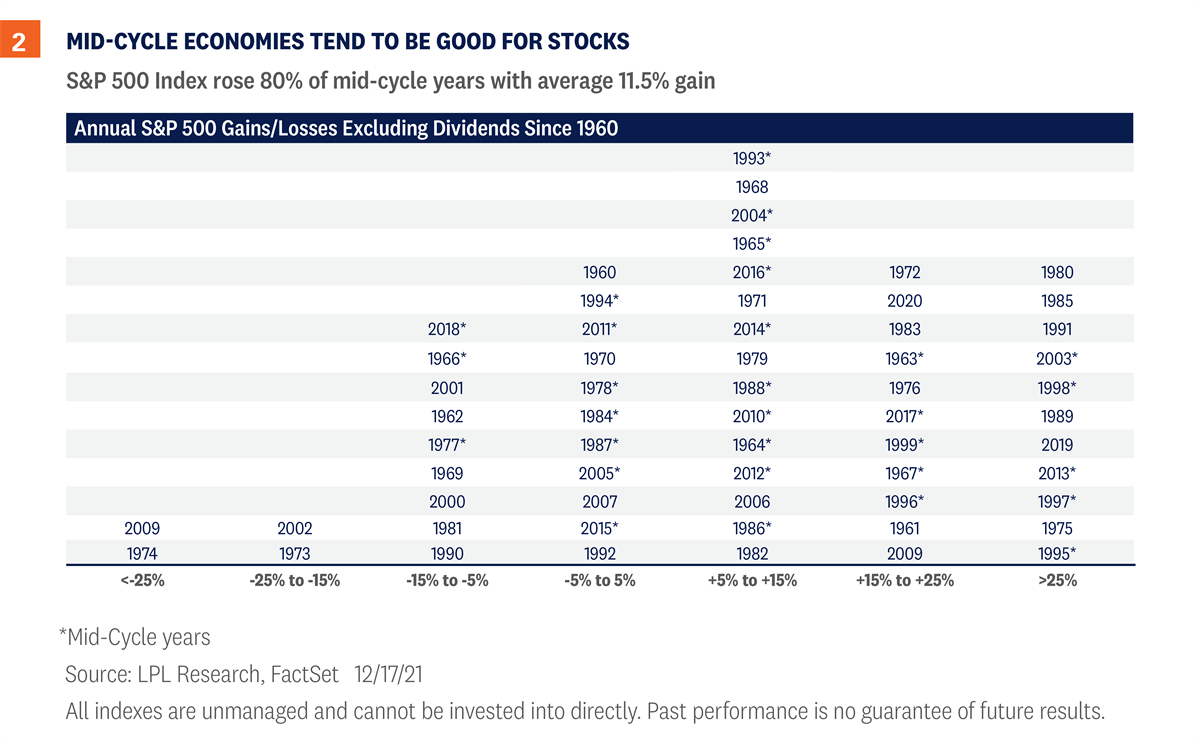
Looking more closely, in a mid-cycle economy, recession fears do not typically cause stocks to fall in a given year, nor do stocks typically surge as investors celebrate emerging from the prior recession. Over the past 60 years, the S&P 500 Index was up an average of 11.5% during the 30 mid-cycle years we identified, with gains in 80% of those years [Figure 2]. As you can see, stocks rose during most of these mid-cycle years, with 1966 and 1977 being the only two years with double-digit losses. The Fed, which we expect to start raising interest rates in early 2023, can also help us gauge the cycle because the central bank typically begins to raise rates when the economy is exhibiting mid-cycle characteristics. That also characterizes 2022 as a likely mid-cycle year. Historically, stocks have done very well during the 12 months leading up to the Fed’s initial rate hike, with gains in each of the past nine instances and an average gain of 15%. Although the timetable for the initial Fed rate hike has been moved forward several months, we expect stocks to follow this mid-cycle pattern and potentially deliver double-digit gains next year as the economy continues to expand at a solid pace.

Earnings are the Anchor

An expanding economy is a great start, but stocks fundamentally derive their value from earnings. On the top line, the environment for companies to grow revenue next year should be excellent, with potential for above-average economic growth and some pricing power from elevated inflation. Revenue growth has historically been well correlated to nominal GDP growth, which is simply real GDP growth (the inflation-adjusted number that’s normally reported) plus inflation. Our 4–4.5% real GDP growth forecast for next year plus perhaps 3% inflation (about the consensus forecast for the increase in the Consumer Price Index) puts a 7% revenue increase in play. With stable profit margins and increasing share buybacks likely next year, a double-digit percentage increase in S&P 500 earnings per share (EPS) is a possibility. But COVID-19-related supply chain issues and materials and labor shortages are risks that could lead to higher costs in 2022, potentially weighing on profit margins. Many companies warned of such pressures during third-quarter earnings season. As a result, we are forecasting slightly below-average S&P 500 earnings growth in the 6-7% range in 2022 to $220 per share. At this point it is unlikely that higher corporate taxes will eat into any of those earnings gains next year, as they have reportedly been pushed out into 2023 in negotiations for President Biden’s social spending package.

Valuations May Not Provide an Assist

Forecasting a year ahead is tough enough, but predicting where stocks might be at the end of 2022 actually requires us to look ahead to 2023. The 2023 earnings outlook will determine where valuations are likely to be at the end of 2022. Strong earnings gains in 2021 have prevented the price-to-earnings ratio (P/E) for the S&P 500 from going much above 20. In fact, stocks are actually more reasonably priced as 2022 approaches than they were at the start of 2021, because 2021 earnings are tracking more than 20% above the estimate when the year began. While a 21 P/E is above the long-term average of around 16, we believe still low interest rates justify current valuation levels. But P/E multiple expansion will likely be difficult if interest rates rise in 2022, potentially leaving earnings growth as the primary driver of any stock market gains.

S&P 500 Index Knocking on the Door of 5,000?

5,000 on the S&P 500 will be a nice round number for investors to celebrate. But will that celebration take place in 2022 or later? If we assume S&P 500 EPS growth in 2023 stays around its long-term average, implying roughly $235 in EPS, while the P/E stays about where it is between 21 and 21.5, the S&P 500 could be fairly valued at 5,000–5,100 at the end of 2022. Note, however, that stocks can stay above (or below) fair value for an extended period of time due to market sentiment, so we would not necessarily view reaching that target as a sell trigger. If interest rates stay lower for longer and support P/E multiple expansion, stocks could potentially exceed this target by year-end 2022. But if profit margins face more intense pressure than anticipated, possibly from wages, earnings may have a hard time growing at all in 2022.

The Race Continues in 2022

Prospects for above-average economic growth and accompanying earnings gains in 2022 point to another potentially good year for stock investors. While the pandemic is not completely behind us as the COVID-19 Omicron variant spreads rapidly (though with a high proportion of mild cases), and there are several other risks to watch, particularly inflation, stocks have historically done well in mid-cycle economies. We do not expect 2022 to be an exception. Ryan Detrick, CMT, Chief Market Strategist, LPL Financial Jeff Buchbinder, CFA, Chief Equity Strategist, LPL Financial ______________________________________________________________________________________________ IMPORTANT DISCLOSURES This material is for general information only and is not intended to provide specific advice or recommendations for any individual. There is no assurance that the views or strategies discussed are suitable for all investors or will yield positive outcomes. Investing involves risks including possible loss of principal. Any economic forecasts set forth may not develop as predicted and are subject to change. References to markets, asset classes, and sectors are generally regarding the corresponding market index. Indexes are unmanaged statistical composites and cannot be invested into directly. Index performance is not indicative of the performance of any investment and does not reflect fees, expenses, or sales charges. All performance referenced is historical and is no guarantee of future results. Any company names noted herein are for educational purposes only and not an indication of trading intent or a solicitation of their products or services. LPL Financial doesn’t provide research on individual equities. All information is believed to be from reliable sources; however, LPL Financial makes no representation as to its completeness or accuracy. U.S. Treasuries may be considered “safe haven” investments but do carry some degree of risk including interest rate, credit, and market risk. Bonds are subject to market and interest rate risk if sold prior to maturity. Bond values will decline as interest rates rise and bonds are subject to availability and change in price. The Standard & Poor’s 500 Index (S&P500) is a capitalization-weighted index of 500 stocks designed to measure performance of the broad domestic economy through changes in the aggregate market value of 500 stocks representing all major industries. The PE ratio (price-to-earnings ratio) is a measure of the price paid for a share relative to the annual net income or profit earned by the firm per share. It is a financial ratio used for valuation: a higher PE ratio means that investors are paying more for each unit of net income, so the stock is more expensive compared to one with lower PE ratio. Earnings per share (EPS) is the portion of a company’s profit allocated to each outstanding share of common stock. EPS serves as an indicator of a company’s profitability. Earnings per share is generally considered to be the single most important variable in determining a share’s price. It is also a major component used to calculate the price-to-earnings valuation ratio. All index data from FactSet. This research material has been prepared by LPL Financial LLC. Securities and advisory services offered through LPL Financial (LPL), a registered investment advisor and broker-dealer (member FINRA/SIPC). Insurance products are offered through LPL or its licensed affiliates. To the extent you are receiving investment advice from a separately registered independent investment advisor that is not an LPL affiliate, please note LPL makes no representation with respect to such entity. Not Insured by FDIC/NCUA or Any Other Government Agency | Not Bank/Credit Union Guaranteed | Not Bank/Credit Union Deposits or Obligations | May Lose Value RES-984450-1221| For Public Use | Tracking # 1-05223960 (Exp. 12/22)

LPL Financial Research Outlook 2022: Passing the Baton

LPL Research Outlook 2022: Passing the Baton  is designed to help you navigate the risks and opportunities over the rest of 2021 and beyond. While the economy continues to move forward, we’re still feeling some aftershocks of COVID-19 and the Delta variant. At the same time, 2021 also saw a resurgence of activities we missed in 2020, and the S&P 500 Index continued to advance as corporate America faced these challenges with resiliency. With the U.S. economy reopened, the growth rate may peak in second quarter 2021, but there is still plenty of momentum left to extend above-average growth into 2022. Inflation must be closely watched, but LPL Research believes recent price pressures are transitory, and that the strong economic recovery may continue to drive strong earnings growth and support further gains for stocks in the second half of 2021. The strong economic recovery and potentially higher inflation expectations may help push interest rates higher and lead to flat or potentially negative core bond returns in the second half. We’ve had a hand up that has helped us through a period of unique economic challenges. In 2022, the economy may be ready for a handoff, back to a greater emphasis on the individual choices of households and business. How smoothly that handoff is executed may determine the course of the recovery. LPL Research’s Outlook 2022 is here to provide insight on the economy, stocks, and bonds and what may lie ahead for next year and beyond.  

View the digital version: https://view.ceros.com/lpl/outlook2022/p/1

        This material is for general information only and is not intended to provide specific advice or recommendations for any individual. The economic forecasts may not develop as predicted. Please read the full Outlook 2022: Passing the Baton publication for additional description and disclosure. This research material has been prepared by LPL Financial LLC. Tracking #1-05207230 (Exp. 12/22)

Potential Catalysts for a Market Turnaround

After a tough start for stocks in 2022, investors are looking for reasons to expect a rebound. After more than doubling off the pandemic lows in March 2020, without anything more than a 5% pullback in 2021, stocks probably needed a break. That doesn’t, however, make this dip feel much more comfortable. Here we cite some reasons we don’t expect this selloff to go a lot further, though a 10% drawdown in the S&P 500 seems reasonable to expect.

Tough start to the year

It’s been a rough few weeks for the stock market. Fears of rising rates and the Federal Reserve pulling back its stimulus more aggressively than previously anticipated to fight high inflation have caused most of the market jitters, though earnings season—albeit in the very early stages—hasn’t helped either. The pain has been particularly acute for the many growth stocks that make up the Nasdaq Composite, which has corrected 14% from its November 2021 high. This is the third worst start to a year ever for the Nasdaq (down 10% year to date), though it was positive the rest of the month the last five times it was down 5% or more year to date through January 20 (thank you to our friends at Bespoke Investment Group for that nugget). Small caps have been hit even harder, with the Russell 2000 Index nearly in bear market territory with its 18% decline since November 8, 2021—though the higher quality S&P 600 small cap index has fared better in losing 12% during this period.

What might get this market turned around

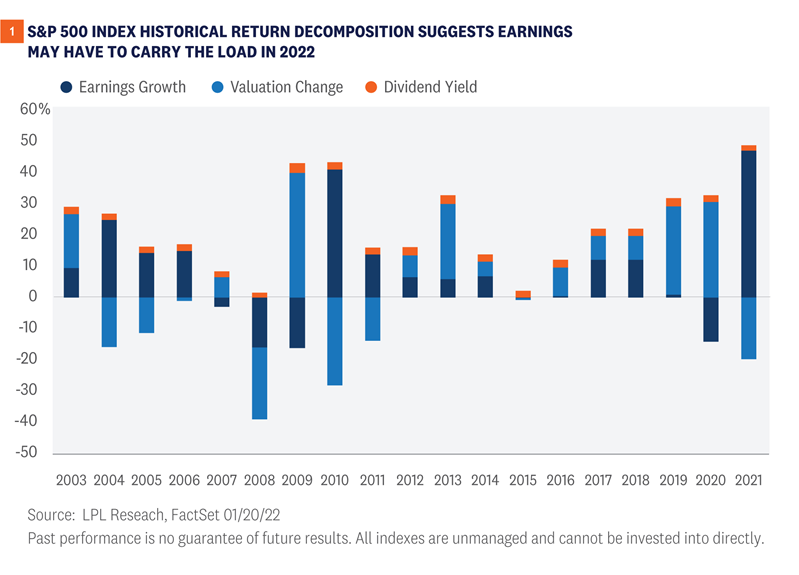
So what might turn this market around? Stabilization in interest rates would help. The 10-year Treasury yield’s inability to break through 1.9% last week and subsequent dip below 1.8% is a good start. Stock valuations are interest rate sensitive and harder to justify if bond yields go much higher (the price-to-earnings ratio for the S&P 500 using the 2022 consensus estimate for earnings per share is currently a touch below 20). On inflation, clearly a key risk for markets right now, the data likely won’t change much in January when it’s reported in February. However, we could soon see more evidence of easing supply chain bottlenecks and more people jumping into the workforce as COVID-19 disruptions hopefully fade (there are a near-record 10.5 million open jobs in the U.S. now compared to less than 7 million pre-pandemic in December of 2019). When the market begins to gain more confidence that inflation will start coming down, hopefully as winter turns to spring, inflation may turn from stock market detractor to a contributor. A Fed meeting this week without any negative surprises would also help. Stable or lower oil prices would help as well. What about earnings as a potential catalyst? As we suggested in our 2022 Outlook: Passing the Baton, earnings growth would likely be the primary source of stock market gains this year. The downward pressure on stock valuations from higher interest rates makes that more likely. In Figure 1 we have decomposed annual returns for the S&P 500 into earnings growth, valuation changes, and dividend yield. During 2019 and 2020, when the S&P 500 returned 24.7% annualized (55.7% cumulative), increases in valuations drove much of the gains. That changed last year when earnings rose an estimated 50% and valuations contracted. We expect 2022 to look more like the mid-cycle mid-2000s or mid-2010s with more modest returns, more contributions from earnings growth and dividends, and little, if any, contribution from valuation. That begs the question whether corporate America has enough earnings power still left in the tank to get investors excited about buying this latest dip. We wrote about the challenges facing corporate America this earnings season in our earnings preview, including supply chain disruptions, wage and other cost pressures, and the Omicron COVID-19 variant, all of which make it tough to predict if earnings season will be a catalyst for a turnaround. Still, we lean toward the rest of earnings season providing some support for stocks for these reasons:
  • Despite these challenges, with about 70 S&P 500 constituents having reported, index earnings are still tracking to 5% upside, in line with the long-term historical average.
  • Profit margin assumptions baked into analysts’ estimates appear to reflect these challenges, increasing the likelihood of mostly positive market reactions to results.
  • Despite a likely smaller upside surprise than in recent quarters, an earnings growth rate potentially in the mid-to-high 20s for the quarter is still impressive.
  • Estimates for 2022 have been holding up well. Historically, earnings estimates fall during reporting season, which isn’t happening so far.

Volatility is uncomfortable but normal

Investors have grown accustomed to steady, consistent gains over the past couple of years which makes the current bumpy ride feel more uncomfortable. After no more than a 5% pullback in 2021 and the S&P 500 having more than doubled off the March 2020 lows, we have been anticipating more volatility in 2022. Higher interest rates and less accommodating monetary policy from the Fed amid stubbornly high inflation are getting most of the blame, and probably deservedly so. But another reason for the rough start to the year could be policy driven. It is a midterm election year, which typically brings more volatility and smaller gains. As shown in Figure 2, historically during mid-term years the S&P 500 has on average done nothing but bounce around the flat line until right before midterm elections, much different than the average path of the market across all years. Although we would argue these midterms may bring less uncertainty than some others in recent decades given gridlock appears more likely than not to most political strategists, policy uncertainty is still there and the environment remains divisive. As a result, we would not be surprised if this year ended up looking more like the typical midterm year with mid-single-digit gains for stocks rather than double-digit gains, and a better second half than first half. It will take time for the biggest clouds to clear (COVID-19 and inflation) and stocks have historically seen very strong rallies after midterm elections pass.

Conclusion

This volatility we’ve seen this year is uncomfortable, but it is well within the range of normal based on history. The S&P 500 has averaged three pullbacks of 5% or more per year and one correction of at least 10% per year over its long history. After just one 5% dip last year, and huge gains off the 2020 lows, we were due for a dip. This pullback in the S&P 500 could easily go to 10%, or even a little more. The average max drawdown in a positive year for stocks is 11%. But based on the still solid overall economic and earnings backdrop, our expectation that the inflation clouds may soon start to clear, and the stock market’s historically solid track record early in Fed rate hike cycles, we wouldn’t expect this pullback to go much further. We continue to see fair value on the S&P 500 at year end at 5,000-5,100, more than 12% above Friday’s closing price at the low end. Jeffrey Buchbinder, CFA, Equity Strategist, LPL Financial Ryan Detrick, CMT, Chief Market Strategist, LPL Financial ______________________________________________________________________________________________ IMPORTANT DISCLOSURES This material is for general information only and is not intended to provide specific advice or recommendations for any individual. There is no assurance that the views or strategies discussed are suitable for all investors or will yield positive outcomes. Investing involves risks including possible loss of principal. Any economic forecasts set forth may not develop as predicted and are subject to change. References to markets, asset classes, and sectors are generally regarding the corresponding market index. Indexes are unmanaged statistical composites and cannot be invested into directly. Index performance is not indicative of the performance of any investment and does not reflect fees, expenses, or sales charges. All performance referenced is historical and is no guarantee of future results. Any company names noted herein are for educational purposes only and not an indication of trading intent or a solicitation of their products or services. LPL Financial doesn’t provide research on individual equities. All information is believed to be from reliable sources; however, LPL Financial makes no representation as to its completeness or accuracy. U.S. Treasuries may be considered “safe haven” investments but do carry some degree of risk including interest rate, credit, and market risk. Bonds are subject to market and interest rate risk if sold prior to maturity. Bond values will decline as interest rates rise and bonds are subject to availability and change in price. The Standard & Poor’s 500 Index (S&P500) is a capitalization-weighted index of 500 stocks designed to measure performance of the broad domestic economy through changes in the aggregate market value of 500 stocks representing all major industries. The PE ratio (price-to-earnings ratio) is a measure of the price paid for a share relative to the annual net income or profit earned by the firm per share. It is a financial ratio used for valuation: a higher PE ratio means that investors are paying more for each unit of net income, so the stock is more expensive compared to one with lower PE ratio. Earnings per share (EPS) is the portion of a company’s profit allocated to each outstanding share of common stock. EPS serves as an indicator of a company’s profitability. Earnings per share is generally considered to be the single most important variable in determining a share’s price. It is also a major component used to calculate the price-to-earnings valuation ratio. All index data from FactSet. This research material has been prepared by LPL Financial LLC. Securities and advisory services offered through LPL Financial (LPL), a registered investment advisor and broker-dealer (member FINRA/SIPC). Insurance products are offered through LPL or its licensed affiliates. To the extent you are receiving investment advice from a separately registered independent investment advisor that is not an LPL affiliate, please note LPL makes no representation with respect to such entity. Not Insured by FDIC/NCUA or Any Other Government Agency | Not Bank/Credit Union Guaranteed | Not Bank/Credit Union Deposits or Obligations | May Lose Value RES-1013950-0122 | For Public Use | Tracking # 1-05235161 (Exp. 1/23)  

Three 2021 Market Lessons for 2022

In many ways, 2021 was a typical year for markets, but it also reinforced some basic market lessons that are hard to learn, even if they are not new. As we launch into the New Year, we’re highlighting three 2021 market lessons that we think may matter for 2022: 1) equity valuations are a poor timing mechanism, 2) structural forces have a large influence on interest rates and may keep them relatively low, and 3) politics and markets don’t mix. Welcome to the New Year for markets, when year-to-date returns all reset to 0% and the year ahead is still a blank slate. No doubt, 2022 will provide its usual mix of ordinary market behavior and unexpected surprises. While these surprises can’t be forecasted, we can say with near certainty that we’ll have some. At the same time, markets have patterns that tend to repeat, even if the emphasis is different from year to year. As we head into the New Year, we’re taking a look back at 2021 and drawing out three lessons that we think will matter for 2022.

Valuations Aren't a Short-Term Market Timing Mechanism

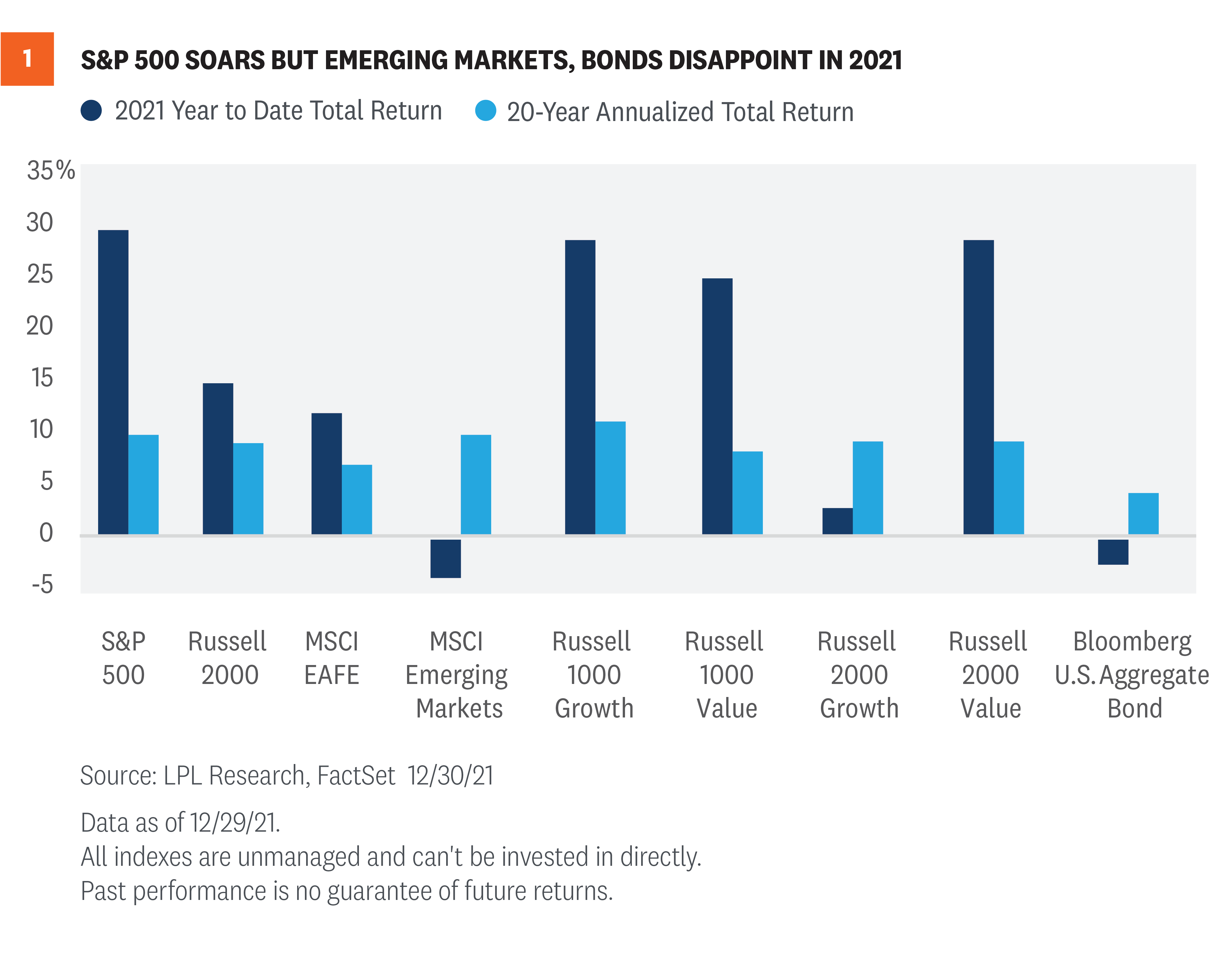
At the start of 2021 we heard concerns that broad U.S. markets were overvalued using many traditional valuation metrics, such as the price-to-earnings ratio (PE). In addition, compared to the U.S., international stocks (both developed and emerging markets) looked relatively cheap. But as shown in Figure 1, the S&P 500 surged higher in 2021, performing well above its historical average, while international equities lagged behind the U.S., with weakness in emerging markets in particular. Once again, valuations were a weak short-term timing mechanism. At the start of 2021, the PE for the S&P 500 was historically elevated at almost 22.5 on forward earnings according to FactSet data. At the same time, interest rates were extraordinarily low, which makes stocks attractive relative to bonds and increases the present value of future earnings. On top of that, an extraordinarily strong year for corporate earnings helped stocks “grow into” their valuations, with the PE actually falling to nearly 21 by the end of the year despite strong stock market gains. Sentiment is often the primary culprit for allowing valuations to remain elevated, and it did play a role in 2021, but market fundamentals were even more important. If investors favored stocks in 2021, it was more about a sizable upside surprise in earnings growth than elevated optimism. The underperformance by international equities this year, which may have surprised some, also reminds us that valuations are not a timing tool. International stocks have been more attractively valued than U.S. stocks for quite some time and yet, they’ve underperformed consistently for over a decade. We believe valuations should be used in combination with technical analysis, which helps measure both sentiment and captures collective market wisdom, to help inform investment decisions. Signals from the charts have helped us side-step some of that performance drag. Also, keep in mind that Europe and Japan are more value-oriented markets than the U.S., so growth-style leadership here at home makes it very difficult for these international markets to keep up. We continue to favor the U.S. over developed international markets for 2022 because of the relatively healthier U.S. economic growth outlook and strong U.S. dollar, but international equities may become increasingly attractive as COVID-19 restrictions are removed globally.

Structural Forces Continue to Weigh on Interest Rates

If someone had told you at the start of 2021 that inflation (as measured by the Consumer Price Index) would be up close to 7% over the year while real gross domestic product (GDP) would grow near 5.5% and asked you where the 10-year Treasury yield would be at the end of the year, most market experts would likely guess well above the approximately 1.50% where we ended the year. It’s true 2021, by many accounts, wasn’t a very good year for core fixed income investors—although that was largely to be expected. Coming into the year, interest rates were still amongst the lowest they have ever been and we thought they were headed higher—and they did. As such, returns for core fixed income investors, as measured by the Bloomberg U.S. Aggregate Bond Index, were negative for the year for only the fourth time in the index’s history dating back to 1976. However, after a 70 basis point (0.70%) increase in the 10-year Treasury yield by mid-March, which led to one of the worst starts to the year ever for core bonds, yields have largely remained range bound. One of the main reasons interest rates have stayed as low as they have this year was the amount of foreign interest in our markets. Despite relatively low yields in the U.S., many foreign investors are still better off investing in U.S. fixed income markets. With approximately $13 trillion in negative yielding debt globally (it’s still crazy to think that you have to pay a country/company to own its debt), even modestly positive yielding debt is an attractive option. This has certainly helped keep interest rates from moving significantly higher—a likely headwind to higher rates in 2022 as well. So what is the key takeaway from 2021? Despite increased inflationary pressures not seen since the 1980s (when 10-year Treasury yields averaged over 10% for the decade), there is still a huge global demand for safety, income, and liquidity in portfolios and that has kept interest rates (and spreads) from moving much higher. While yields for U.S. core fixed income may seem low, the role it plays in portfolios is still an important one.

Politics and Investing Don't Mix

This is one lesson we likely knew before the year began, but 2021 provided another strong example of why politics and investing don’t mix, both for broad markets and for the market impact of more specific policy. For example, when President Biden was elected, one of the sectors most expected to suffer was traditional energy. The bear case for energy was that Democratic policies towards fracking and the fossil fuels industry would further harm one of the worst performing sectors over the past decade. In contrast, the solar industry was expected to benefit from an acceleration towards renewable and clean energy sources. Well, what happened? The complete opposite. The S&P 500 Energy Sector was by far the top performing sector of the year, up more than 50%, while the MAC Global Solar Energy Index, a basket of stocks focused on solar energy, fell nearly 30%. And this isn’t the only time in recent history we have seen the energy sector returns upend traditional thinking. When President Trump was elected back in 2016, the two consensus sector winners from his presidency were expected to be energy and financials due to deregulation. However, from the date of the 2016 Presidential election to the 2020 election, energy stocks were cut in half while the financials sector returned less than half that of the broader market. Forecasters had the policy right and the business impact was generally as expected, but nevertheless it seemed small from a pure market perspective compared to other drivers influencing sector returns. Speaking more broadly, stocks have done extremely well over the past decade, with little regard or correlation to which party has held the White House or Congress, and we believe investors would do well to remember that in 2022 as midterm elections begin to dominate the news cycle. It’s not that policy prognostications are incorrect or that policy doesn’t matter. Rather, when it comes to markets there are larger economic forces in play that typically matter a lot more.

What Lies Ahead in 2022

We do not expect 2022 to simply be a repeat of 2021. We’ve moved further toward the middle of the economic cycle, inflation is likely to decrease rather than increase, and economic momentum will probably slow. But perhaps most importantly, the policy support from central banks and governments that have helped global economies bridge the economic fissures left by COVID-19 will likely begin to fade, leaving the economy to stand increasingly on its own two feet while putting more emphasis on the aggregate decisions of businesses and households. (For a broad overview of our expectations for 2022, see our Outlook 2022: Passing the Baton.) But for all the differences, we expect some important lessons learned in 2021 to matter in 2022, and as the year evolves we’ll continue to monitor and share the market signals that will help shape the market environment in the New Year.   Barry Gilbert, PhD, CFA, Asset Allocation Strategist, LPL Financial Ryan Detrick, CMT, Chief Market Strategist, LPL Financial Jeffrey Buchbinder, CFA, Equity Strategist, LPL Financial Lawrence Gillum, CFA, Fixed Income Strategist, LPL Financial ______________________________________________________________________________________________ IMPORTANT DISCLOSURES This material is for general information only and is not intended to provide specific advice or recommendations for any individual. There is no assurance that the views or strategies discussed are suitable for all investors or will yield positive outcomes. Investing involves risks including possible loss of principal. Any economic forecasts set forth may not develop as predicted and are subject to change. References to markets, asset classes, and sectors are generally regarding the corresponding market index. Indexes are unmanaged statistical composites and cannot be invested into directly. Index performance is not indicative of the performance of any investment and does not reflect fees, expenses, or sales charges. All performance referenced is historical and is no guarantee of future results. Any company names noted herein are for educational purposes only and not an indication of trading intent or a solicitation of their products or services. LPL Financial doesn’t provide research on individual equities. All information is believed to be from reliable sources; however, LPL Financial makes no representation as to its completeness or accuracy. U.S. Treasuries may be considered “safe haven” investments but do carry some degree of risk including interest rate, credit, and market risk. Bonds are subject to market and interest rate risk if sold prior to maturity. Bond values will decline as interest rates rise and bonds are subject to availability and change in price. The Standard & Poor’s 500 Index (S&P500) is a capitalization-weighted index of 500 stocks designed to measure performance of the broad domestic economy through changes in the aggregate market value of 500 stocks representing all major industries. The PE ratio (price-to-earnings ratio) is a measure of the price paid for a share relative to the annual net income or profit earned by the firm per share. It is a financial ratio used for valuation: a higher PE ratio means that investors are paying more for each unit of net income, so the stock is more expensive compared to one with lower PE ratio. Earnings per share (EPS) is the portion of a company’s profit allocated to each outstanding share of common stock. EPS serves as an indicator of a company’s profitability. Earnings per share is generally considered to be the single most important variable in determining a share’s price. It is also a major component used to calculate the price-to-earnings valuation ratio. All index data from FactSet. This research material has been prepared by LPL Financial LLC. Securities and advisory services offered through LPL Financial (LPL), a registered investment advisor and broker-dealer (member FINRA/SIPC). Insurance products are offered through LPL or its licensed affiliates. To the extent you are receiving investment advice from a separately registered independent investment advisor that is not an LPL affiliate, please note LPL makes no representation with respect to such entity. Not Insured by FDIC/NCUA or Any Other Government Agency | Not Bank/Credit Union Guaranteed | Not Bank/Credit Union Deposits or Obligations | May Lose Value RES-994650-1221| For Public Use | Tracking # 1-05227512 (Exp. 1/23)

LPL Research Discusses Outlook 2022 & the Coming Year

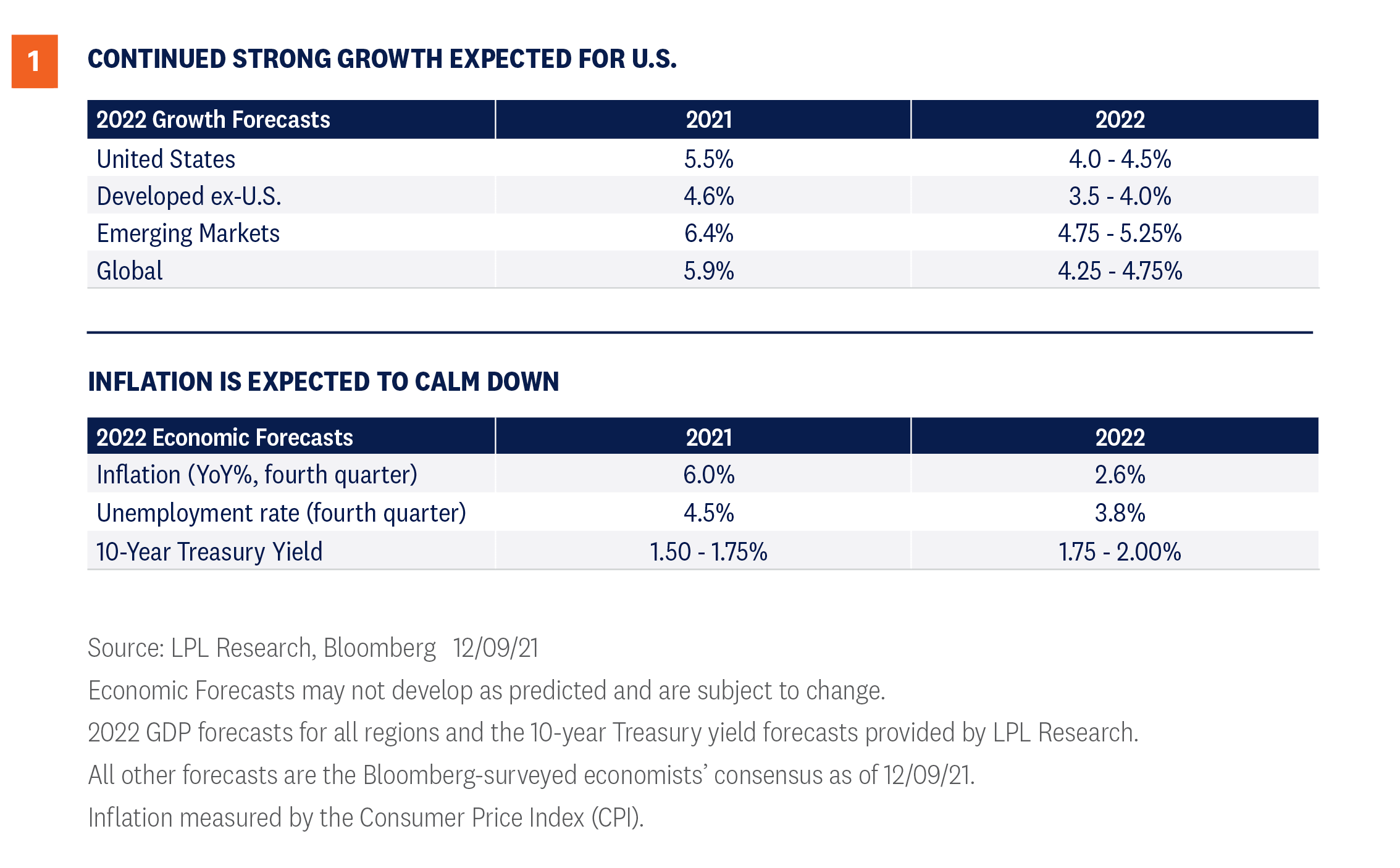
We believe pent-up demand, gradual improvement in supply chain challenges, solid labor force growth, and productivity gains will all contribute to another year of above-trend economic growth in 2022. COVID-19-related risks remain and the potential for a policy mistake may be elevated as the economy moves towards normalization, but we think the overall environment will be supportive of business growth and ultimately equity markets The U.S. economy bounced back from its worst year since the Great Depression in 2020 with one of the best years of growth in nearly 40 years in 2021. A combination of record stimulus, a healthy consumer, an accommodative Federal Reserve (Fed), vaccinations, and reopening of businesses all contributed to the big year. In what amounted to the shortest recession on record, only two months in March and April 2020, the economy came roaring back to produce what is currently expected to be over 5% GDP growth in 2021, more than making up for the 3.4% drop in GDP in 2020. Of course, there have been hiccups along the way. You can’t shut down a $20 trillion economy and then expect it to get going again without warming up first. Supply chain backlogs, materials and labor shortages, and higher prices all held the economy back to varying degrees. The good news is, demand is still very strong, and as the backlogs unwind (which could take years in some cases), we expect above-trend economic growth and see low risk of a recession in 2022. As the U.S. economy moves more to mid-cycle, our 2022 forecast is for 4.0–4.5% GDP growth in 2022 [Figure 1]. While a slowdown from 2021, it’s still a very solid number. We expect inflation to tame from 2021 levels to a potential run rate under 3% by the fourth quarter with core inflation numbers lower, a step in the right direction, although it may still be on an upward trajectory the early part of the year. Globally, Europe and Japan were hit especially hard by the pandemic in 2021. But as COVID-19 cases potentially fall globally, those areas could be ripe for better economic growth in 2022. Meanwhile, emerging market economies may disappoint as growth in China could be constrained by regulatory crackdowns.  

TIME FOR A HANDOFF

Fiscal and monetary policy played big roles in the economic recovery in 2021, but we see 2022 playing out as a handoff—from stimulus bridging a pandemic recovery to an economy growing firmly on its own, with consumer demand, workforce gains, productivity, small businesses expansion, and capital investment all playing parts in the next stage of economic growth. You have to give the U.S. consumer credit for continuing to drive the economy forward, and 2022 shouldn’t change that. Don’t forget, it took retail sales only five months to get back to pre-COVID-19 levels after the lockdowns in March and April 2020. Bottlenecks and the Delta variant surge have done little to slow an eager consumer. With likely still low interest rates, increased equity in people’s homes, nearly $3 trillion in money markets (retail and institutional), and another $3.5 trillion in excess liquidity in bank accounts, the consumer should remain quite healthy in 2022. Like every other time in history, those who adapt will survive. Businesses have already started to adapt to the new world, which may help productivity increase in 2022, as output-per-hour (productivity) potentially starts to accelerate again. Productivity allows for stronger growth and can help contain inflation, since more goods and services are produced. The 1970s was known as a time of high inflation, but it was also a time of very low productivity—fortunately a scenario we don’t see happening this time around. Another key to the economic transition may be capital expenditures (capex). These include business investment in property, plants, buildings, technology, and equipment. These investments could boost overall productivity and overall output, but might take time to build, so the results could be years away in some cases. Additional capex spending would be one of the best ways to see if corporate America is indeed over the shock of the pandemic and ready to invest for future growth opportunities. Standard and Poor’s data shows capital expenditures are expected to have grown an impressive 13% in 2021 and likely even more in 2022. In fact, the capex rebound in this recovery has already been faster than previous downturns, with plenty of room to go in our view. And it isn’t just a U.S. theme, as 2021 was likely the best year for European capex since 2006, and the global chip shortage has led to major investments in Japan and South Korea as well.

THE EVERYTHING SHORTAGE

2021 was the year nearly everything was in a shortage, and it all translated to added inflationary pressure. Record numbers of ships waiting at ports, a lack of materials, unfilled job openings, higher commodity prices, a lack of truck drivers, major backlogs, and supply chain disruptions all added to the larger price increases seen essentially across the board in 2021. While we do believe these pressures will steadily decrease over the next year and inflation will eventually settle back to 2–2.5%, it will likely be a gradual process. While inflation is broadly elevated, some key core elements remain more stable, and we believe these will be the center of gravity over time for some of the more volatile price changes we’ve seen. Still, supply chains may take a year or two to be fully addressed, depending on the product and the scale of the problem. Despite challenges around supply chains, hiring, and prices, if the demand is there it should help drive continued improvement as businesses adapt to address challenges. That is likely to leave us with a positive economic backdrop for at least 2022, and maybe much longer, despite current inflation levels.

HOW MUCH TIME LEFT?

Let’s face it, this wasn’t your average recession. Some industries actually did better during the pandemic, while segments of other industries were severely constrained. Spending patterns shifted. Stimulus was delivered quickly on a massive scale. How strange did that make it? This was the first recession in history that saw FICO scores go up. Recessions are necessary to wash out the excesses, but some imbalances weren’t worked off this time around. For this reason, we think this economic expansion could be mid-cycle much sooner and likely won’t be as long as the record 10 years we saw last cycle. The average expansion since World War II has been just over five years, suggesting there are still potentially several years of growth remaining, especially since we don’t see typical recessionary warning signals right now. Far from it, we anticipate above-trend growth in 2022. But we’ll be on watch early.

RISKS AND MARKET IMPLICATIONS

Our baseline economic outlook would likely provide a positive backdrop for equity markets, supporting further earnings gains while productivity gains potentially help offset some of the margin pressure from wage growth. At the same time, there are clear risks to our view. Handoffs can be fumbled and with inflation running hot and risks around COVID-19 still in play, the potential for a policy mistake is elevated. And while we’ve made substantial progress against COVID-19, ranging from vaccines to treatments to public health policy, we don’t yet have full clarity on how it will continue to impact the economy. Nevertheless, our baseline is a continued move toward normalcy as the choices of businesses and households play a bigger role in determining the shape of the expansion.   Ryan Detrick, CMT, Chief Market Strategist, LPL Financial Barry Gilbert, PhD, CFA, Asset Allocation Strategist, LPL Financial ______________________________________________________________________________________________ IMPORTANT DISCLOSURES This material is for general information only and is not intended to provide specific advice or recommendations for any individual. There is no assurance that the views or strategies discussed are suitable for all investors or will yield positive outcomes. Investing involves risks including possible loss of principal. Any economic forecasts set forth may not develop as predicted and are subject to change. References to markets, asset classes, and sectors are generally regarding the corresponding market index. Indexes are unmanaged statistical composites and cannot be invested into directly. Index performance is not indicative of the performance of any investment and does not reflect fees, expenses, or sales charges. All performance referenced is historical and is no guarantee of future results. Any company names noted herein are for educational purposes only and not an indication of trading intent or a solicitation of their products or services. LPL Financial doesn’t provide research on individual equities.   All information is believed to be from reliable sources; however, LPL Financial makes no representation as to its completeness or accuracy. U.S. Treasuries may be considered “safe haven” investments but do carry some degree of risk including interest rate, credit, and market risk. Bonds are subject to market and interest rate risk if sold prior to maturity. Bond values will decline as interest rates rise and bonds are subject to availability and change in price. The Standard & Poor’s 500 Index (S&P500) is a capitalization-weighted index of 500 stocks designed to measure performance of the broad domestic economy through changes in the aggregate market value of 500 stocks representing all major industries.   The PE ratio (price-to-earnings ratio) is a measure of the price paid for a share relative to the annual net income or profit earned by the firm per share. It is a financial ratio used for valuation: a higher PE ratio means that investors are paying more for each unit of net income, so the stock is more expensive compared to one with lower PE ratio. Earnings per share (EPS) is the portion of a company’s profit allocated to each outstanding share of common stock. EPS serves as an indicator of a company’s profitability. Earnings per share is generally considered to be the single most important variable in determining a share’s price. It is also a major component used to calculate the price-to-earnings valuation ratio. All index data from FactSet. This research material has been prepared by LPL Financial LLC. Securities and advisory services offered through LPL Financial (LPL), a registered investment advisor and broker-dealer (member FINRA/SIPC). Insurance products are offered through LPL or its licensed affiliates. To the extent you are receiving investment advice from a separately registered independent investment advisor that is not an LPL affiliate, please note LPL makes no representation with respect to such entity. Not Insured by FDIC/NCUA or Any Other Government Agency | Not Bank/Credit Union Guaranteed | Not Bank/Credit Union Deposits or Obligations | May Lose Value RES-977801-1221| For Public Use | Tracking # 1-05221199 (Exp. 12/22)

Don’t Expect the Fed To End This Bull Anytime Soon

The Federal Reserve (Fed) has engineered a massive hawkish shift, causing a bit more stock market volatility recently. But how worried should investors be? Here we take a look back at historical performance for stocks before, after, and much after initial Fed rate hikes to help reassure any nervous investors out there. We also take a quick look at what the Fed pivot could mean for growth/value and large cap/small cap trends given the maturing business cycle.

Massive Hawkish Shift

With the recent pivot by Jay Powell and Company at the Fed, rate hikes have been getting a lot of attention. And rightly so, given the bond market has gone from pricing in one 2022 rate hike just a few months ago to now pricing in three to four. That’s one of the most dramatic hawkish shifts by the Fed in a short period of time that we’ve ever seen, so some market jitters are not surprising.

How Much Should We Worry?

A look back at history may help calm some investors’ jitters around the start of Fed rate hikes. As we wrote in our Outlook 2022: Passing the Baton, stocks tend to do well leading up to initial Fed rate hikes. There we highlighted the average 15% gain during the 12 months ahead of the initial hike of an economic cycle, including gains in all nine cases back more than 60 years. This makes sense given it takes a strengthening economy to create the job gains and inflation the Fed needs to see to take away the punchbowl. We see the first rate hike coming in either March or May, and with the S&P 500 Index up nearly 20% since March of 2021, and more than 10% since May 2021, those gains may already have occurred. Looking beyond the initial hike, on our LPL Research blog last week we looked at how stocks performed during various periods after the Fed starts to hike rates. The story is similar, with the S&P 500 up an average of 7.5% six months later and 10.8% over the next 12 months historically. Stock were up all eight times one year after those initial hikes going back to the early 1980s. So based on history, the start of a rate hiking campaign by the Fed should not be too worrisome for investors.

Looking Out Longer Term

But what does the hike mean further out, say 2023 and beyond? In Outlook 2022, we noted that initial Fed rate hikes can help us mark where the economy is in its cycle. The start of rate hikes typically happens in the early-to-middle stages of the cycle, where stocks historically see solid gains as we are forecasting for 2022. But we can extend this exercise further and look at how stocks have done from the initial rate hike of a cycle until the end of the accompanying bull market, as we have done in [Figure 1]. Those first rate hikes have been followed by an average gain of 67% before the subsequent bull market peak. For those keeping score at home, that would take the S&P 500 to over 7,700 (no, that is not a forecast) before the next 20% or more decline. On average, after rate hikes start, bull markets have run for about three to four years (or 40 more months) before peaking, with the longest in the late 1990s at six years (72 months) between the 1994 hike and the bull market top in March of 2000.

We can also look at where in economic cycles these first rate hikes occurred based on the dates of the economic expansion. This can give us a rough idea of how much more economic growth we might expect after the Fed starts hiking rates. This exercise reveals that, on average, expansions were 40% completed upon arrival of the Fed’s first hike. However, the August 1983 hike occurred only about one-quarter of the way through that expansion, which we think is more representative of how long this unusual cycle may last. We’re not even two years in and we think this cycle has a few more years left.

Implications For the Growth-Value Rotation

After growth stocks performed so well throughout much of the pandemic, value stocks have shown signs of life recently. Year to date the Russell 1000 Value Index has gained 1%, ahead of the more than 5% drop in the 1000 Growth Index. That follows about four percentage points of outperformance by value in December. As shown in [Figure 2], the relative strength of value stocks has been closely tied to the yield curve, or the difference between 2-year and 10-year U.S. Treasury yields. A steeper yield curve tends to be good for financials, the biggest value sector, so this makes sense. One of the reasons we squared up our views on the growth and value styles this month in our latest Global Portfolio Strategy report is because we think the opportunity for yield curve steepening may be somewhat limited now that the Fed pivot has occurred and the bond market is pricing in more than three rate hikes for 2022. If the 10-year yield doesn’t get much higher than 2% this year, as we expect, and the Fed follows through with a series of hikes and maintains its credibility as an effective inflation fighter, then the yield curve may actually flatten. We are not worried about an inverted yield curve signaling recession, but we are skeptical that value stocks will continue to outperform at such a strong pace for much longer even with support from strong, though slower, economic growth and a likely further rise in interest rates.

Scales May Be Tilting Toward Large Caps

Small cap stocks have historically done better early in economic expansions, so as this cycle matures, large caps may have an edge. While we do not fear an impending recession, we do believe tighter monetary policy marks the economy’s progress toward mid-cycle. As such, we have become a bit less enamored with small caps, taking our view down from positive to neutral this month. While small caps have historically performed well in inflationary environments, this cycle is unique and we believe larger companies are better positioned for the current environment of supply chain challenges and labor shortages (where a big chunk of the inflation is coming from). In addition, weakness in biotech and other more speculative, richly valued pockets of the market, should it continue, will make it difficult for smaller cap stocks to keep up with their mostly higher quality, better-resourced large cap peers.

Conclusion

The Fed has engineered a massive hawkish pivot, contributing to an increase in volatility recently. But a look back at history provides some reassurance, as stocks have historically performed well leading up to and after the first rate hike of a cycle, with significant upside before eventual bull market tops. Bottom line, even with rate hikes coming soon, we think this economic cycle and bull market have quite a bit left in the tank.         Jeffrey Buchbinder, CFA, Equity Strategist, LPL Financial Ryan Detrick, CMT, Chief Market Strategist, LPL Financial ______________________________________________________________________________________________ IMPORTANT DISCLOSURES This material is for general information only and is not intended to provide specific advice or recommendations for any individual. There is no assurance that the views or strategies discussed are suitable for all investors or will yield positive outcomes. Investing involves risks including possible loss of principal. Any economic forecasts set forth may not develop as predicted and are subject to change. References to markets, asset classes, and sectors are generally regarding the corresponding market index. Indexes are unmanaged statistical composites and cannot be invested into directly. Index performance is not indicative of the performance of any investment and does not reflect fees, expenses, or sales charges. All performance referenced is historical and is no guarantee of future results. Any company names noted herein are for educational purposes only and not an indication of trading intent or a solicitation of their products or services. LPL Financial doesn’t provide research on individual equities. All information is believed to be from reliable sources; however, LPL Financial makes no representation as to its completeness or accuracy. U.S. Treasuries may be considered “safe haven” investments but do carry some degree of risk including interest rate, credit, and market risk. Bonds are subject to market and interest rate risk if sold prior to maturity. Bond values will decline as interest rates rise and bonds are subject to availability and change in price. The Standard & Poor’s 500 Index (S&P500) is a capitalization-weighted index of 500 stocks designed to measure performance of the broad domestic economy through changes in the aggregate market value of 500 stocks representing all major industries. The PE ratio (price-to-earnings ratio) is a measure of the price paid for a share relative to the annual net income or profit earned by the firm per share. It is a financial ratio used for valuation: a higher PE ratio means that investors are paying more for each unit of net income, so the stock is more expensive compared to one with lower PE ratio. Earnings per share (EPS) is the portion of a company’s profit allocated to each outstanding share of common stock. EPS serves as an indicator of a company’s profitability. Earnings per share is generally considered to be the single most important variable in determining a share’s price. It is also a major component used to calculate the price-to-earnings valuation ratio. All index data from FactSet. This research material has been prepared by LPL Financial LLC. Securities and advisory services offered through LPL Financial (LPL), a registered investment advisor and broker-dealer (member FINRA/SIPC). Insurance products are offered through LPL or its licensed affiliates. To the extent you are receiving investment advice from a separately registered independent investment advisor that is not an LPL affiliate, please note LPL makes no representation with respect to such entity. Not Insured by FDIC/NCUA or Any Other Government Agency | Not Bank/Credit Union Guaranteed | Not Bank/Credit Union Deposits or Obligations | May Lose Value RES-1008301-0122 | For Public Use | Tracking # 1-05232903 (Exp. 1/23)  

How Much Higher Can Treasury Yields Go?

We expect interest rates to move modestly higher in 2022 based on near-term inflation expectations above historical trends and improving growth expectations once the impact of COVID-19 variants recede. Our year-end 2022 forecast for the 10-year Treasury yield is 1.75–2.00%. An aging global demographic that needs income, higher global debt levels, and an ongoing bull market in equities may keep interest rates from going much higher. Most of this content was taken from Outlook 2022: Passing the Baton Coming into 2021, we expected Treasury yields to move higher from their very low levels and they did. Higher inflation expectations, less involvement in the bond market by the Federal Reserve (Fed), and a record amount of Treasury issuance were all reasons we thought interest rates could end 2021 between 1.50% and 1.75%. For 2022, near-term inflation expectations above historical trends and improving growth expectations once the COVID-19 variants recede are reasons why we believe interest rates could move moderately higher from current levels. In 2022, we expect the 10-year Treasury yield to end the year between 1.75% and 2.00%. However, an aging global demographic that needs income, higher global debt levels, and an ongoing bull market in equities (which potentially means more frequent rebalancing into fixed income) may keep interest rates from going much higher in 2022. While we don’t expect interest rates to move much higher next year, because starting yields for core fixed income are still low by historical standards, returns are likely to be flat to the low single digits in 2022. Not a great year, but we should see an improvement over the negative fixed income returns we have seen in 2021.

The role of fixed income

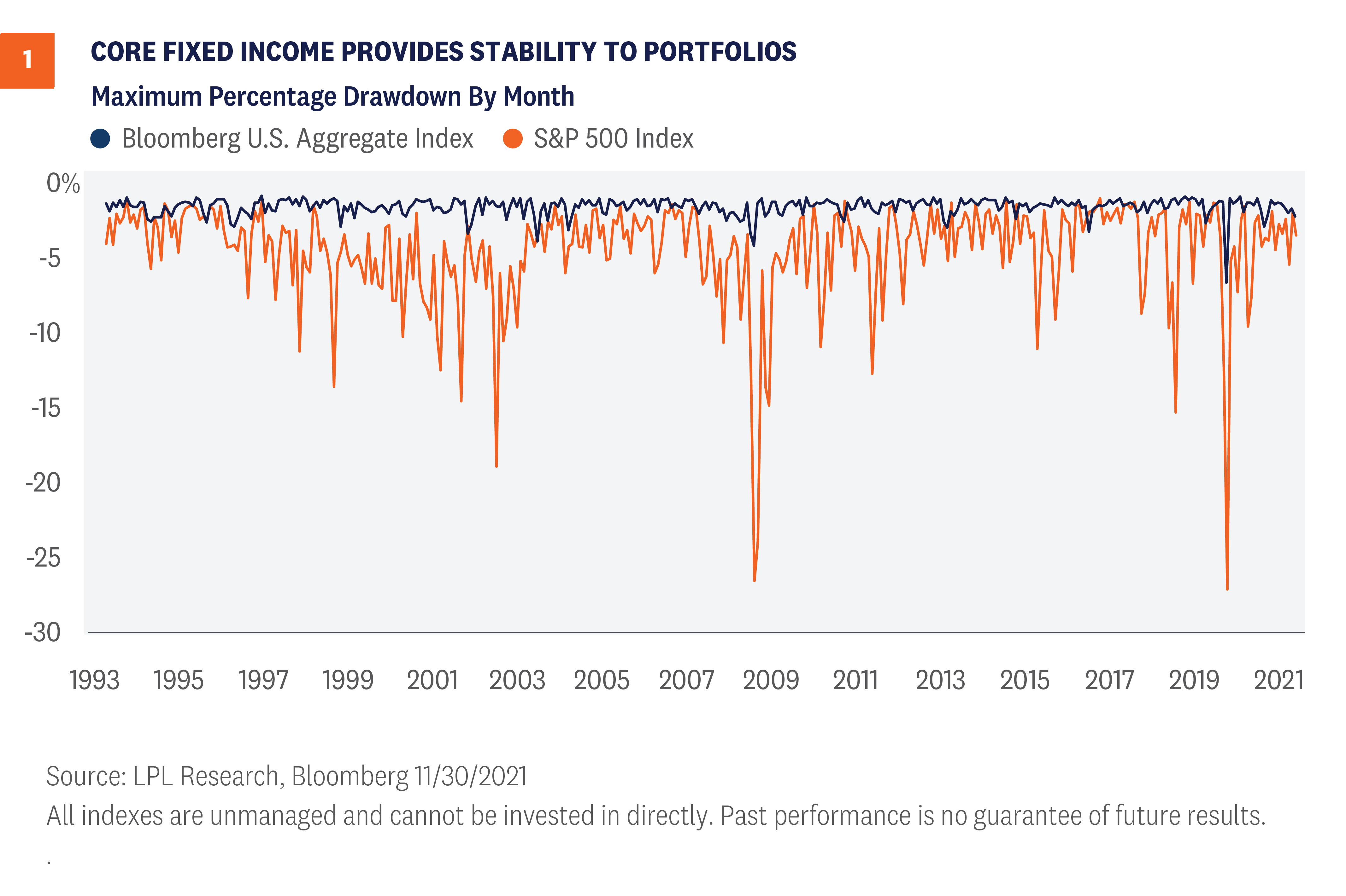
With long-term interest rates close to what we think will be cycle highs, it’s important to revisit the case for fixed income within a broader asset allocation. Core bonds have historically provided capital preservation, diversification, and liquidity to portfolios, which we think are important portfolio construction objectives and help clients remain committed to their investment goals. With the economy likely transitioning to mid-cycle, the need for high-quality bonds increases in our view. Moreover, the need to offset potential equity market volatility remains an important role for core fixed income. Bonds, particularly core bonds, have been less volatile than stocks and have historically provided ballast to portfolios during equity market drawdowns, which as we know, are normal occurrences from time to time. The maximum drawdown for bonds, in any given month, has been dramatically less severe than stocks [Figure 1]. While the worst drawdown in a month for equities was -28%, the worst bonds have done during a month was down 6%, and those losses were quickly reversed. So, when combined with equities, bonds help reduce total portfolio volatility, which makes for a smoother investment experience for investors.

What’s next for credit?

As interest rates increased during 2021, investment-grade corporate debt was negatively impacted as the sector, perhaps surprisingly, is among the most interest rate sensitive fixed income asset classes. U.S. high-yield investors, however, were rewarded for owning riskier debt. During the year, credit risk was rewarded as opposed to interest rate risk. As the economy transitions into mid-cycle, credit investors need to be more cognizant of downside risks. While the economy should still be conducive to credit risk and corporate balance sheets generally remain in good shape, credit spreads are among the lowest they’ve been in years, which means compensation for the added risk of corporates is low. Both investment-grade corporate credit spreads and high-yield credit spreads are in the bottom 25% compared to history, which means valuations have been cheaper 75% of the time over the past 20 years [Figure 2]. Corporate credit markets, both investment grade and high yield, are currently priced near perfection, so any unforeseen event—either related to the economy or at the corporate level—could negatively impact credit markets. We remain neutral on investment-grade corporate credit, but we think equities continue to offer better upside return potential than high-yield bonds, where we remain underweight. For income-oriented investors willing to take on more risk, we think bank loans still make sense, where appropriate.

The Fed takes a step back

Since March 2020, the Fed has supported the economy and financial markets by purchasing $120 billion in Treasury and mortgage securities each month and by keeping short-term interest rates near zero. As the economy continues to recover, however, the need for continued monetary support wanes. The Fed recently announced accelerated plans to end its bond buying programs in March 2022 to provide optionality to raise interest rates should inflationary pressures remain elevated. As such, due to the Fed’s recent pivot, we think the Fed could start to raise short-term interest rates as early as June 2022 but acknowledge that an earlier timetable is possible. More importantly, is how high the Fed tries to raise interest rates and how quickly it tries to get there. A slow deliberate pace of rate hikes, regardless of when liftoff takes place, will likely lead to a better outcome for the economy, and thus markets, than an overly aggressive one. The Fed is certainly aware of the risk of hiking interest rates higher than markets are anticipating. So, as it stands now, we think the Fed will likely tread lightly after the first few rounds of interest rate hikes next year.       Lawrence Gillum, CFA, Fixed Income Strategist, LPL Financial ______________________________________________________________________________________________ IMPORTANT DISCLOSURES This material is for general information only and is not intended to provide specific advice or recommendations for any individual. There is no assurance that the views or strategies discussed are suitable for all investors or will yield positive outcomes. Investing involves risks including possible loss of principal. Any economic forecasts set forth may not develop as predicted and are subject to change. References to markets, asset classes, and sectors are generally regarding the corresponding market index. Indexes are unmanaged statistical composites and cannot be invested into directly. Index performance is not indicative of the performance of any investment and do not reflect fees, expenses, or sales charges. All performance referenced is historical and is no guarantee of future results. Any company names noted herein are for educational purposes only and not an indication of trading intent or a solicitation of their products or services. LPL Financial doesn’t provide research on individual equities. All information is believed to be from reliable sources; however, LPL Financial makes no representation as to its completeness or accuracy. US Treasuries may be considered “safe haven” investments but do carry some degree of risk including interest rate, credit, and market risk. Bonds are subject to market and interest rate risk if sold prior to maturity. Bond values will decline as interest rates rise and bonds are subject to availability and change in price. The Standard & Poor’s 500 Index (S&P500) is a capitalization-weighted index of 500 stocks designed to measure performance of the broad domestic economy through changes in the aggregate market value of 500 stocks representing all major industries. The PE ratio (price-to-earnings ratio) is a measure of the price paid for a share relative to the annual net income or profit earned by the firm per share. It is a financial ratio used for valuation: a higher PE ratio means that investors are paying more for each unit of net income, so the stock is more expensive compared to one with lower PE ratio. Earnings per share (EPS) is the portion of a company’s profit allocated to each outstanding share of common stock. EPS serves as an indicator of a company’s profitability. Earnings per share is generally considered to be the single most important variable in determining a share’s price. It is also a major component used to calculate the price-to-earnings valuation ratio. All index data from FactSet. This research material has been prepared by LPL Financial LLC. Securities and advisory services offered through LPL Financial (LPL), a registered investment advisor and broker-dealer (member FINRA/SIPC). Insurance products are offered through LPL or its licensed affiliates. To the extent you are receiving investment advice from a separately registered independent investment advisor that is not an LPL affiliate, please note LPL makes no representation with respect to such entity. Not Insured by FDIC/NCUA or Any Other Government Agency | Not Bank/Credit Union Guaranteed | Not Bank/Credit Union Deposits or Obligations | May Lose Value RES-988800-1221| For Public Use | Tracking # 1-05225134 (Exp. 12/22)  

Outlook 2022 | Passing the Baton | December 7,2021

Get a head start on your financial future with LPL Research's economic and market forecasts for 2022 with Outlook 2022: Passing the Baton. Source: WEEKLY COMMENTARY