Corporate America did it again. Companies blew by estimates and made strategists and analysts look silly (though we humbly suggest that we may have looked less silly than most in our earnings preview on July 12). S&P 500 earnings growth did not surprise by quite as much as in the first quarter, but came pretty close—boosted by the biggest quarterly upside revenue surprise in at least 13 years. Here, we recap the strong numbers and raise our forecasts for earnings and for S&P 500 fair value at year-end.
BLOWOUT NUMBERS…AGAIN
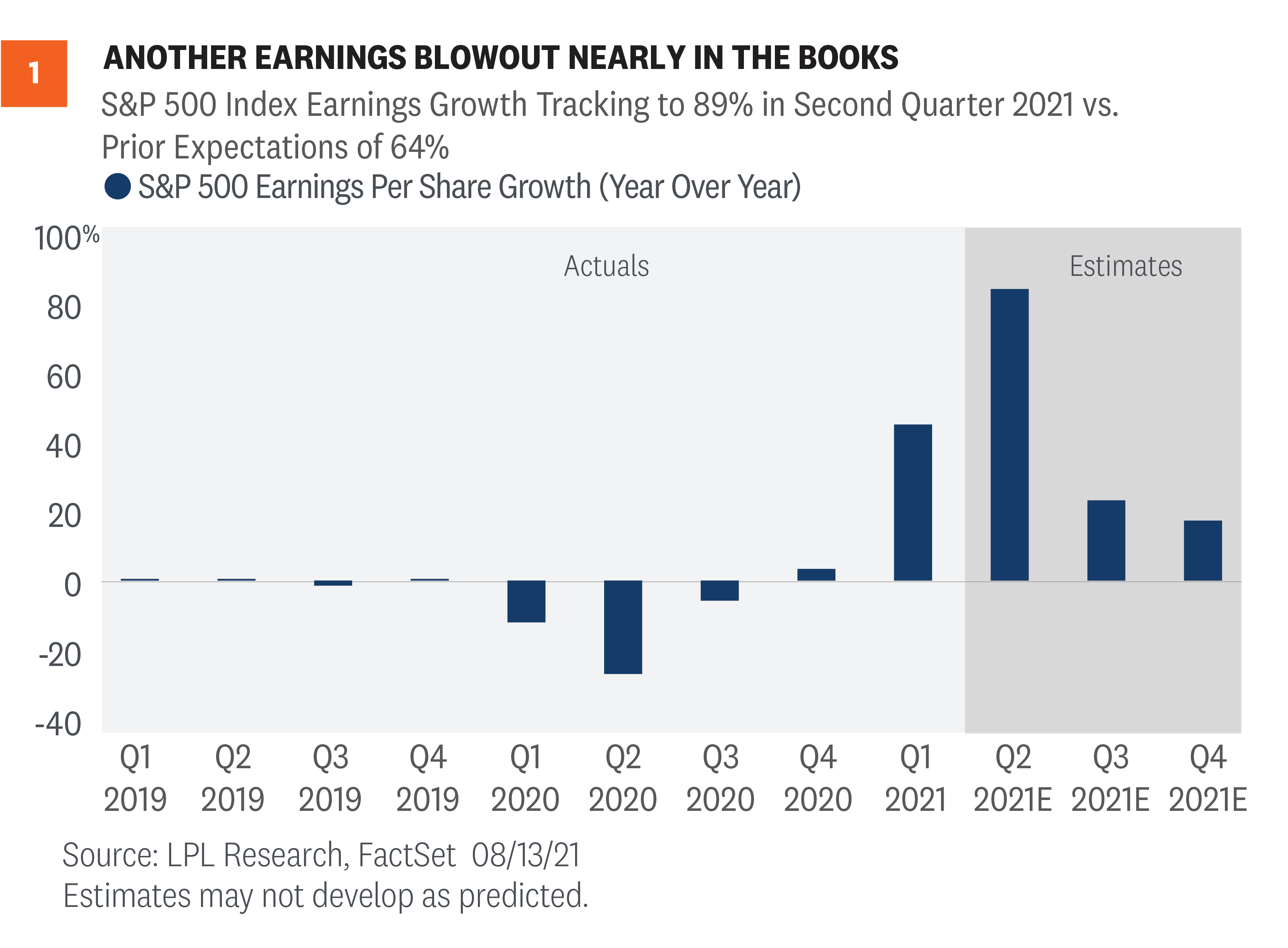
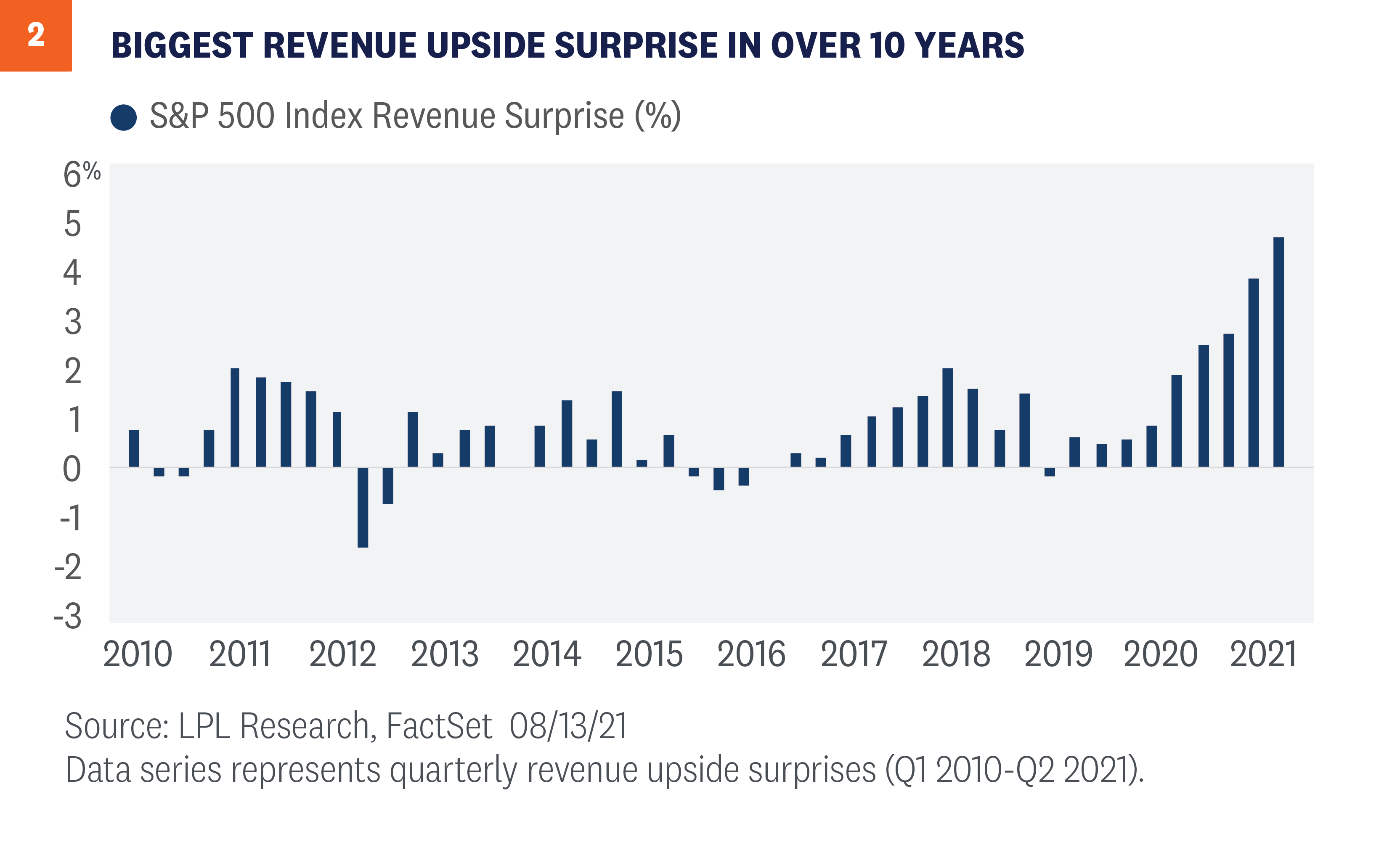
In our earnings preview commentary in mid-July, we wrote that we expected another quarter of solid upside surprises. Huge earnings growth rates were never in question, considering that so much of the U.S. economy was shut down during the year-ago quarter. But strong second-quarter economic data and rising earnings estimates pointed to faster earnings growth than the consensus estimate implied on July 1. As shown in [Figure 1], S&P 500 earnings are tracking to a nearly 90% year-over-year increase, or about 25 percentage points above the consensus estimate when earnings season began. While a remarkable amount of upside, and still with 8% of S&P 500 companies left to report, it stands about 3 percentage points shy of the first quarter’s mind-blowing numbers when earnings grew 52% compared with the 24% estimate on April 1. Estimates are usually too low, but this amount of upside isn’t normal. Analysts and strategists often miss turns in economic conditions and underestimate companies’ ability to adapt to changing conditions. However, after four consecutive quarters of huge upside surprises, we expected analysts to catch up more quickly. The average upside since 2010 is about 6%, so a 10-point beat is spectacular. Two 20-point beats in a row is ridiculous. Revenue upside was especially impressive during the quarter, reflecting the improving economy and strong pricing power enjoyed by leading companies. In fact, the second quarter produced the biggest upside surprise to revenue ever recorded at 4.9 percentage points, breaking last quarter’s record of 4 points [Figure 2]. Energy more than doubled revenue year-over-year and delivered a more than 11% upside revenue surprise—the largest among all S&P 500 sectors. Revenue upside is encouraging because it is more likely to be sustained than cost cuts to prop up profit margins.
WHAT HAVE ANALYSTS MISSED?
Here are some of the reasons why we think analysts again dramatically underestimated the earnings power of corporate America during the second quarter:
Reopening continued largely uninterrupted. Steady progress in the reopening continued through June, perhaps catching some analysts off guard late in the quarter when the Delta variant of COVID-19 became more prevalent. Measures of mobility were generally resilient throughout the quarter.
Analysts may be too “micro” focused. Strong consumer spending and manufacturing activity might have both been underestimated again because analysts are too focused on the “micro,” leaving a structural blind spot to the “macro” picture that includes not only a big reopening push, but also a lot of stimulus spending still working its way through the economy. Caution from company management teams due to the ongoing uncertainty, which has been surprisingly persistent, has also likely been a factor.
Well-managed input cost pressures. Analysts may have gotten the timing wrong or overestimated the amount of input cost pressures that companies would be able to absorb (likely both). Pricing power has likely been underestimated and helped prop up record-setting margins. These pressures may still hit margins but that may be a quarter or two away.
Corporate efficiency is off the charts. Profit margins are at record highs, thanks to productivity-enhancing technology spending and cost savings (on business travel, entertainment, or office space, for example). These productivity enhancements will likely continue to bear fruit, though we do worry about wage pressures going forward—and some of those cost savings will likely reverse in coming quarters.
Financials delivered in a big way. The credit environment remains very healthy, boosting financial company results well beyond what analysts anticipated. Financials were by far the biggest sector contributor to earnings growth, and the average company beat earnings estimates by 27%—second only to consumer discretionary at 28%.
WHAT DO THESE STRONG RESULTS MEAN FOR THE OUTLOOK
The key question now is: Will the strong earnings momentum continue? We think so, although the amount of upside will likely continue to shrink in the second half, as it did between the first and second quarters. One reason for optimism is that estimates have risen during earnings season amid positive guidance. Nearly 60% of the guidance provided for the third quarter has been positive, well above the 5-year average at 37%. Since July 1, the consensus S&P 500 earnings per share (EPS) estimate has risen from $191 to $201. For 2022, the number has increased from $213 to near $219. Rising estimates tend to be a signal of more strong results ahead. In addition, although the second quarter may represent the peak of economic growth for this expansion, inventories need to be restocked. Second quarter 2021 gross domestic product (GDP) missed expectations largely because of inventory drawdowns. Restocking lifts earnings, on top of the likely boost from the reopening and stimulus. With substantially better second-quarter earnings results than we anticipated, rising forward estimates, and the strong economic growth outlook, our 2021 S&P 500 EPS estimate of $195 looks low. Maintaining the second-quarter EPS level for the next two quarters will put S&P 500 EPS at $205 for the full year 2021, a 46% year-over-year increase. Although our second-half estimates may appear conservative, we believe our forecast is reasonable given the risks surrounding the Delta variant and potential margin pressures (and consider consensus is only at $201). We have also raised our S&P 500 EPS forecast for 2022, from $205 to $218. We considered a higher forecast, but corporate tax increases are likely coming next year (in our view—we put the odds at about 70%). If those tax increases don’t happen, then we could potentially see S&P 500 EPS in 2022 of $225 or higher.
RAISING S&P 500 FAIR VALUE TARGET
As a result of the stronger earnings outlook, we are raising our 2021 year-end S&P 500 fair value target range from 4,400 – 4,450 to 4,650 – 4,700. The new target is based on a 21.5 PE and our revised 2022 S&P 500 EPS forecast. The midpoint of the new S&P 500 fair value target is 5% above the August 13 close and 5% above the midpoint of our prior target. We acknowledge there are risks to that higher forecast, with the Delta variant topping the list. Other concerns include potential “sticky” inflation, tax increases, historic deficit spending, U.S.-China tensions, and other geopolitical risks. We are also keenly aware that the second year of bull markets has historically brought more market volatility, the S&P 500 hasn’t experienced a 5% pullback in 10 months, stocks have already outpaced their average gain for the second year of a bull market, and August and September have historically been weaker months for stocks. So, while our base case is for stocks to add to stellar 2021 returns over the next four months, we remain on the lookout for bumps in the road as we discussed in our Midyear Outlook 2021: Picking Up Speed. Read previous editions of Weekly Market Commentary on lpl.com at News & Media. Jeff Buchbinder, CFA, Equity Strategist, LPL Financial
Ryan Detrick, CMT, Chief Market Strategist, LPL Financial ______________________________________________________________________________________________ IMPORTANT DISCLOSURES This material is for general information only and is not intended to provide specific advice or recommendations for any individual. There is no assurance that the views or strategies discussed are suitable for all investors or will yield positive outcomes. Investing involves risks including possible loss of principal. Any economic forecasts set forth may not develop as predicted and are subject to change. References to markets, asset classes, and sectors are generally regarding the corresponding market index. Indexes are unmanaged statistical composites and cannot be invested into directly. Index performance is not indicative of the performance of any investment and do not reflect fees, expenses, or sales charges. All performance referenced is historical and is no guarantee of future results. Any company names noted herein are for educational purposes only and not an indication of trading intent or a solicitation of their products or services. LPL Financial doesn’t provide research on individual equities. All information is believed to be from reliable sources; however, LPL Financial makes no representation as to its completeness or accuracy. US Treasuries may be considered “safe haven” investments but do carry some degree of risk including interest rate, credit, and market risk. Bonds are subject to market and interest rate risk if sold prior to maturity. Bond values will decline as interest rates rise and bonds are subject to availability and change in price. The Standard & Poor’s 500 Index (S&P500) is a capitalization-weighted index of 500 stocks designed to measure performance of the broad domestic economy through changes in the aggregate market value of 500 stocks representing all major industries. The PE ratio (price-to-earnings ratio) is a measure of the price paid for a share relative to the annual net income or profit earned by the firm per share. It is a financial ratio used for valuation: a higher PE ratio means that investors are paying more for each unit of net income, so the stock is more expensive compared to one with lower PE ratio. Earnings per share (EPS) is the portion of a company’s profit allocated to each outstanding share of common stock. EPS serves as an indicator of a company’s profitability. Earnings per share is generally considered to be the single most important variable in determining a share’s price. It is also a major component used to calculate the price-to-earnings valuation ratio. All index data from FactSet. Please read the full Midyear Outlook 2021: Picking Up Speed publication for additional description and disclosure. This research material has been prepared by LPL Financial LLC. Securities and advisory services offered through LPL Financial (LPL), a registered investment advisor and broker-dealer (member FINRA/SIPC). Insurance products are offered through LPL or its licensed affiliates. To the extent you are receiving investment advice from a separately registered independent investment advisor that is not an LPL affiliate, please note LPL makes no representation with respect to such entity. Not Insured by FDIC/NCUA or Any Other Government Agency | Not Bank/Credit Union Guaranteed | Not Bank/Credit Union Deposits or Obligations | May Lose Value
RES-857551-0821 | For Public Use | Tracking # 1-05179575 (Exp. 08/22)
Last week was a huge news week, from the Fed, to gross domestic product (GDP), to a giant week of earnings reports. Below we review the big events from last week, while also looking ahead to what could be an eventful August for investors.
Earnings Continue To Soar
Last week was a very busy week for quarterly earnings reports and as we wrote in Midyear Outlook 2021: Picking Up Speed, we expected strong earnings growth to support further gains for stocks in the second half of 2021. Well, the second half is only a month old, but corporate America has sure delivered so far this earnings season. With only about half of S&P 500 Index constituents having reported so far, earnings growth is tracking to a year-over-year increase of 85% (source: FactSet), more than 20 percentage points above the consensus expectation when earnings season began and well ahead of our optimistic upside target in the mid-to-high-70s. We thought the bar had been raised too high for that much upside. Clearly we were wrong. Growing earnings from the depressed year-ago quarter while much of the economy was shut down is not very impressive on its own. But blowing away analysts’ estimates after they’ve been consistently raised since last fall is very impressive, especially when considering ongoing challenges around COVID-19, supply chain bottlenecks, labor and materials shortages, and input cost pressures. The strong momentum doesn’t appear ready to stop anytime soon. Estimates have been rising as companies have shared their outlooks. The consensus estimate for 2022 has increased 1.7 percentage points since July 1, a strong result given the history of estimate reductions during reporting season and the fact that about half of the index has yet to report.
Latest From The Fed
Last week the July Federal Open Market Committee (FOMC) meeting provided no real surprises and no changes were made to current interest rate or bond purchasing policies. The Fed did acknowledge that the economy has made progress toward meeting employment and inflation goals; so, we’re getting closer to an official tapering announcement likely coming in the next few months. Chairman Jerome Powell said that the FOMC discussed the pace and composition of tapering but did not make any final decisions. He indicated that there is “little support” for tapering mortgage-backed securities (MBS) purchases first. The FOMC doesn’t formally meet again until September 21, but we may get additional details on the eventual removal of monetary accommodation at the Jackson Hole, WY, Economic Symposium which begins August 26. Additionally, the meeting minutes from the July FOMC meeting will be released on August 18, so we’re likely to get further details around the Fed’s plans to reduce its bond purchases at that time. Given the varying viewpoints within the Committee on tapering, the next meeting minutes could be market moving.
Big GDP Growth, But Still Misses
The other big event last week was second quarter GDP. The U.S. economy grew at a 6.5% annualized pace, well below the 8.5% that was expected, but still above the first quarter’s 6.3% pace according to the Bureau of Economic Analysis’ (BEA) preliminary estimate of real GDP. The composition of the growth largely reinforced the prevailing narratives of a strong consumer juxtaposed with supply chain bottlenecks, restricting growth. Consumer spending, as is typical, represented the dominant growth contributor, surging in the second quarter in part due to government transfer payments. Crucially, though, spending on services, which is largely in-person, bounced strongly, signaling an increased confidence among consumers to venture out. Business fixed investment came in strong and demonstrated businesses’ attempts to ramp up output to meet surging demand. Residential investment had a more predictable decline, as well-documented labor shortages and high materials costs are restricting new projects. The volatile inventory components, though, did represent a drag, but may reverse and provide a boost to growth in coming quarters. Looking forward, we expect continued growth in the third quarter but with a different composition. Consumer spending should still be respectable, but likely will recede a bit due to the fading impact of past government transfer payments and less impetus from the reopening. Business investment should continue to recover, though, and net exports may improve as the rest of the world plays catch-up to the U.S. in their recoveries, consuming more of our goods and services.
August Could Be Rough
At the start of the month we noted that July is the best month of the year for stocks in a post-election year; well, the bad news is August is quite weak in a post-election year. As Figure 1 shows, the S&P 500 Index is down 1.4% on average in post-election years, with only February worse. Taking things a step further, when August is lower, it can be really lower. In fact, since 1950, when August is negative it is down 3.9% on average, making it the worst month of the year when it is lower. Considering stocks are up six months in a row, the chances that a well-deserved pullback could happen are only increasing. Besides August’s weak historical performance, investors need to be aware that September is the worst month on average since 1950. Even more recently stocks have struggled during these two months, as they are the only two months with a negative average return over the past 10- and 20-year periods. That being said, we believe the magnitude of a pullback could be limited by a solid economic backdrop, strong earnings momentum, corporate buyback activity, and attractive valuations for stocks relative to cash and high-quality bonds. We’ve also seen the 50-day moving average consistently provide support for stocks so far this year, and that level is currently just 3% below where the S&P 500 Index is trading at this time.
China Regulations Heat Up
China’s stock market has been hit hard in response to several sudden regulatory actions that have concerned investors. First came the crackdown on ride sharing service DiDi, which has about a 90% market share in China. Regulators had announced a cybersecurity review soon after its initial public offering on the New York Stock Exchange (NYSE), eventually ordering the removal of DiDi from app stores. Then there were fines against tech giants Alibaba and Tencent. Next came an announcement that for-profit tutoring services would no longer be able to charge for certain core classes. The rapid sequence of government action against publicly traded companies has shaken market participants. Hong Kong’s Hang Seng Index sold off nearly 15% in about a month. China has been seeking increased access to international capital markets for decades, but free market mechanisms are not sitting well with an increasingly authoritarian style of government. Chinese officials have more recently taken a more conciliatory tone to try to settle markets back down, but broken trust is not easily restored. Recent price declines may bring opportunities and China’s economy continues to thrive, but we don’t believe the added uncertainty from possible government interference has yet been fully priced in. How things play out in August may set the tone for the rest of the year.
Conclusion
Market moving events happen all the time, but last week was one of the largest of the year. With stocks still flirting with all-time highs, the bar could be set quite high and any disappointment could lead to a pullback or correction. However, we continue to believe the earnings being generated by U.S. companies are strong enough to justify current valuations, and that stocks may add to strong year-to-date returns over the next five months even with a potential increase in volatility that tends to occur during the second year of bull markets. We continue to recommend a modest overweight allocation to stocks relative to bonds. As we head into the historically volatile months of August – October, investors need to be ready for some potential big moves. Could it be the Fed, inflation, China, or something else that causes the volatility? Stay tuned, but we’ll be here to explain it whatever it is. For more of our thoughts on the rest of this year, we invite you to read the full Midyear Outlook 2021: Picking Up Speed for more investment insights, and for the interactive version, click here.Thanks to Tom Goulder and Lawrence Gillum for their help this week.
______________________________________________________________________________________________ IMPORTANT DISCLOSURES This material is for general information only and is not intended to provide specific advice or recommendations for any individual. There is no assurance that the views or strategies discussed are suitable for all investors or will yield positive outcomes. Investing involves risks including possible loss of principal. Any economic forecasts set forth may not develop as predicted and are subject to change. References to markets, asset classes, and sectors are generally regarding the corresponding market index. Indexes are unmanaged statistical composites and cannot be invested into directly. Index performance is not indicative of the performance of any investment and do not reflect fees, expenses, or sales charges. All performance referenced is historical and is no guarantee of future results. Any company names noted herein are for educational purposes only and not an indication of trading intent or a solicitation of their products or services. LPL Financial doesn’t provide research on individual equities. All information is believed to be from reliable sources; however, LPL Financial makes no representation as to its completeness or accuracy. US Treasuries may be considered “safe haven” investments but do carry some degree of risk including interest rate, credit, and market risk. Bonds are subject to market and interest rate risk if sold prior to maturity. Bond values will decline as interest rates rise and bonds are subject to availability and change in price. The Standard & Poor’s 500 Index (S&P500) is a capitalization-weighted index of 500 stocks designed to measure performance of the broad domestic economy through changes in the aggregate market value of 500 stocks representing all major industries. The PE ratio (price-to-earnings ratio) is a measure of the price paid for a share relative to the annual net income or profit earned by the firm per share. It is a financial ratio used for valuation: a higher PE ratio means that investors are paying more for each unit of net income, so the stock is more expensive compared to one with lower PE ratio. Earnings per share (EPS) is the portion of a company’s profit allocated to each outstanding share of common stock. EPS serves as an indicator of a company’s profitability. Earnings per share is generally considered to be the single most important variable in determining a share’s price. It is also a major component used to calculate the price-to-earnings valuation ratio. All index data from FactSet. Please read the full Midyear Outlook 2021: Picking Up Speed publication for additional description and disclosure. This research material has been prepared by LPL Financial LLC. Securities and advisory services offered through LPL Financial (LPL), a registered investment advisor and broker-dealer (member FINRA/SIPC). Insurance products are offered through LPL or its licensed affiliates. To the extent you are receiving investment advice from a separately registered independent investment advisor that is not an LPL affiliate, please note LPL makes no representation with respect to such entity.
Not Insured by FDIC/NCUA or Any Other Government Agency | Not Bank/Credit Union Guaranteed | Not Bank/Credit Union Deposits or Obligations | May Lose Value
RES-844300-0721 | For Public Use | Tracking # 1-05173990 (Exp. 07/22)
Markets are always forward looking, and in LPL Research’s Midyear Outlook 2021 Picking Up Speed, we help you keep your eyes on the road ahead.
Source: WEEKLY COMMENTARY
First and foremost, this week’s commentary should not be construed to suggest that we are saying stocks will go up forever. We are also not saying that stocks are immune from a pullback in the final four months of 2021. Corrections are a normal part of investing and the S&P 500 Index has yet to pull back even 5% so far this year, something that happens on average three times per year. However, we remain steadfastly bullish and this week want to explore five things that some bears believe that do not worry us.
Bear Argument #1: Equities Have Gone Too Far, Too Fast
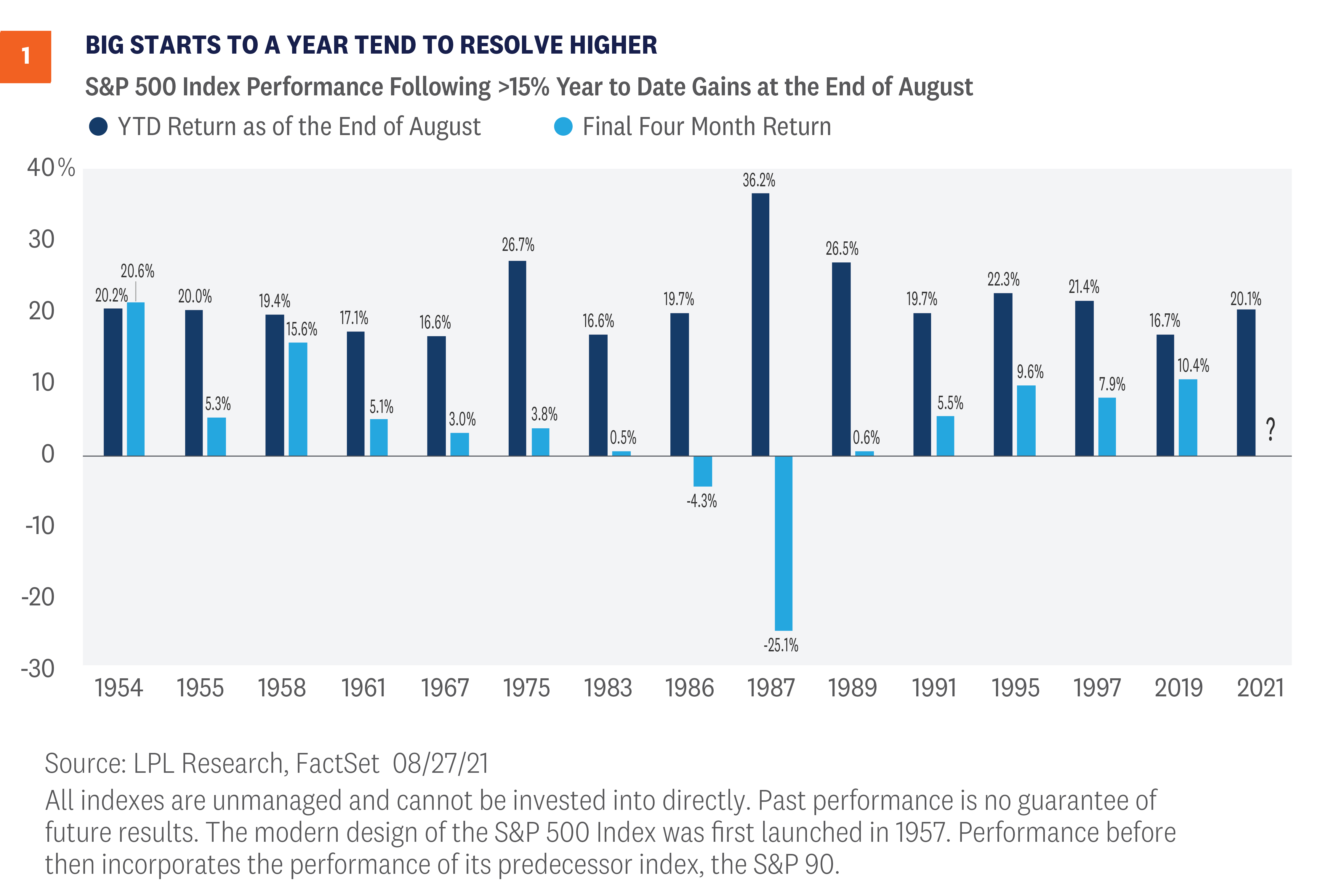
2021 has been an amazing year for stocks, with the S&P 500 up approximately 20% for the year without so much as a 5% pullback. Additionally, it has made 52 new all-time highs so far. To put in context how rare this is, only 1964 and 1995 saw more than 50 new highs before August was over. In fact, the all-time record for new highs in one year is 77, set in 1995, and this year is on pace to come very close to that record. What should investors do now? One of the common bear worries is stocks moving up a lot means stocks will come down a lot. That simply isn’t true, fortunately. In fact, as [Figure 1] shows, when the S&P 500 is up more than 15% year to date at the end of August (as 2021 likely will be), the final four months have been up the past five times, with the last three up 9.6%, 7.9%, and 10.4%, respectively. In fact, the average return in the final four months after a great start to the year is 4.2%, with a very impressive median return of 5.2%. Both numbers are above the average, and the median return for all years during the final four months is 3.6%.
Bear Argument #2: Strong Earnings Have Just Been Due To Easy Comps
The economy’s remarkable stimulus-aided recovery from the swift but severe pandemic recession of 2020 set the stage for a tremendous earnings surge that has been going on for a year now. And it is true that a good portion of that growth was due to the lockdowns in the year-ago quarter boosting the growth rate. But that isn't the whole story—not even close. Our S&P 500 earnings per share (EPS) estimates for 2021 is now $205, up 46% from $140 in 2020 and—even more impressively—26% above the pre-pandemic level of $163 in 2019. These earnings gains have prevented stocks from getting more expensive this year, as the price-to-earnings ratio for the S&P 500 has held steady despite the index’s 20% year-to-date advance. In our second-quarter earnings preview, we posed the question, “Is this as good as it gets?” The answer is almost certainly yes, as the 90% second-quarter growth rate probably won't be duplicated for a long time. However, we expect earnings to grow at a very solid pace of over 20% in the third and fourth quarters. Companies generally provided optimistic outlooks during earnings season with 58% of the guidance being positive compared with the 5-year average of 37%, which we believe increases the likelihood of better-than-expected results for the next quarter or two. We can’t entirely dismiss the risks, including the Delta variant, supply chain disruptions, and inflation pressures—particularly wages. But we expect corporate America’s efficiency and the strength of the reopening to continue to power earnings ahead and lead to additional gains for stocks over the rest of 2021.
Bear Argument #3: Cyclical Stocks Are Flashing a Warning Sign
It is true that cyclical stocks have largely underperformed the market over the past several months. The Dow Jones Transportation Average topped out in early May, while areas like banks and small caps have been going sideways for even longer. However, the context of these moves is lost when looking purely at recent performance. All of these sectors and asset classes have seen sideways action following historic runs from Q4 2020 into the early part of this year. However, despite recent underperformance, all of these groups remain above upward-sloping 200-day moving averages, a sign that the uptrends are firmly intact. We believe that recent underperformance is simply working off extreme overbought conditions, but those conditions are bullish over the longer-term. Perhaps most importantly though, we are seeing signs that this underperformance may be coming to an end. Last week, small caps outperformed large by the most since March. Banks have seen an expansion in new highs, and airlines, which have been one of the biggest drags on transports over recent months, are actually up 8% over the past six weeks despite fears surrounding Delta. The final variable to watch may be interest rates, which are highly correlated with cyclical and small-cap outperformance. We believe the yield on the 10-year Treasury has seen the bottom and is poised to continue higher through year-end.
Bear Argument #4: A Taper Tantrum is Coming
According to recent investor surveys, equity and fixed income investors are worried about a potential “taper tantrum” when the Federal Reserve (Fed) starts to reduce its bond-buying programs. As a reminder, in 2013, Fed Chairman Ben Bernanke casually mentioned that the Fed would start to reduce (taper) its bond buying programs in the coming months. His comments caught equity and fixed income investors by surprise and both markets reacted negatively—although the equity markets went on to return 30% for the year. While we are in a similar situation today with the Fed ready to announce its intentions to taper its bond buying programs, the markets have no reason to be surprised. The Fed has been communicating its intentions to eventually taper bond purchases for several months now. Markets should be well prepared at this point as the Fed learned its lesson from 2013 and has done a much better job communicating its intentions. Moreover, we think we are still several years away from full monetary normalization. After tapering ends, the Fed will likely wait some time before it starts to raise short-term interest rates. Last time we were in this position (in 2013), it was two years before the Fed began to increase interest rates, which took place over a four-year horizon. Former Fed Chair William McChesney Martin famously quipped that the job of the Federal Reserve is "to take away the punch bowl just as the party gets going." We don’t think the current Fed is going to take away the punch bowl anytime soon, and expect it will remain accommodative for the foreseeable future.
Bear Argument #5: The White House Agenda Will Derail The Bull
We don’t think Washington policy developments are a serious threat to broad markets in the near-to-medium term. We know that people get passionate about policy and that’s a good thing—that’s what makes a democracy go. But a direct connection between policy and broader market direction is rare. Even when it comes to the narrow impact of policy on an individual sector or industry, the outcome for markets may not be in line with what conventional wisdom expects—or may be overwhelmed by larger economic forces. Policy does matter, but unless there’s a glaring mistake, it’s unlikely to be a policy decision that takes the bull market down. President Biden’s agenda is likely a mixed bag for markets. Markets tend to respond positively to stimulus, and we believe we may see a total of $2–2.5 trillion in new spending, spread out over about 10 years, passed by the end of the year. But higher taxes could be a headwind, and that additional spending may be paid for, in part, by $1–1.5 trillion in new taxes, the rest coming through borrowing. But either way the primary driver of the recovery will continue to be businesses looking for better ways to compete, innovate, and grow. That’s a powerful force, and market history says compared to that what happens in Washington is usually not enough of a catalyst to reverse market momentum.
Conclusion
LPL Research continues to believe that tactical investors should tilt portfolios in favor of stocks over bonds. This certainly does not mean that an exogenous shock could not cause stocks to correct. However, when looking at the recent pace of earnings, the policy environment, and market history, we fail to see a compelling bear case against equities. For more information, please read our Midyear Outlook 2021: Picking Up Speed. Please note: We will not publish a Weekly Market Commentary next week in observance of the Labor Day holiday. We will resume our regular schedule on September 13. Read previous editions of Weekly Market Commentary on lpl.com at News & Media. Ryan Detrick, CMT, Chief Market Strategist, LPL Financial
Jeff Buchbinder, CFA, Equity Strategist, LPL Financial
Scott Brown, CMT, Senior Analyst, LPL Financial ______________________________________________________________________________________________ IMPORTANT DISCLOSURES This material is for general information only and is not intended to provide specific advice or recommendations for any individual. There is no assurance that the views or strategies discussed are suitable for all investors or will yield positive outcomes. Investing involves risks including possible loss of principal. Any economic forecasts set forth may not develop as predicted and are subject to change. References to markets, asset classes, and sectors are generally regarding the corresponding market index. Indexes are unmanaged statistical composites and cannot be invested into directly. Index performance is not indicative of the performance of any investment and do not reflect fees, expenses, or sales charges. All performance referenced is historical and is no guarantee of future results. Any company names noted herein are for educational purposes only and not an indication of trading intent or a solicitation of their products or services. LPL Financial doesn’t provide research on individual equities. All information is believed to be from reliable sources; however, LPL Financial makes no representation as to its completeness or accuracy. U.S. Treasuries may be considered “safe haven” investments but do carry some degree of risk including interest rate, credit, and market risk. Bonds are subject to market and interest rate risk if sold prior to maturity. Bond values will decline as interest rates rise and bonds are subject to availability and change in price. The Standard & Poor’s 500 Index (S&P500) is a capitalization-weighted index of 500 stocks designed to measure performance of the broad domestic economy through changes in the aggregate market value of 500 stocks representing all major industries. The PE ratio (price-to-earnings ratio) is a measure of the price paid for a share relative to the annual net income or profit earned by the firm per share. It is a financial ratio used for valuation: a higher PE ratio means that investors are paying more for each unit of net income, so the stock is more expensive compared to one with lower PE ratio. Earnings per share (EPS) is the portion of a company’s profit allocated to each outstanding share of common stock. EPS serves as an indicator of a company’s profitability. Earnings per share is generally considered to be the single most important variable in determining a share’s price. It is also a major component used to calculate the price-to-earnings valuation ratio. All index data from FactSet. Please read the full Midyear Outlook 2021: Picking Up Speed publication for additional description and disclosure. This research material has been prepared by LPL Financial LLC. Securities and advisory services offered through LPL Financial (LPL), a registered investment advisor and broker-dealer (member FINRA/SIPC). Insurance products are offered through LPL or its licensed affiliates. To the extent you are receiving investment advice from a separately registered independent investment advisor that is not an LPL affiliate, please note LPL makes no representation with respect to such entity. Not Insured by FDIC/NCUA or Any Other Government Agency | Not Bank/Credit Union Guaranteed | Not Bank/Credit Union Deposits or Obligations | May Lose Value
RES-873950-0821 | For Public Use | Tracking # 1-05184665 (Exp. 08/22)
The highly transmissible Delta variant of COVID-19 now makes up an overwhelming majority of the new cases in the U.S., bringing with it a rise in cases and hospitalizations. Widespread vaccine distribution and distancing measures have helped limit the variant’s impact, but we could still see some drag on economic growth as some restrictions are reintroduced and consumers potentially become more cautious. While we may see an increase in market volatility due to the Delta variant, we believe the S&P 500 is still likely to see more gains through the end of the year.
The Delta Variant May Drag On Economic Growth
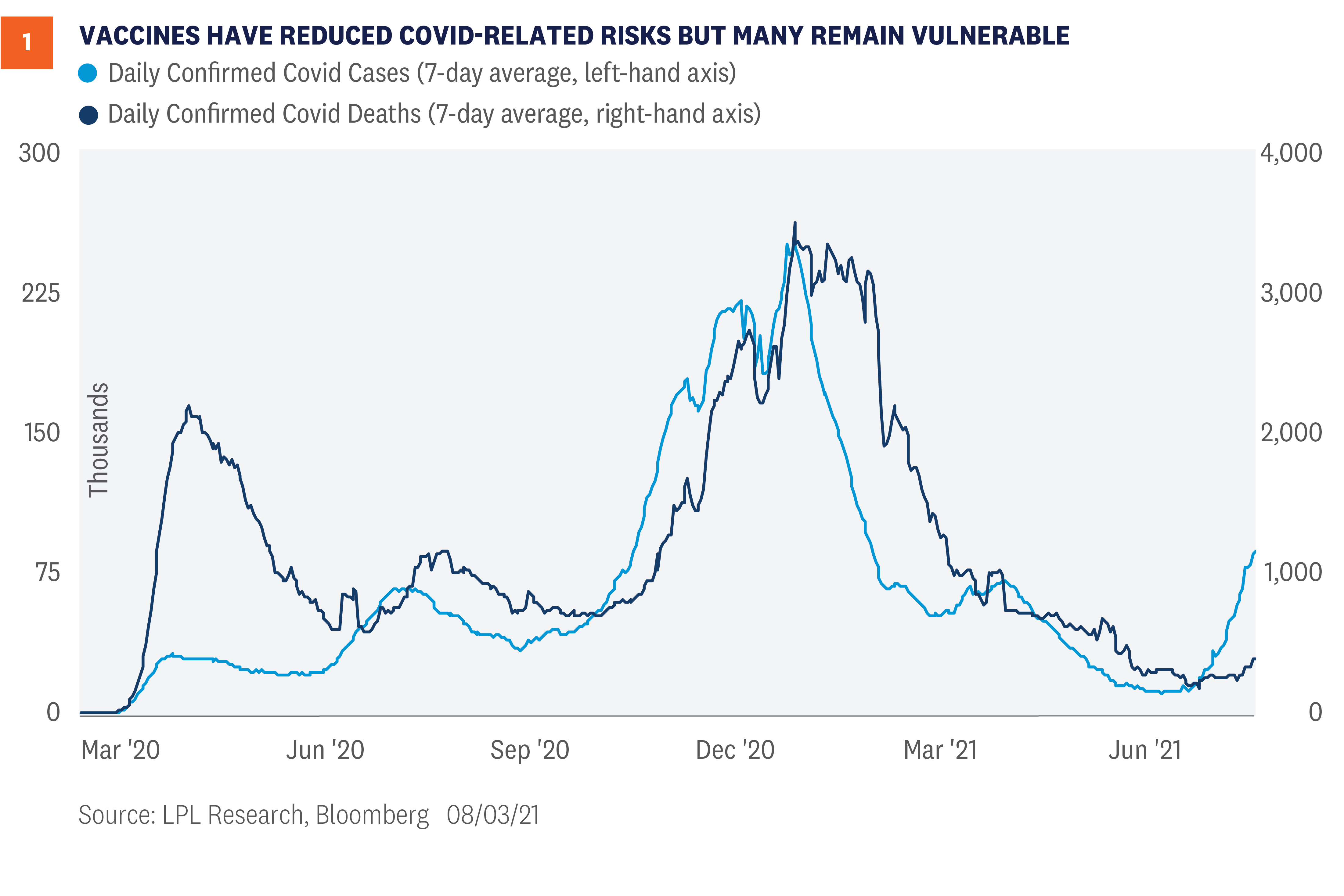
Despite the increased transmissibility of Delta and the increased health threat for those who aren’t vaccinated, our understanding of the measures needed to contain COVID-19 is in an entirely different place than it was in 2020. Above all else, we have not just one but several vaccines, which drastically reduces the risk from the variant, although it can’t completely eliminate it. We understand the effectiveness of masks in limiting transmission. Treatments have improved. We also know that the virus is not easily transmitted by touching surfaces—especially with simple good practices around handwashing—limiting the need for certain restrictions. Because of that, deaths from COVID remain near the lowest level of the pandemic despite the pick-up in cases [Figure 1]. Much of that is due to the vaccines’ ability to limit serious cases, though health risks remain high for those who aren’t vaccinated. We are also seeing some strain on healthcare systems in regions with low vaccination rates. Our view has consistently been that governments should, and generally will, impose restrictions only to the degree necessary to protect the most vulnerable and keep our healthcare system from getting overwhelmed. There’s not a clean, scientific answer to exactly what that point is, but there is a solid set of guidelines. If individuals, businesses, and officials use those guidelines as appropriate for their communities, there will still likely be some added drag on economic growth—but we think it will be manageable, with the drag still outweighed by the on-going rebound. How much added drag? The most recent gross domestic product (GDP) reading for the U.S. put economic activity back above the level where it was before the pandemic. That does raise the bar. We do think third-quarter GDP forecasts could fall a few percentage points, the lost growth being pushed back into late 2021 and early 2022. But even if the impact was so strong that we saw modest economic contraction, which we view as unlikely, we would expect the economy to bounce back quickly.
New Restrictions, Supply Chains Sources of Concern
Any drag on economic growth would likely come from a few key sources: While we are unlikely to see a new wave of widespread shutdowns in the U.S., there may be added restrictions. The effectiveness of vaccines and our increased understanding of how to contain COVID will limit the need for restrictions, especially with vaccination rates rising again and vaccines available to anyone eligible who wants them. The strongest measures will probably be around mask mandates and social distancing, with stronger restrictions confined to localities where they are most needed. Even without government mandates, there will still be changes in individual behavior that may slow the rate of economic growth. Changes in individual behavior due to safety concerns will probably have a larger impact than government intervention. This will likely be especially true for those with young children who are not eligible for vaccinations and those who choose not to get vaccinated. Behavioral changes may slow the recovery in the job market in particular if the changing environment places additional childcare demands on parents or raises workplace safety concerns. We are likely to see an extension of supply chain disruptions. While the impact from Delta could slow demand growth, it may have a bigger impact on the supply side. Some countries where vaccine availability has been low have already imposed added restrictions, which could limit factory activity, exacerbate shortages, and create added price pressures. The economy has been slowly starting to work its way through supply/demand imbalances, but this may negate some of the progress, putting a temporary cap on growth.
Market-Positive Elements of Response May Gain Traction
Not all the news around the Delta variant has been bad from a market perspective. We may even be close to the inflection point where much of the bad news has been priced in and markets start looking past the Delta variant’s growth impact. Markets tend to lead the economy, not the other way around. Think about where we were on March 23, 2020, when the S&P 500 bottomed. Granted, we are in a very different place right now, as we have not seen a substantial Delta-related pullback yet, only rotation toward some less risky areas of the market, so there may still be bumps ahead. But we think any dips in stock prices are likely to be short-lived and it may not even take all that much clarity before we see some rotation back to the market sectors that would benefit most from reopening. Vaccination rates are starting to rise again. While some people may still choose to remain unvaccinated, it’s hard to ignore the extreme risk disparities between those who are vaccinated and those who aren’t as Delta has spread. Rising cases, as well as efforts of local officials, have led to vaccination rates starting to rise again, and we recently crossed the threshold of 70% of U.S. adults having received at least one vaccination shot. Delta’s greater transmissibility does mean “herd immunity” will be harder to achieve, but there does seem to be progress. Europe is showing improvement. Europe is providing a model of the ability of countries with high vaccination rates to limit the impact of the Delta variant. Europe has been battling Delta longer than the U.S. and seems to be turning the corner, reinforcing that we do have the tools to limit the spread of the variant without large economic disruptions. While it’s clear that the Delta variant could create significant added economic strain if left unchecked, it’s also becoming increasingly clear that we have the tools to contain the impact while still protecting the economy. Stimulus is more likely to stay in place or even expand. Equity markets almost universally like stimulus even if there might be potential long-term negative consequences. Delta has already pushed back expectations of the first Federal Reserve rate hike. Market-based expectations had been pulled forward to 2022 as U.S. growth surprised to the upside, but have now been pushed back again to 2023. The Biden administration’s stimulus plans may also receive greater support if the economy stumbles due to Delta, and we could even see some added COVID-oriented measures. Even if the stimulus comes with a long-term cost, it is likely to be viewed as market positive in the near term due to the added safety net it provides. Reopening momentum will be difficult to reverse. Even with heightened restrictions in place, individuals and businesses will be reluctant to completely lose reopening momentum. Of course, it’s not completely in their control, but we think there will be a bias toward not being overly cautious, and less of a need where vaccination rates are high. There is rising concern over the Delta variant, and people will be more cautious on average, but we are very unlikely to return to the levels of fear seen in 2020.
Short-Term Concerns are Real But Market Impact Likely Limited
Despite the greater transmissibility of the Delta variant and increased health risk for those who are not vaccinated, we think the U.S. and global economy will continue to expand over the rest of the year. We maintained our 2021 U.S. growth forecast at 6.25 – 6.75% in our Midyear Outlook 2021: Picking Up Speed even as forecasts were rising and that decision now seems prudent, but we also see no need to lower it. Global vaccine distribution has a long way to go, but we’re making steady progress. Meanwhile, vaccine availability is high in the U.S. and our understanding of how to contain the virus has deepened substantially since the outbreak began in early 2020. There are still increased risks to growth and we may see patches of market volatility, but we believe any meaningful dip in equity markets should still be viewed as an opportunity to add risk for appropriate investors, and may also provide opportunities to rebalance portfolios toward reopening beneficiaries. Read previous editions of Weekly Market Commentary on lpl.com at News & Media. Barry Gilbert, CFA, Asset Allocation Strategist, LPL Financial ______________________________________________________________________________________________ IMPORTANT DISCLOSURES This material is for general information only and is not intended to provide specific advice or recommendations for any individual. There is no assurance that the views or strategies discussed are suitable for all investors or will yield positive outcomes. Investing involves risks including possible loss of principal. Any economic forecasts set forth may not develop as predicted and are subject to change. References to markets, asset classes, and sectors are generally regarding the corresponding market index. Indexes are unmanaged statistical composites and cannot be invested into directly. Index performance is not indicative of the performance of any investment and do not reflect fees, expenses, or sales charges. All performance referenced is historical and is no guarantee of future results. Any company names noted herein are for educational purposes only and not an indication of trading intent or a solicitation of their products or services. LPL Financial doesn’t provide research on individual equities. All information is believed to be from reliable sources; however, LPL Financial makes no representation as to its completeness or accuracy. US Treasuries may be considered “safe haven” investments but do carry some degree of risk including interest rate, credit, and market risk. Bonds are subject to market and interest rate risk if sold prior to maturity. Bond values will decline as interest rates rise and bonds are subject to availability and change in price. The Standard & Poor’s 500 Index (S&P500) is a capitalization-weighted index of 500 stocks designed to measure performance of the broad domestic economy through changes in the aggregate market value of 500 stocks representing all major industries. The PE ratio (price-to-earnings ratio) is a measure of the price paid for a share relative to the annual net income or profit earned by the firm per share. It is a financial ratio used for valuation: a higher PE ratio means that investors are paying more for each unit of net income, so the stock is more expensive compared to one with lower PE ratio. Earnings per share (EPS) is the portion of a company’s profit allocated to each outstanding share of common stock. EPS serves as an indicator of a company’s profitability. Earnings per share is generally considered to be the single most important variable in determining a share’s price. It is also a major component used to calculate the price-to-earnings valuation ratio. All index data from FactSet. Please read the full Midyear Outlook 2021: Picking Up Speed publication for additional description and disclosure. This research material has been prepared by LPL Financial LLC. Securities and advisory services offered through LPL Financial (LPL), a registered investment advisor and broker-dealer (member FINRA/SIPC). Insurance products are offered through LPL or its licensed affiliates. To the extent you are receiving investment advice from a separately registered independent investment advisor that is not an LPL affiliate, please note LPL makes no representation with respect to such entity. Not Insured by FDIC/NCUA or Any Other Government Agency | Not Bank/Credit Union Guaranteed | Not Bank/Credit Union Deposits or Obligations | May Lose Value
RES-850750-0721 | For Public Use | Tracking # 1-05176386 (Exp. 08/22)
2021 has been a very strong year for both stocks and the economy, but that doesn’t mean there haven’t been some surprises. Below we take a look at some things that have happened so far in 2021 that have surprised the LPL Research team.
Surprise 1: Yields Aren't Higher
Interest rates have surprised us twice this year. While we expected interest rates to increase this year, the strength of the move higher in the first quarter of 2021 was the first surprise. But reversing course and steadily falling since March may be an even bigger one. Put them together and the 10-year Treasury yield is still about 0.35% above where it was at the start of the year. Incredibly enough, we’re still in a rising rate environment. But the more recent decline is what’s on investors’ minds. We don’t think there’s a simple explanation for why rates have fallen since March. A lot of factors have contributed: outsized inflation expectations coming down; short covering from crowded bets on higher rates; foreign buying; the drawdown of the Treasury General Account balance; and rising economic concerns about the impact of the Delta variant have all contributed. Part of the story is just one surprise correcting another. The 10-year yield had likely risen too far too fast in late 2020 and early 2021 and a course correction was natural, even if the pullback has been stronger than expected. What’s the outlook for the rest of the year? Despite four months of falling rates, growth and inflation expectations still point to higher rates. Plus, don’t forget that the 10-year yield is still higher this year and we wouldn’t be at all surprised to see it resume its climb.
Surprise 2: Stocks Have Been Strong and Calm
Although we came into the year expecting solid stock gains, even we are surprised by just how much strength there has been this year for equities. After gaining 16% last year and 29% in 2019, the S&P 500 Index is up another more than 17% so far this year. Even more surprising though is the lack of volatility we’ve seen so far. Historically, year two of a bull market can be choppy and quite frustrating. After the huge gains we saw the last nine months of 2020, we entered 2021 expecting there to be more give and take than we’ve seen this year. In fact, the S&P 500 hasn’t even had as much as a 5% pullback since October 2020, one of the longest streaks ever. That is very surprising indeed. After more than a 90% rally off the March 2020 bear market bottom (and near double on a total return basis) we do think the odds are much higher of a standard 5-8% pullback during the historically troublesome August/September/October period. This isn’t a bad thing though, as some type of break could be necessary before another move higher.
Surprise 3: President Biden Has Been Tough on China
In the aftermath of President Biden’s victory, political pundits immediately began forecasting friendlier relations with China than had been experienced under the Trump administration. The logic was relatively straightforward. Foreign policy is one area where a president can act relatively unilaterally, and under the Obama administration, then-Vice President Biden played a crucial role in America’s policy of ‘engagement’ with China and reportedly had a warm personal relationship with President Xi Jinping. So what happened? Since then, China has grown bolder in its ambitions to become the dominant global player, continuing unfair trade practices and intellectual property theft to help fuel its rise. President Biden seems determined to follow through on President Trump’s more hardline approach, maintaining the Trump tariffs on China, calling out China for human rights abuses, demanding a global investigation into the origins of COVID-19, and perhaps most importantly building a coalition of European allies to confront China on its trade practices and its increasingly aggressive foreign policy. Whereas President Trump took a more ‘on our own’ stance toward China, President Biden is building a coalition allied against China. The more hardline approach may be particularly important during this period of significant technological infrastructure buildout, such as 5G internet, which may set the technological rules of the road for decades to come. Frosty relations with China looks to be one feature of the prior US administration that is here to stay.
Surprise 4: Crude Oil Soared
A Democratic sweep in the 2020 elections brought with it expectations for swift climate action, and, some thought, likely much lower oil prices. It may seem a bit counterintuitive, therefore, that oil prices and its investors have benefitted greatly since then, with crude oil starting the year at less than $50 a barrel but currently flirting with $70 a barrel. The macroeconomic backdrop has played a large part. Coming out of the 2020 recession, risk assets, including oil, generally rallied strongly. While an unprecedented strong fiscal response was enacted to rescue the economy, investments tied to a reflationary environment, such as crude oil, saw outsized gains. The resulting ballooning deficit paired with a “risk on” market environment has seen the US dollar generally fall since the market bottom in March 2020, buoying commodities broadly. But, there have also been some specific policy actions that have propped up oil. Political analysts generally expected a swift resumption of the Obama-era Iran nuclear deal, which would have paved the road for Iranian crude to come back to market. This has still yet to occur, limiting global supply relative to prior expectations. Meanwhile, at home, President Biden has generally sought to restrict US oil production, lowering supply expectations and boosting prices. Finally, OPEC+ has so far generally cooperated well with one another, cautiously increasing supply and (narrowly) avoiding the breakdowns in negotiations that have led to supply gluts and lower crude prices in the past.
Surprise 5: Growth Isn't Dead
Value stocks outperformed growth by 6 percentage points in the final four months of 2020 and we expected that trend to continue amid the early stages of the economic expansion. That thesis played out in the first few months of the year, as the Russell 1000 Value Index outperformed its Russell Growth counterpart by more than 12 percentage points through early March. However, since then growth stocks have staged a furious comeback, breaking out higher in absolute terms, while value-oriented sectors have largely stagnated amid falling Treasury yields. Through July 23, value and growth are separated by less than 1%, with both indexes returning approximately 17% year to date. We believe value stocks will see leadership again in 2021 as Treasury yields rebound and the under-the-surface rotation continues. However, the first half of this year has made it clear that rumors of growth’s demise are greatly exaggerated. We believe a balance of both styles, with a modest tilt toward value, will be important for diversified investors over the historically volatile next few months.
Surprise 6: Blow Out Earnings
Coming out of lockdowns last summer, we were amazed by the pace of the economic recovery. Just as surprising was how well corporate America managed through the pandemic, putting the powerful earnings rebound near the top of our list of biggest surprises this year. When 2021 began, the consensus estimate for S&P 500 Index earnings per share (EPS) was about $167. Today that number is about 14% higher at over $190 (Source: FactSet). This is impressive on its own. But considering estimates have historically fallen by an average of about 10% during calendar years, it’s even more impressive. Companies have simply blown away expectations, having delivered some of the biggest quarterly upside surprises ever recorded, even under challenging conditions. The pandemic disrupted supply chains, bringing shortages of key materials and labor. Input cost pressures from a variety of sources weighed on profit margins. Yet, despite these challenges, in 2021 S&P 500 companies are on track to exceed the pre-pandemic peak in earnings by more than 20%. Our forecast for S&P 500 EPS in 2021 is $195, a nearly 40% increase over 2020.
Conclusion
There are always going to be surprises when it comes to investing and 2021 is no different than any other year. Still, our big calls this year, included stocks significantly outperforming bonds and the economy likely seeing one of its best years ever, are alive and well so far. What could the rest of 2021 hold? We’d be willing to bet there will be more surprises for sure, but the good news is the economy continues to improve and the earnings backdrop is spectacular. For more of our thoughts on the rest of this year, we invite you to read the full Midyear Outlook 2021: Picking Up Speed for more investment insights, and for the interactive version, click here. Thanks to Barry Gilbert and Scott Brown for their help this week. Read previous editions of Weekly Market Commentary on lpl.com at News & Media. Ryan Detrick, CMT, Chief Market Strategist, LPL Financial
Jeff Buchbinder, CFA, Equity Strategist, LPL Financial
Thomas Goulder, CFA, Senior Analyst, LPL Financial ______________________________________________________________________________________________ IMPORTANT DISCLOSURES This material is for general information only and is not intended to provide specific advice or recommendations for any individual. There is no assurance that the views or strategies discussed are suitable for all investors or will yield positive outcomes. Investing involves risks including possible loss of principal. Any economic forecasts set forth may not develop as predicted and are subject to change. References to markets, asset classes, and sectors are generally regarding the corresponding market index. Indexes are unmanaged statistical composites and cannot be invested into directly. Index performance is not indicative of the performance of any investment and do not reflect fees, expenses, or sales charges. All performance referenced is historical and is no guarantee of future results. Any company names noted herein are for educational purposes only and not an indication of trading intent or a solicitation of their products or services. LPL Financial doesn’t provide research on individual equities. All information is believed to be from reliable sources; however, LPL Financial makes no representation as to its completeness or accuracy. US Treasuries may be considered “safe haven” investments but do carry some degree of risk including interest rate, credit, and market risk. Bonds are subject to market and interest rate risk if sold prior to maturity. Bond values will decline as interest rates rise and bonds are subject to availability and change in price. The Standard & Poor’s 500 Index (S&P500) is a capitalization-weighted index of 500 stocks designed to measure performance of the broad domestic economy through changes in the aggregate market value of 500 stocks representing all major industries. The PE ratio (price-to-earnings ratio) is a measure of the price paid for a share relative to the annual net income or profit earned by the firm per share. It is a financial ratio used for valuation: a higher PE ratio means that investors are paying more for each unit of net income, so the stock is more expensive compared to one with lower PE ratio. Earnings per share (EPS) is the portion of a company’s profit allocated to each outstanding share of common stock. EPS serves as an indicator of a company’s profitability. Earnings per share is generally considered to be the single most important variable in determining a share’s price. It is also a major component used to calculate the price-to-earnings valuation ratio. All index data from FactSet. Please read the full Midyear Outlook 2021: Picking Up Speed publication for additional description and disclosure. This research material has been prepared by LPL Financial LLC. Securities and advisory services offered through LPL Financial (LPL), a registered investment advisor and broker-dealer (member FINRA/SIPC). Insurance products are offered through LPL or its licensed affiliates. To the extent you are receiving investment advice from a separately registered independent investment advisor that is not an LPL affiliate, please note LPL makes no representation with respect to such entity. Not Insured by FDIC/NCUA or Any Other Government Agency | Not Bank/Credit Union Guaranteed | Not Bank/Credit Union Deposits or Obligations | May Lose Value
RES-836750-0721 | For Public Use | Tracking # 1-05171228 (Exp. 07/22)
The term stagflation has been circulating increasingly in the financial media as inflation readings have risen sharply in recent months. The term is often associated with the 1970s, which saw runaway inflation—largely driven by sky-high energy prices—and lackluster economic growth. Stagflation and a return to the weak equity markets of the 1970s would be understandably scary. However, when looking at the data, we remain skeptical that either runaway inflation or low growth are right around the corner, much less both at the same time.
The Misery Index
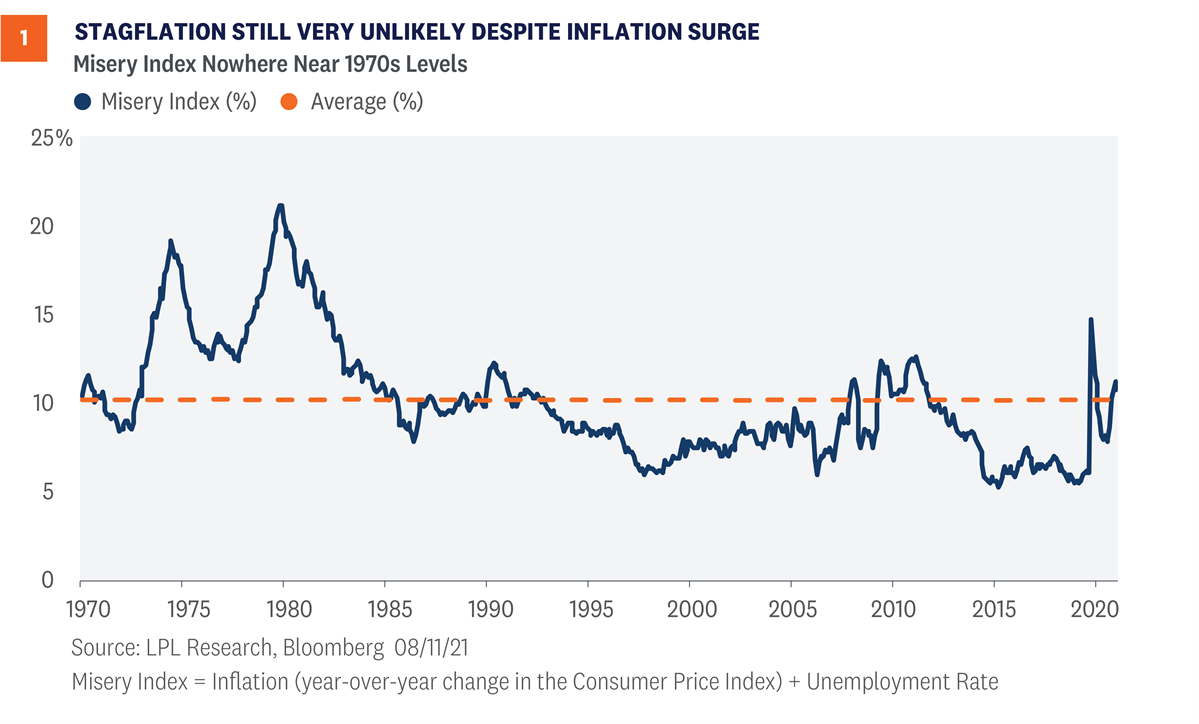
One way to gauge stagflation is to calculate what is commonly referred to as the Misery Index—inflation plus unemployment. As shown in [Figure 1], the Misery Index today is nowhere near the extreme levels of the 1970s. In fact, the level of “misery” is very close to the long-term average near 10—despite the highest inflation readings we’ve seen in over a decade. “We don’t believe the current environment is anything like the stagflation experiences of the 1970s,” explained LPL Financial Director of Research Marc Zabicki. “We think much of the elevated inflation readings we’re seeing now are transitory and related to pandemic bottlenecks and material shortages. Meanwhile, the economic reopening and massive stimulus should provide a strong one-two punch to keep economic growth well above average through 2022.”
Price Competition Anchors Inflation
The irony of inflation concerns is that the Federal Reserve has been trying, without success, for the past decade to stimulate inflation to its 2% long-term target. We believe there are several structural considerations at play that have—and will continue to—put downward pressure on prices over the medium- to long-term. Demographics and global trade are two of those considerations. We also believe that more acute price competition is an important variable that can keep prices contained. In our view, the ubiquitous use of the internet has indeed raised the price consciousness of the consumer. It has streamlined the price discovery process and has served to shift the pricing balance of power from producers to consumers. After all, consumers can sift through products, services, and their pricing on their smartphones without leaving their home. Just a decade ago, what consumers could purchase on the internet may have been limited to small-ticket commodity items, electronics, and books. Now the list of goods and services for which consumers can comparison shop includes nearly everything from new vehicles to airline tickets to homes to rent or buy. In this context, it is little surprise to us that inflation has been benign for years, and we anticipate price pressures could again subside once coronavirus-related supply/demand imbalances run their course.
Market Inflation Expectations Peaked In May
Much of the runaway inflation case had centered on skyrocketing commodity prices, a valid concern to be sure. However, since May nearly every commodity that was causing alarm has seen a significant decline. Lumber prices? Down more than 70%. Copper prices? Down 15%. Even crop prices such as corn and soybeans have fallen significantly over the past few months. As they often say, the cure for high prices is high prices. We also take comfort in the fact that the bond market actually agrees with our view of transitory inflation. If one was simply looking at recent economic reports or reading media headlines, they might be surprised to realize that the market isn’t actually looking for more extreme inflation readings. By looking at the difference between what bond traders pay for inflation-protected Treasuries and plain vanilla nominal Treasuries, we can get a good idea of what the market’s expectations for inflation actually are. Market-implied inflation expectations or “breakevens” rose rapidly from extremely low levels last year. However, a funny thing happened after the release of the April Consumer Price Index (CPI) report in early May: Inflation expectations actually fell. And those expectations have continued to fall despite higher subsequent readings. Currently, market participants are estimating inflation to be less than 2.5% annualized over the next five years, more than 30 basis points (0.30%) lower than the expectation in early May.
Growth Outlook is Favorable
The other key component of the Misery Index is the unemployment rate, a sort of proxy for growth and economic health. The unemployment rate is not yet back to its pre-pandemic levels, but the most recent jobs report showed that the economy added nearly a million jobs in July, bringing the unemployment rate down to 5.4%. We see the potential for further job gains as schools reopen and unemployment benefits expire for a significant amount of the unemployed in early September.
That said, after the boosts from the reopening and stimulus pass, the U.S. economy may resume its pre-pandemic growth trend in the neighborhood of 2% real gross domestic product (GDP) growth. Bloomberg’s survey of economists points to just 2.3% real GDP growth in 2023, after 4.2% next year. Given the limited population growth in the United States, demographic headwinds as baby boomers retire, and low immigration rates, the opportunity for stronger economic growth than that may be limited, and that slower growth makes higher inflation all the less likely.
Conclusion
Stagflation is understandably a concern. Low growth and high inflation lead to a situation where the vast majority of people become poorer in real terms. However, we simply do not believe the evidence indicates this to be a likely scenario. While prices are not likely to outright decline and create deflation, we expect recent inflation readings to moderate and growth to remain at a solid speed over the next year. We believe this helps bolster the case for stocks to add to gains through the remainder of 2021.
For more information, please read our Midyear Outlook 2021: Picking Up Speed.
Read previous editions of Weekly Market Commentary on lpl.com at News & Media. Jeff Buchbinder, CFA, Equity Strategist, LPL Financial
Ryan Detrick, CMT, Chief Market Strategist, LPL Financial
Scott Brown, CMT, Senior Analyst, LPL Financial ______________________________________________________________________________________________ IMPORTANT DISCLOSURES This material is for general information only and is not intended to provide specific advice or recommendations for any individual. There is no assurance that the views or strategies discussed are suitable for all investors or will yield positive outcomes. Investing involves risks including possible loss of principal. Any economic forecasts set forth may not develop as predicted and are subject to change. References to markets, asset classes, and sectors are generally regarding the corresponding market index. Indexes are unmanaged statistical composites and cannot be invested into directly. Index performance is not indicative of the performance of any investment and do not reflect fees, expenses, or sales charges. All performance referenced is historical and is no guarantee of future results. Any company names noted herein are for educational purposes only and not an indication of trading intent or a solicitation of their products or services. LPL Financial doesn’t provide research on individual equities. All information is believed to be from reliable sources; however, LPL Financial makes no representation as to its completeness or accuracy. U.S. Treasuries may be considered “safe haven” investments but do carry some degree of risk including interest rate, credit, and market risk. Bonds are subject to market and interest rate risk if sold prior to maturity. Bond values will decline as interest rates rise and bonds are subject to availability and change in price. The Standard & Poor’s 500 Index (S&P500) is a capitalization-weighted index of 500 stocks designed to measure performance of the broad domestic economy through changes in the aggregate market value of 500 stocks representing all major industries. The PE ratio (price-to-earnings ratio) is a measure of the price paid for a share relative to the annual net income or profit earned by the firm per share. It is a financial ratio used for valuation: a higher PE ratio means that investors are paying more for each unit of net income, so the stock is more expensive compared to one with lower PE ratio. Earnings per share (EPS) is the portion of a company’s profit allocated to each outstanding share of common stock. EPS serves as an indicator of a company’s profitability. Earnings per share is generally considered to be the single most important variable in determining a share’s price. It is also a major component used to calculate the price-to-earnings valuation ratio. All index data from FactSet. Please read the full Midyear Outlook 2021: Picking Up Speed publication for additional description and disclosure. This research material has been prepared by LPL Financial LLC. Securities and advisory services offered through LPL Financial (LPL), a registered investment advisor and broker-dealer (member FINRA/SIPC). Insurance products are offered through LPL or its licensed affiliates. To the extent you are receiving investment advice from a separately registered independent investment advisor that is not an LPL affiliate, please note LPL makes no representation with respect to such entity.
Not Insured by FDIC/NCUA or Any Other Government Agency | Not Bank/Credit Union Guaranteed | Not Bank/Credit Union Deposits or Obligations | May Lose Value
RES-867001-0821 | For Public Use | Tracking # 1-05181664 (Exp. 08/22)