RESEARCH

What to Watch This Earnings Season

First quarter earnings season is rolling. BlackRock, Delta Airlines, Goldman Sachs, JPMorgan Chase, and Morgan Stanley were among the first 16 S&P 500 companies to report March quarter results, following 20 index constituents with quarters ending in February that had already reported. Below we preview earnings season, highlight what we are watching, and share our latest thoughts on the 2022 profit outlook.

What to expect

We expect corporate America to again report earnings above consensus estimates in the first quarter. The consensus estimate is now calling for a 5% year-over-year increase in S&P 500 Index earnings per share, not an easy target by any stretch [Figure 1]. Pressure on profit margins from higher costs for virtually everything, notably labor, materials, and transportation, made this quarter difficult to navigate. Add spillover from the Russia-Ukraine conflict and intermittent COVID-19 lockdowns in China, and companies’ bottom lines are getting hit from several directions. Despite the tough environment, we believe the odds favor companies beating estimates as they have done historically on the back of double-digit revenue growth. High inflation translates into more revenue so earnings can grow at a solid pace even with some narrowing of profit margins. LPL Research expects S&P 500 revenue for the first quarter to rise 11% year over year, with energy and healthcare making the biggest contributions. Energy sector earnings are expected to contribute 5 percentage points of growth for the S&P 500—basically all of it based on current consensus estimates—and roughly 3 percentage points of revenue growth. Still, we probably will not get the 8 percentage points of upside S&P 500 companies delivered in the fourth quarter of 2021. Inflation, COVID-19, and geopolitical challenges have dampened the overall pace of economic activity in recent months and impaired profits. Meanwhile, the percentage of pre-announcing companies taking numbers down, at 70%, is above the five-year average of 60% and signals less potential upside. Nonetheless, upside of 3-4 percentage points seems like a reasonable expectation, or a year-over-year earnings gain of 8-9%.
What to Watch

Here are three things we are watching this earnings season—all inflation related—to help assess the near-term earnings outlook:
  1. Margin pressures. This one is going to be highlighted in our earnings previews for a while. We will continue to watch for signs of pressure on profit margins from rising wages, costs of materials, energy, and transportation. Companies defied the skeptics (including ourselves) and held margins fairly steady in the fourth quarter. Market participants appear to be braced for lower margins in the first quarter so markets may not react negatively to modest deterioration—our expectation.
  2. Pricing power. The inflationary environment has brought pricing power to many companies along with more revenue for commodity producers. This is evident in the double-digit revenue growth S&P 500 companies are expected to produce for the quarter. If companies are able to pass through their higher costs as they generally did in the fourth quarter, they should be able to hit their earnings targets pretty easily this quarter.
  3. Supply chain status. Companies generally communicated that they expected most supply chain issues to be resolved by mid-2022, which now appears overly optimistic. While the progress toward containing COVID-19 is encouraging in the United States, China’s failures are keeping global supply chains snarled longer than many companies had anticipated.

Early thoughts on 2022 earnings

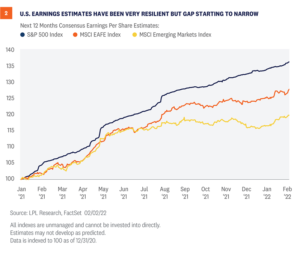
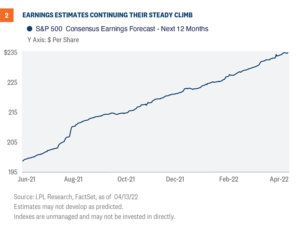
S&P 500 earnings estimates for 2022 have risen 2.2% this year to $228.50 per share (source: FactSet), which is remarkable considering how difficult the operating environment has become. We have sharply higher inflation, slower global growth, dampened consumer confidence, and a devastating war in Eastern Europe. Through that, analysts’ profit targets are rising, which means our $220 per share forecast for 2022 S&P 500 earnings (6-7% growth) is probably too low. The consensus estimate for the next 12 months is up to $235 per share, in line with our forecast for calendar 2023 [Figure 2]. However, we believe Wall Street’s estimates for 9-10% earnings growth this year are too high given the margin pressures noted above are likely to persist, and we have cut a full percentage point off of our forecasts for U.S. and global gross domestic product (GDP) since January 1. We would view a slight estimate cut during earnings season as a win, especially considering historically estimates are cut by about 3% as companies report results. So while the higher estimates are encouraging, we expect estimates to fall over the next couple quarters, which could lead to more choppiness for markets in the near term.
Conclusion

Earnings will be key to the path for stocks the rest of the year given that we believe valuation expansion will be tough to come by with higher interest rates and stubbornly high inflation. We expect S&P 500 earnings to grow in the high single-digits this year despite the challenges, supporting gains for stocks, in our view. But inflation is the most important factor for markets this year, as we noted here two weeks ago. Our expectation is that inflation pressures will soon start to abate, reducing the likelihood of an overly aggressive Federal Reserve and taking some of the wind out of the 10-year Treasury yield’s sails. The re-steepening of the 2-year/10-year Treasury yield curve is encouraging. We continue to recommend a modest overweight allocation to equities and a slight underweight to fixed income relative to investors’ targets, as appropriate. Our year-end 2022 fair value target for the S&P 500 is 4,800–4,900.   Jeff Buchbinder, CFA, Equity Strategist, LPL Financial Ryan Detrick, CMT, Chief Market Strategist, LPL Financial ______________________________________________________________________________________________ IMPORTANT DISCLOSURES This material is for general information only and is not intended to provide specific advice or recommendations for any individual. There is no assurance that the views or strategies discussed are suitable for all investors or will yield positive outcomes. Investing involves risks including possible loss of principal. Any economic forecasts set forth may not develop as predicted and are subject to change. References to markets, asset classes, and sectors are generally regarding the corresponding market index. Indexes are unmanaged statistical composites and cannot be invested into directly. Index performance is not indicative of the performance of any investment and does not reflect fees, expenses, or sales charges. All performance referenced is historical and is no guarantee of future results. Any company names noted herein are for educational purposes only and not an indication of trading intent or a solicitation of their products or services. LPL Financial doesn’t provide research on individual equities. All information is believed to be from reliable sources; however, LPL Financial makes no representation as to its completeness or accuracy. U.S. Treasuries may be considered “safe haven” investments but do carry some degree of risk including interest rate, credit, and market risk. Bonds are subject to market and interest rate risk if sold prior to maturity. Bond values will decline as interest rates rise and bonds are subject to availability and change in price. The Standard & Poor’s 500 Index (S&P500) is a capitalization-weighted index of 500 stocks designed to measure performance of the broad domestic economy through changes in the aggregate market value of 500 stocks representing all major industries. The PE ratio (price-to-earnings ratio) is a measure of the price paid for a share relative to the annual net income or profit earned by the firm per share. It is a financial ratio used for valuation: a higher PE ratio means that investors are paying more for each unit of net income, so the stock is more expensive compared to one with lower PE ratio. Earnings per share (EPS) is the portion of a company’s profit allocated to each outstanding share of common stock. EPS serves as an indicator of a company’s profitability. Earnings per share is generally considered to be the single most important variable in determining a share’s price. It is also a major component used to calculate the price-to-earnings valuation ratio. All index data from FactSet. This research material has been prepared by LPL Financial LLC. Securities and advisory services offered through LPL Financial (LPL), a registered investment advisor and broker-dealer (member FINRA/SIPC). Insurance products are offered through LPL or its licensed affiliates. To the extent you are receiving investment advice from a separately registered independent investment advisor that is not an LPL affiliate, please note LPL makes no representation with respect to such entity. Not Insured by FDIC/NCUA or Any Other Government Agency | Not Bank/Credit Union Guaranteed | Not Bank/Credit Union Deposits or Obligations | May Lose Value RES-1125690-0422 | For Public Use | Tracking # 1-05268433 (Exp. 4/23)

Are Core Bonds Under Pressure?

Core bond investors have experienced one of the worst starts to the year ever, potentially calling into question the validity of bonds in a portfolio. Despite the poor start, we don’t think the value proposition for bonds has changed much. Moreover, with yields on most fixed income markets moving sharply higher, now could be a good time to revisit fixed income markets. Starting yields are still the best expectation of future returns and have become more attractive in a number of markets recently.

Has the value proposition of core bonds changed?

With most equity and fixed income markets down to start the year, a traditional 60/40 portfolio has come under pressure. Moreover, seeing both markets down simultaneously may cause investors to question the validity of a 60/40 portfolio broadly and core bonds specifically. For us, the value proposition for core bonds is that they tend to provide liquidity, diversification (to equity market risk), and positive total returns to portfolios. Unfortunately, none of those values are 100% certain all the time. Like all markets, fixed income investing involves risks and, at times, negative returns (although negative fixed income returns tend to be much smaller than negative equity returns). That said, as painful a start to the year as it has been for equity and core fixed income investors, it isn’t all that uncommon to experience negative returns for both equity and fixed income markets at the same time. In fact, since 1995, nearly 15% of monthly returns have had both negative equity and fixed income returns. Again, it doesn’t make the experience of a diversified portfolio any less painful this year, but we believe it also doesn’t change the argument to own core bonds in a portfolio. Moreover, with the economy likely in the middle of the economic cycle, the need for high-quality bonds actually increases, in our view. That is, the need to offset potential equity market volatility remains an important role for core fixed income. Bonds, particularly core bonds, have been less volatile than stocks and have historically provided a ballast to portfolios during equity market drawdowns, which as we know, are normal occurrences from time to time. The maximum drawdown for bonds, in any given month, has been dramatically less severe than stocks. While the worst drawdown in a month for equities was -28%, the worst bonds have done during a month was lose 6%, and those losses were quickly reversed. So, when combined with equities, bonds help reduce total portfolio volatility, which makes for a smoother investment experience for investors.

It’s all about the bond math

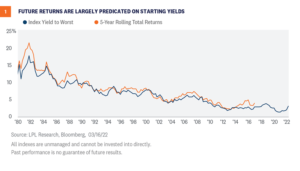
Fixed income instruments, for the most part, are unique in their structures in that, absent defaults, expected returns are largely determined by starting yields. That is, we tend to have a pretty good idea what to expect out of many fixed income instruments over time because coupon and principal payments are known in advance and are contractually obligated. As such, whether you’re invested in an individual bond, an investment that tracks an index like the Bloomberg Aggregate index [Figure 1] or a strategy designed to actively outperform an index, returns are largely predicated on starting yields. And this is true if you hold the fixed income instrument to maturity (for an individual bond) or at least five years (for a portfolio of bonds) regardless of what interest rates do in the interim. An important point about the negative returns we’re seeing this year is that yields are moving higher because of the expectations of higher short-term interest rates and not an increase in credit risk. Fixed income markets repriced, rather quickly, the prospects of accelerated Federal Reserve (Fed) rate hikes this year. Towards the end of 2021, fixed income markets only expected one or two rate hikes this year, but in January and February, markets have priced in seven hikes this year. This quick adjustment in expectations caused yields across the curve to move higher. However, there is a huge distinction between yields moving higher due to the prospects of higher short-term interest rates versus yields moving higher because of higher credit/default risks, which could represent permanent impairments of capital. As shown above, absent defaults, starting yields represent the best expectation for future returns regardless of what interest rates do. That is, if you buy and hold a fixed income investment, the short-term volatility you experience due to changing interest rate expectations is just volatility. It has very little bearing on the actual total return if held to maturity (or if held to the average maturity of a portfolio of bonds). If you consider the historical returns of the Bloomberg Aggregate Bond Index, the overwhelming majority of returns came from coupon income and not price returns (which is generally the opposite of equity investments). For example, over the last five years, the index returned 12.52%, on a cumulative basis, of which price volatility only detracted by -0.75% over the entire five years (and that includes this year as well). Coupon and principal payments are much more important than price volatility.

What goes down, must go up?

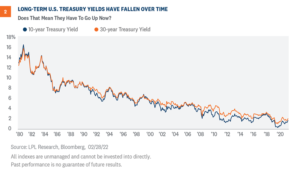
What has been characterized as a bond bull market, bond yields have seemingly only fallen from very lofty levels over the past 40 years [Figure 2]. Long-term yields peaked above 15%, in the early 1980s and have fallen to a little over 2% currently. Because interest rates are seemingly bound by zero in the U.S. (although there remains over $3 trillion in negative yielding debt globally), some investors are wondering if the only way is up for interest rates (which would mean negative bond prices). We remain unconvinced. Moreover, just because a bull market ends, either in equities or bonds, doesn’t automatically mean a new bear market must immediately follow. However, that yields have continued to fall over time are due to a number of structural reasons, which, we think remain in place and should keep U.S. Treasury yields from persistently increasing. These factors include:
  • Demographics- A primary reason for the continued march lower in bond yields, especially over the past 20 years, has been aging global demographics and, more specifically, the need for income. That hasn’t changed. The need for safe, reliable income is as high as it’s ever been and should keep yields from going too much higher.
  • Global Debt dynamics- With over $225 trillion in debt globally (IMF), elevated debt levels limit economic growth potential especially as debt service costs increase. Lower interest rates are actually correlated with lower economic growth.
  • Dis-Inflation- Due to a number of factors, inflation has fallen over the past 40 years. Certainly, the inflationary pressures we’re seeing now should give core fixed income investors pause and remain the wildcard for higher yields. However, with central bankers around the world embarking on rate increases to arrest high consumer prices, we don’t believe we are in a new, higher inflationary regime. Moreover, longer-term market implied inflation expectations remain well within historical ranges, suggesting inflationary pressures should abate over time.
  • Flight to safety- Core bonds and, more specifically, U.S. Treasury securities continue to be the best diversifier to broad-based equity market sell-offs, which tend to happen when the economy slows or there are macroeconomic shocks. When we look at how Treasury securities have performed during periods of equity market selloffs, Treasury security returns have been mostly positive—although not every time. But in every situation, Treasury securities outperformed equities, which means an allocation to Treasury securities would have both improved portfolio returns and reduced portfolio volatility during these periods.
  • Active fixed income management- With trillions invested with active fixed income managers, any move higher in yields, absent an increase in default expectations, presents an investment opportunity. Additionally, because of strong equity market returns over the last few years, private pension funds are well-funded and are actively de-risking portfolios by buying long-term bonds. According to the Organization for Economic Co-operation and Development (OECD), there are $35 trillion in pension fund assets with most of these plans fully funded. This could provide a tailwind to bond prices.

Time to buy the dip?

Firmly ingrained, at least recently, in equity investors has been this buy the dip mentality. However, it may not be as ingrained in retail bond investors although maybe it should be. As noted above, future returns, absent defaults, are largely determined by starting yields, regardless of what the interest rate and inflationary environments look like. And with yields moving higher recently in most fixed income markets, future returns for fixed income investors have improved. We’re seeing increasing investment opportunities in a number of shorter maturity securities (since yields on shorter maturity securities have moved up the most) such as short maturity investment grade corporates and Treasury securities and lower rated corporate credit. Moreover, with yields on the core bond index now back up close to its longer-term average, core fixed income broadly is more attractive.

Conclusion

Core bonds have been a staple in diversified asset allocations. However, with returns as negative as they’ve been this year, investors may be undergoing a rethink of the utility of core bonds. We think that may be a mistake. We still think the value proposition for core bonds remains. Liquidity, equity diversification, and total returns are all valuable properties core bonds bring to diversified portfolios. Moreover, bonds are unique in their structures in that coupon and principal payments are, for the most part, guaranteed and the primary factors of long-term total returns. The price volatility we’ve seen so far this year doesn’t impact those payments. And with yields higher in many markets, now may be a good time to start looking at additional investment opportunities within fixed income. Lawrence Gillum, CFA, Fixed Income Strategist, LPL Financial Ryan Detrick, CMT, Chief Market Strategist, LPL Financial ______________________________________________________________________________________________ IMPORTANT DISCLOSURES This material is for general information only and is not intended to provide specific advice or recommendations for any individual. There is no assurance that the views or strategies discussed are suitable for all investors or will yield positive outcomes. Investing involves risks including possible loss of principal. Any economic forecasts set forth may not develop as predicted and are subject to change. References to markets, asset classes, and sectors are generally regarding the corresponding market index. Indexes are unmanaged statistical composites and cannot be invested into directly. Index performance is not indicative of the performance of any investment and do not reflect fees, expenses, or sales charges. All performance referenced is historical and is no guarantee of future results. Any company names noted herein are for educational purposes only and not an indication of trading intent or a solicitation of their products or services. LPL Financial doesn’t provide research on individual equities. All information is believed to be from reliable sources; however, LPL Financial makes no representation as to its completeness or accuracy. US Treasuries may be considered “safe haven” investments but do carry some degree of risk including interest rate, credit, and market risk. Bonds are subject to market and interest rate risk if sold prior to maturity. Bond values will decline as interest rates rise and bonds are subject to availability and change in price. The Standard & Poor’s 500 Index (S&P500) is a capitalization-weighted index of 500 stocks designed to measure performance of the broad domestic economy through changes in the aggregate market value of 500 stocks representing all major industries. The PE ratio (price-to-earnings ratio) is a measure of the price paid for a share relative to the annual net income or profit earned by the firm per share. It is a financial ratio used for valuation: a higher PE ratio means that investors are paying more for each unit of net income, so the stock is more expensive compared to one with lower PE ratio. Earnings per share (EPS) is the portion of a company’s profit allocated to each outstanding share of common stock. EPS serves as an indicator of a company’s profitability. Earnings per share is generally considered to be the single most important variable in determining a share’s price. It is also a major component used to calculate the price-to-earnings valuation ratio. All index data from FactSet. This research material has been prepared by LPL Financial LLC. Securities and advisory services offered through LPL Financial (LPL), a registered investment advisor and broker-dealer (member FINRA/SIPC). Insurance products are offered through LPL or its licensed affiliates. To the extent you are receiving investment advice from a separately registered independent investment advisor that is not an LPL affiliate, please note LPL makes no representation with respect to such entity. Not Insured by FDIC/NCUA or Any Other Government Agency | Not Bank/Credit Union Guaranteed | Not Bank/Credit Union Deposits or Obligations | May Lose Value RES-1094501-0322 | For Public Use | Tracking # 1-05257812 (Exp. 3/23)

How Soon Are Rate Hikes Coming?

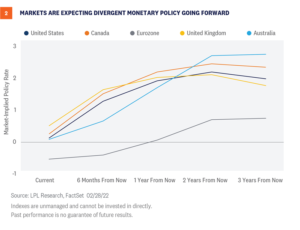
With inflationary pressures running higher than many central bankers are comfortable with, calls for interest rate hikes have become louder. A number of important central bank meetings are set to take place in March including the Federal Reserve, European Central Bank, Bank of Canada, Bank of England, and the Reserve Bank of Australia, to name a few. As such, March could be an important month for monetary policy shifts. The COVID-19 pandemic was an unprecedented shock across the global economy. But the economic damage was met with an extraordinary global monetary response with central banks cutting rates to near zero levels and expanding balance sheets by nearly $10 trillion to provide additional levels of monetary accommodation. Moreover, governments around the world provided fiscal support and, on average, annual spending increased by 7% of gross domestic product (Bloomberg). As economies have recovered and the impact of COVID-19 fades, these extraordinary levels of monetary accommodation are no longer necessary, and thus we’re likely to see the active removal of monetary support. While these extraordinary fiscal and monetary measures certainly helped stave off broader economic weakness, these tailwinds are likely to become marginal headwinds to the global economy in the upcoming years. Additionally, a confluence of events has raised inflationary pressures to the highest in several decades. Direct fiscal stimulus gave discretionary funds to consumers, which instantaneously boosted demand, especially for consumer goods as most people were spending much less on services during the pandemic. The quick rebound in consumer goods spending put stress on the logistics and transportation sectors, crimping supply and thereby creating an upward spiral on prices. Moreover, due to continued price pressures (as defined by each respective country’s Consumer Price Index) that remain above central bank targets, global central banks began wrestling with the conundrum of a fragile economy coupled with rising prices [Figure 1]. With inflationary pressures running higher than most central bankers are comfortable with, calls for interest rate hikes have become louder. A number of important central bank meetings are set to take place in March, including the Federal Reserve (Fed), European Central Bank (ECB), Bank of Canada (BOC), Bank of England (BOE), and the Reserve Bank of Australia (RBA). As such, March could be an important month for monetary policy shifts. And while many central banks have stopped providing forward guidance on an actual plan to raise short-term interest rates, markets have already priced in a number of interest rate hikes over the next 12 months. As seen in [Figure 2], market expectations for rate hikes are broadly expected and include fairly significant rate hiking campaigns for the BOC, BOE, and the Fed over the next year. Markets expect these central banks to increase interest rates five to seven times over the course of a year, which seems fairly aggressive to us. Moreover, markets are expecting somewhat divergent policy rate paths after the second year of rate hikes. Specifically, markets are expecting the U.K. and U.S. to cut interest rates in 2024. Interest rate cuts tend to happen around broad market stresses or while at the precipice of a recession. It should be noted that these market-implied expectations are volatile and expectations can and do change over time. Our view remains that interest rate hikes for the U.S. will likely begin in March with a 25 basis point (0.25%) hike and then three to four more rate hikes at subsequent meetings in 2022. Moreover, we think the Fed will start to reduce its nearly $9 trillion balance sheet in the second half of 2022. There is a risk to the upside (in hikes) depending on the trajectory of inflationary pressures. If consumer price pressures moderate over the course of the year, as we and the Fed expect, then we think the Fed and other central bankers can take a more moderate approach to interest rate hikes. However, if inflationary pressures remain stubbornly high and, importantly, we start to see longer-term inflation expectations become unanchored, central bankers may be forced to move more aggressively than what is already priced in. That said, given the current conflict in the Ukraine, there remains considerable near term uncertainty with central bank intentions. Additionally, upward pressure on commodity prices, already impacted by COVID-19-related supply chain disruptions, may see a more sustained impact as economic sanctions play out and will probably be the main source of risk for possible broader economic repercussions. As such, inflationary pressures may remain high particularly as it relates to gas prices. Finally, and we can’t stress this enough, these views and opinions are secondary to the conflict taking place in Ukraine. While our primary job is to provide investment advice, we certainly recognize that there is an immediate humanitarian crisis taking place in eastern Europe. We hope the conflict ends quickly and offer our thoughts to those impacted.   Lawrence Gillum, CFA, Fixed Income Strategist, LPL Financial Ryan Detrick, CMT, Chief Market Strategist, LPL Financial ______________________________________________________________________________________________ IMPORTANT DISCLOSURES This material is for general information only and is not intended to provide specific advice or recommendations for any individual. There is no assurance that the views or strategies discussed are suitable for all investors or will yield positive outcomes. Investing involves risks including possible loss of principal. Any economic forecasts set forth may not develop as predicted and are subject to change. References to markets, asset classes, and sectors are generally regarding the corresponding market index. Indexes are unmanaged statistical composites and cannot be invested into directly. Index performance is not indicative of the performance of any investment and do not reflect fees, expenses, or sales charges. All performance referenced is historical and is no guarantee of future results. Any company names noted herein are for educational purposes only and not an indication of trading intent or a solicitation of their products or services. LPL Financial doesn’t provide research on individual equities. All information is believed to be from reliable sources; however, LPL Financial makes no representation as to its completeness or accuracy. US Treasuries may be considered “safe haven” investments but do carry some degree of risk including interest rate, credit, and market risk. Bonds are subject to market and interest rate risk if sold prior to maturity. Bond values will decline as interest rates rise and bonds are subject to availability and change in price. The Standard & Poor’s 500 Index (S&P500) is a capitalization-weighted index of 500 stocks designed to measure performance of the broad domestic economy through changes in the aggregate market value of 500 stocks representing all major industries. The PE ratio (price-to-earnings ratio) is a measure of the price paid for a share relative to the annual net income or profit earned by the firm per share. It is a financial ratio used for valuation: a higher PE ratio means that investors are paying more for each unit of net income, so the stock is more expensive compared to one with lower PE ratio. Earnings per share (EPS) is the portion of a company’s profit allocated to each outstanding share of common stock. EPS serves as an indicator of a company’s profitability. Earnings per share is generally considered to be the single most important variable in determining a share’s price. It is also a major component used to calculate the price-to-earnings valuation ratio. All index data from FactSet. This research material has been prepared by LPL Financial LLC. Securities and advisory services offered through LPL Financial (LPL), a registered investment advisor and broker-dealer (member FINRA/SIPC). Insurance products are offered through LPL or its licensed affiliates. To the extent you are receiving investment advice from a separately registered independent investment advisor that is not an LPL affiliate, please note LPL makes no representation with respect to such entity. Not Insured by FDIC/NCUA or Any Other Government Agency | Not Bank/Credit Union Guaranteed | Not Bank/Credit Union Deposits or Obligations | May Lose Value RES-1066650-0222 | For Public Use | Tracking # 1-05248727 (Exp. 2/23)

Which Region Will Get the Gold in 2022

The near-10% correction in the S&P 500 Index and even larger drawdown in the Nasdaq have gotten a lot of attention this year. What hasn’t gotten as much attention—and maybe surprising to some—is the relative resilience in equity markets outside the U.S. In our special Winter Olympics edition of the Weekly Market Commentary, we hand out medals to the U.S., developed international, and emerging markets. Who do we think will get the gold? Read on to find out.

U.S. Has Been Skiing Uphill

It’s been a rough start to the year for U.S. stocks with some stiff headwinds. The path of the S&P 500 in January looked like something Mikaela Shiffrin might ski on given the steepness of the decline with twists and turns. Fears that the Federal Reserve (Fed) might be behind the curve in its inflation battle got most of the blame for the market selloff, while a few high-profile earnings misses—Meta (Facebook) being the latest—have added to investors’ anxiety levels. Meanwhile, the international equity markets have held up relatively well. The S&P 500 Index is down 5.6% year to date, outrun by the 3.8% and 0.9% declines in the MSCI EAFE Index (developed international equities) and the MSCI Emerging Markets (EM) Index. To assess which regional market might come out on top at the end of the 2022 competition, we take a look at global fundamentals, valuations, and technicals.

Economic Growth Likely to be a Close Race

Starting with economic growth outlooks, emerging markets may produce the fastest gross domestic product (GDP) growth in 2022, but it could be a close finish [Figure 1]. China’s zero-COVID-19 policy may delay the restoration of the EM growth premium while we wait for an eventual end to the pandemic. Meanwhile, distressed property developers present a headwind to growth, though monetary stimulus is helping turn the tide some in China in the near term. We expect developed international and U.S. economies to generate similar growth in 2022, though rising forecasts for Japan are encouraging. Europe may also see more benefit from pandemic-related pent-up demand as the region is earlier in its economic cycle than the U.S. And U.S. growth has gotten off to a slow start in the first quarter because of the Omicron variant.

U.S. the Clear Favorite in the Earnings Event

The U.S. comes into 2022 as the earnings favorite. Consensus estimates are calling for a 9% increase in S&P 500 earnings this year, ahead of the 5% and 7% increases expected for developed international markets and EM, respectively. As shown in Figure 2, U.S. earnings estimates have marched steadily higher over the past year, outpacing the increases outside of the U.S. While it’s tempting to think EM will generate better earnings growth because economic growth is better, EM companies have had a difficult time translating economic growth into profits over the past decade (certainly part of the reason why valuations are low in EM, as discussed below). In addition, China’s regulatory crackdown still presents earnings risk even though the headlines have settled down. On the flip side, the recent increase in EM earnings estimates for 2022 is encouraging (2.7% over the past month, compared to 1.5% for the U.S. and 2.3% for developed international). So while we consider EM an earnings underdog in 2022 and consider it more of a show-me story, it’s only a small hit to its medal hopes.

U.S. Skating on Thin Ice When it Comes to Valuations

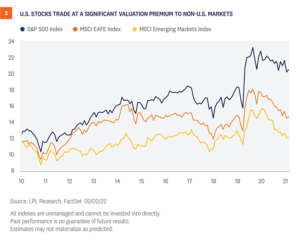
The valuation competition is the clearest cut. Figure 3 shows that U.S. stocks continue to trade at a significant premium to their international and EM counterparts and have for a long time. In fact, developed international stocks, measured by the MSCI EAFE Index, are trading at a 28% discount to the S&P 500 on a forward price-to-earnings (PE) basis. That discount is the largest in at least 30 years, and probably much more if we had data going back farther. Emerging market stock valuations are not in uncharted territory like developed international, but at a 40% discount to the S&P 500’s forward PE, a 20-year low, EM is clearly attractively valued. If we knew the earnings would come through this year, EM would warrant consideration for the gold medal in the valuation competition, but we’ll give it to developed international given the unprecedented discount and greater earnings predictability.

Technicals Still Favor the U.S., For Now

When we compare the charts of developed international and emerging markets to the U.S., the trend still favors a home-country bias. Relative to the S&P 500, both the MSCI EAFE and MSCI EM indexes remain below downward sloping 200-day moving averages, a simple but effective measure of a downtrend. That said, we’re open to the idea of that trend changing at some point in 2022. Both regions have outperformed the U.S. year to date, but for unique reasons. Developed international markets such as Europe and Japan, which are more value-oriented markets, have benefited from having fewer high-flying tech stocks, while some segments of the Chinese technology sector have finally begun to show signs of stabilization after falling more than 50% last year. One potential tailwind that could benefit international equities this year is the U.S. dollar. After surprising many investors and rising throughout 2021, the U.S. dollar began to show signs of topping in December. Last week the U.S. Dollar Index suffered its worst week since 2020, and a continued reversal lower should benefit holders of international equities.

Conclusion

Developed international and emerging markets have been making some pretty good runs lately. Many investors expected little out of them coming into this year following a series of slips and falls over the past decade. These markets are more attractively valued, may get a boost if the U.S. dollar weakens, and have seen earnings estimates rise recently, all of which introduce the possibility of a durable shift in global leadership. But the U.S. is the defending champion. The home team is still in a good position for a silver for economic growth, remains the gold medal favorite in the earnings competition, and possesses a better performance trend than developed international or EM despite the slow start to this year. Our technical analysis work puts the U.S. at least in the hunt for a gold. The S&P 500’s scores have not kept up with these other markets so far in 2022, but the opening ceremony just happened. We continue to believe U.S. equities could outperform their international and EM counterparts this year, though likely in a much closer race than we saw in 2021. We put the U.S. as the gold medal favorite, with developed international and EM slightly behind battling it out for silver. Tune in, this should be an entertaining race. Jeff Buchbinder, CFA, Equity Strategist, LPL Financial Ryan Detrick, CMT, Chief Market Strategist, LPL Financial Scott Brown, CMT, Technical Market Strategist, LPL Financial ______________________________________________________________________________________________ IMPORTANT DISCLOSURES This material is for general information only and is not intended to provide specific advice or recommendations for any individual. There is no assurance that the views or strategies discussed are suitable for all investors or will yield positive outcomes. Investing involves risks including possible loss of principal. Any economic forecasts set forth may not develop as predicted and are subject to change. References to markets, asset classes, and sectors are generally regarding the corresponding market index. Indexes are unmanaged statistical composites and cannot be invested into directly. Index performance is not indicative of the performance of any investment and does not reflect fees, expenses, or sales charges. All performance referenced is historical and is no guarantee of future results. Any company names noted herein are for educational purposes only and not an indication of trading intent or a solicitation of their products or services. LPL Financial doesn’t provide research on individual equities. All information is believed to be from reliable sources; however, LPL Financial makes no representation as to its completeness or accuracy. Investing in foreign and emerging markets securities involves special additional risks. These risks include, but are not limited to, currency risk, geopolitical risk, and risk associated with varying accounting standards. Investing in emerging markets may accentuate these risks. The Standard & Poor’s 500 Index (S&P500) is a capitalization-weighted index of 500 stocks designed to measure performance of the broad domestic economy through changes in the aggregate market value of 500 stocks representing all major industries. The PE ratio (price-to-earnings ratio) is a measure of the price paid for a share relative to the annual net income or profit earned by the firm per share. It is a financial ratio used for valuation: a higher PE ratio means that investors are paying more for each unit of net income, so the stock is more expensive compared to one with lower PE ratio. Forward Price To Earnings is a measure of the price-to-earnings ratio (P/E) using forecasted earnings for the P/E calculation. While the earnings used are just an estimate and are not as reliable as current earnings data, there is still benefit in estimated P/E analysis. The forecasted earnings used in the formula can either be for the next 12 months or for the next full-year fiscal period. Earnings per share (EPS) is the portion of a company’s profit allocated to each outstanding share of common stock. EPS serves as an indicator of a company’s profitability. Earnings per share is generally considered to be the single most important variable in determining a share’s price. It is also a major component used to calculate the price-to-earnings valuation ratio. All index data from FactSet. The MSCI EAFE Index is made up of approximately 1,045 equity securities issued by companies located in 19 countries and listed on the stock exchanges of Europe, Australia, and the Far East. All values are expressed in U.S. dollars. The MSCI Emerging Markets Index is a free float-adjusted market capitalization index that is designed to measure equity market performance of emerging markets. The MSCI Emerging Markets Index consists of the following 21 emerging market country indices: Brazil, Chile, China, Colombia, Czech Republic, Egypt, Hungary, India, Indonesia, Korea, Malaysia, Mexico, Morocco, Peru, Philippines, Poland, Russia, South Africa, Taiwan, Thailand, and Turkey. US Dollar Index - A measure of the value of the U.S. dollar relative to majority of its most significant trading partners. This index is similar to other trade-weighted indexes, which also use the exchange rates from the same major currencies. This research material has been prepared by LPL Financial LLC. Securities and advisory services offered through LPL Financial (LPL), a registered investment advisor and broker-dealer (member FINRA/SIPC). Insurance products are offered through LPL or its licensed affiliates. To the extent you are receiving investment advice from a separately registered independent investment advisor that is not an LPL affiliate, please note LPL makes no representation with respect to such entity. Not Insured by FDIC/NCUA or Any Other Government Agency | Not Bank/Credit Union Guaranteed | Not Bank/Credit Union Deposits or Obligations | May Lose Value RES-1033234-0222 | For Public Use | Tracking # 1-05240886 (Exp. 2/23)

Headwinds to Global Growth: An Economy of Two Halves

LPL Research reduced U.S. and global GDP forecasts due to Russian commodity disruptions, elevated inflation dynamics, and higher borrowing costs. Still, we expect the U.S. economy to grow 2.7-3.2% in 2022, supported by business investment and consumer services spending in the latter half of this year. Forecasts for GDP growth in developed economies excluding the U.S. and emerging markets were also reduced this month to 2.5–3% and 3.8–4.3% respectively, bringing the LPL Research global GDP growth forecast down about one percentage point to 3–3.5%.

Tale of Two Halves

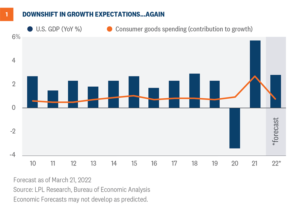
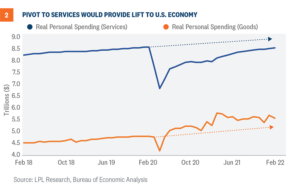
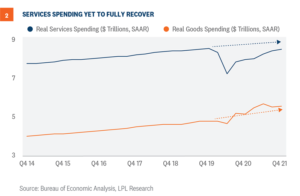
This year, many aspects of the economy will likely be told as tales of two halves. Economic growth during the first half of this year will likely be different than the second half. Moreover, inflation pressures affect the lower half of the consumer base differently than the upper half. As the country adjusts to pandemic reshuffling and rising mortgage rates, we will likely observe greater regional and demographic divergence within the housing market. Overall, the first half of this year will likely drag on 2022 U.S. economic growth while the second half of the year could rebound if global conditions improve. We started this year with a variant strain of COVID-19, and consumers and businesses alike pulled back spending. Before the economy could recover, geopolitical tensions snapped from Russia’s decision to invade Ukraine. Commodity prices rose to record levels, some markets temporarily closed, and fixed income markets responded to a new paradigm. Globally-coordinated sanctions will impact markets for as long as Russia’s war remains. Because of geopolitical conflict and persistent inflation pressures, we revised our U.S. GDP forecast again in March after a downward revision in February. We now expect the U.S. to grow 2.7–3.2% in 2022, as noted in our latest Global Portfolio Strategy report. Last year, as the economy rebounded from the lockdowns, consumers concentrated spending on goods versus services, which translated into an outsized contribution to growth [Figure 1]. As consumers pivot to services spending, the 2022 growth estimate will have support from a rebound in services spending in addition to strong business investment. Consumers likely have pent up demand for services foregone since March 2020. If spending patterns revert to trends, the economy will have $500 billion added to the consumer services component of GDP [Figure 2]. The forecast is also predicated on wage growth from a tight labor market and households flush with cash.

Consumer Confidence Implies Weakness, Not Necessarily Recession

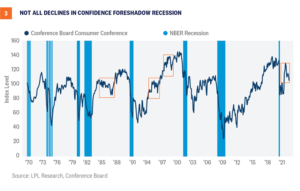
Recent consumer surveys point to weakness for the first half of this year but a rebound in the second half is still possible. Both Conference Board and University of Michigan surveys reveal a burden on consumers, particularly from pricing pressures. Surprisingly, buying plans within the next six months for big-ticket items such as cars and houses are at or above trend. The headline Consumer Confidence Index is lower than recent months, but a decline in consumer confidence does not always foreshadow an imminent recession [Figure 3]. The Index fell in the mid-1980s and throughout the 1990s, and recessions did not immediately follow. On the contrary, during the late 1980s, consumer confidence steadily rose after the low point in January 1987. Even though recession risks are rising, the LPL Research base case scenario is no recession in the U.S. this year, assuming the Federal Reserve (Fed) does not overtighten and supply constraints ease, to list just a few risks to growth. The weak survey in January and February is consistent with the overall narrative that first quarter GDP growth will be very low, but if inflation pressures subside and the labor market remains solid, GDP growth should recover in the latter half of the year.

Higher Expected Treasury Yields

Core bonds (as measured by the Bloomberg Aggregate index) have had the worst start to the year since the 1980s due to a significant repricing of Fed rate hike expectations. At the end of September 2021, markets were expecting only one 25 basis point (0.25%) rate hike this year, but markets are now expecting the Fed to hike short-term interest rates by 250 basis points (2.50%). This has caused U.S. Treasury yields, across the curve, to move meaningfully higher this year. At 2.60% (as of 4/07/22), the 10-year Treasury yield has already increased by over 1.1% this year and by over 2% from the August 2020 low of 0.50%. As markets are forward-looking, this move higher in yields due to expected interest rate hikes is consistent with past rate hiking campaigns and suggest we may be near the peak in yields for this cycle. In each of the last three Fed rate hiking campaigns for example, the 10-year Treasury yield moved more ahead of the hikes than during the hikes. The fed funds rate was raised by 175 basis points, 425 basis points, and 225 basis points each of last three cycles while the 10-year Treasury yield moved higher by just 62 basis points, 60 basis points, and 47 basis points, respectively. So that said, as inflationary pressures have broadened this year, and with the Fed likely forced to tighten monetary policy quicker than we originally expected, we now expect the 10-year Treasury yield to end the year between 2.25% and 2.50% with risks to the upside. As this is a yearend target, there is a high likelihood that yields could get as high as 2.75%-3.00% in the near term, depending on the path of inflation over the summer months. If inflationary pressures remain stubbornly high, forcing the Fed to follow through with rate hike expectations, yields could continue to climb marginally higher, which is consistent with history. However, if inflationary pressures fade over the course of the year, potentially resulting in a less aggressive rate hiking campaign, it’s likely that yields could move back down to around current levels, which is our expectation. An additional consideration, though, is if the Fed is forced to hike rates more aggressively than markets are expecting, there is a possibility that recessionary risks are pulled forward into 2023, which could cause interest rates to move lower than current levels. Given the three potential scenarios, we think the biggest move higher in yields has likely already happened but we do think elevated levels of volatility are likely to remain.

Conclusion

Due to a confluence of factors, we expect slower economic growth in the U.S. and globally. Fully functioning supply chains, restored relationships in Eastern Europe, and improving inflation metrics are all key factors for our baseline forecast. Growth in the latter half of the year will likely come from business fixed investment and consumer services spending as both commodity markets and fixed income markets settle into the post-pandemic central bank tightening cycle.     Jeffrey Roach, PhD, Chief Economist, LPL Financial Lawrence Gillum, CFA, Fixed Income Strategist, LPL Financial ______________________________________________________________________________________________ IMPORTANT DISCLOSURES This material is for general information only and is not intended to provide specific advice or recommendations for any individual. There is no assurance that the views or strategies discussed are suitable for all investors or will yield positive outcomes. Investing involves risks including possible loss of principal. Any economic forecasts set forth may not develop as predicted and are subject to change. References to markets, asset classes, and sectors are generally regarding the corresponding market index. Indexes are unmanaged statistical composites and cannot be invested into directly. Index performance is not indicative of the performance of any investment and does not reflect fees, expenses, or sales charges. All performance referenced is historical and is no guarantee of future results. Any company names noted herein are for educational purposes only and not an indication of trading intent or a solicitation of their products or services. LPL Financial doesn’t provide research on individual equities. All information is believed to be from reliable sources; however, LPL Financial makes no representation as to its completeness or accuracy. U.S. Treasuries may be considered “safe haven” investments but do carry some degree of risk including interest rate, credit, and market risk. Bonds are subject to market and interest rate risk if sold prior to maturity. Bond values will decline as interest rates rise and bonds are subject to availability and change in price. The Standard & Poor’s 500 Index (S&P500) is a capitalization-weighted index of 500 stocks designed to measure performance of the broad domestic economy through changes in the aggregate market value of 500 stocks representing all major industries. The PE ratio (price-to-earnings ratio) is a measure of the price paid for a share relative to the annual net income or profit earned by the firm per share. It is a financial ratio used for valuation: a higher PE ratio means that investors are paying more for each unit of net income, so the stock is more expensive compared to one with lower PE ratio. Earnings per share (EPS) is the portion of a company’s profit allocated to each outstanding share of common stock. EPS serves as an indicator of a company’s profitability. Earnings per share is generally considered to be the single most important variable in determining a share’s price. It is also a major component used to calculate the price-to-earnings valuation ratio. All index data from FactSet. This research material has been prepared by LPL Financial LLC. Securities and advisory services offered through LPL Financial (LPL), a registered investment advisor and broker-dealer (member FINRA/SIPC). Insurance products are offered through LPL or its licensed affiliates. To the extent you are receiving investment advice from a separately registered independent investment advisor that is not an LPL affiliate, please note LPL makes no representation with respect to such entity. Not Insured by FDIC/NCUA or Any Other Government Agency | Not Bank/Credit Union Guaranteed | Not Bank/Credit Union Deposits or Obligations | May Lose Value RES-1120754-0422 | For Public Use | Tracking # 1-05266415 (Exp. 4/23)

Ready, Set, Rate Hike

The Federal Reserve (Fed) meets this week and in all likelihood will raise short-term interest rates for the first time since emergency levels of monetary accommodation were provided to markets after the COVID-19 shutdowns. Inflationary pressures are running higher than the central bankers are comfortable with, but the conflict in Eastern Europe adds to the uncertain path of policy normalization. Prospects of yield curve inversion make the Fed’s job trickier.

Interest Rate Hikes Are (Likely) Coming

The Federal Reserve is widely expected to increase short-term interest rates this week for the first time since emergency levels of monetary support were enacted in the aftermath of the COVID-19 shutdowns. With its asset purchase programs fully winding down last week (the Fed was buying $120 billion a month of U.S. Treasury and mortgage securities), the Fed has signaled that it is ready to take the next step towards policy normalization and is set to start a series of interest rate hikes over the coming years. How many rate hikes and how quickly the Fed gets back to a neutral policy rate—the interest rate that neither stimulates nor restrains economic growth—is still uncertain. As seen in Figure 1, markets expect the Fed to raise interest rates at least six times this year, which would bring the policy rate to between 1.50% and 1.75%. It should be noted that these market-implied expectations are volatile and expectations can and do change over time. Our view remains that Fed interest rate hikes will likely begin this week with a 25 basis point (0.25%) increase and then three to four more rate hikes at subsequent meetings in 2022. Moreover, we think the Fed will start to reduce its nearly $9 trillion balance sheet in the second half of 2022. There is a risk to the upside (in hikes) depending on the trajectory of inflationary pressures. If consumer price pressures moderate over the course of the year as we and the Fed expect, then we think the Fed can take a more gradual approach to interest rate hikes. However, if inflationary pressures remain stubbornly high and we start to see longer-term inflation expectations become unanchored (more on this below), the Fed may be forced to move more aggressively than what is even already priced in. The Committee will also release individual meeting participants’ projections for real gross domestic product (GDP) growth, the unemployment rate, and inflation for the next several years, as well as its longer-term forecasts. It’s largely expected that the Fed will confirm that we are near/at full employment and that the strong labor market can handle a series of interest rate hikes. The Fed will also likely adjust its forecast for GDP growth down (from December’s forecast of 4.0% GDP growth in 2022) and its forecasts for inflation up (with PCE headline and core metrics, their preferred inflation measures, at 2.6% and 2.7% back in December). However, the Committee will likely maintain its stance that inflation will fall back to its longer-term trend in 2023.

Has The Fed Lost Control Of The Inflation Narrative?

Inflation expectations are informative about how the current inflation experience has shaped the public’s views regarding future inflation. And the Fed pays close attention to how these expectations change over time. De-anchored inflation expectations tend to make further inflationary pressures self-fulfilling. So, it’s notable that the Fed’s January Survey of Consumer Expectations (the most recent one available) showed a decrease in short and medium-term inflation expectations. While still elevated, falling consumer expectations about future consumer price increases is encouraging. Moreover, longer-term market-implied inflation expectations are in line with historical averages. It seems that, despite the elevated inflation readings we’ve seen over the past few months, markets and consumers still expect price pressures to abate, which could allow the Fed to take a more moderate approach to interest rate hikes.

Geopolitics Add Uncertainty To Policy Normalization

Complicating the expected path of policy normalization, however, is the ongoing conflict in Ukraine. As sanctions and boycotts continue against Russia, which is the world’s third largest oil producer, we may see continued upward pressure on commodity prices, on top of the inflation effects already in place from COVID-19-related supply chain disruptions. Additionally, Ukraine and Russia together account for more than a quarter of global trade of wheat. The conflict has closed major ports in Ukraine and severed logistics and transport links. As such, the negative impact to global trade, both energy and ex-energy, are likely to weigh on the prospects for global economic growth, at least in the near term. This heightened uncertainty and potential shock to financial and economic growth trajectories further complicate the Fed’s ability to aggressively raise short-term interest rates. That said, while we think the Fed will be less hawkish than it otherwise would be due to the ongoing conflict in Eastern Europe, price stability is one of its primary mandates. So, as long as inflation pressures remain above the Fed’s inflation target, we think the Fed will continue along the path of policy normalization.

Will Fed Rate Hikes invert the Yield Curve?

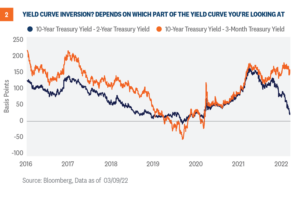
One of the big risks associated with Fed rate hikes, though, is when the Fed funds rate is pushed higher than longer-term Treasury yields. In this instance, the yield curve becomes inverted, which means shorter maturity securities out-yield longer maturity securities. Generally, the opposite is true and the yield curve is upward sloping. The slope of the yield curve is an important economic gauge, as an inverted yield curve has presaged every recession since the 1970s (though not all inverted yield curves have been followed shortly by recessions). The Fed’s ability to substantially raise interest rates before yield curve inversion has been trending lower over the last few decades. Because the 10-year Treasury yield has been in a secular decline since the mid-80s, the Fed’s ability to raise short-term has been constrained. That said, we’re likely to hear more in the coming months about yield curve inversion and, thus, increased recessionary risks. And while it’s true that the Fed has never started a rate hiking campaign when the yield curve has been this flat (as seen in Figure 2 as measured by the difference in yields between 10-year and 2-year U.S. Treasury), the more important tenors on the yield curve, at least in terms of presaging recessions, are the three-month and 10-year yields, which are still far from inversion. As such, we believe the Fed has room to raise interest rates before true inversion takes place.

Help Wanted?

As if the Fed’s job wasn’t challenging enough in the current environment, it will be meeting this week with candidates for three vacant Governor seats. Congress has yet to confirm the five Fed nominations, including Chair Pro Tempore Jerome Powell and Vice Chair Lael Brainard. Powell and Brainard will still be able to vote (while their respective terms have ended, they are able to stay on the Board until the positions are replaced) and the exclusion of three regular voting members shouldn’t be disruptive. Nonetheless, three fewer voters (and thus fewer opinions on the Committee) likely couldn’t come at a worse time as the Fed is dealing with stubbornly elevated consumer price pressures.

Conclusion

The job of a central banker is never an easy one but given all the uncertainty in the world, their jobs have become much more challenging. The situation in Eastern Europe is certainly adding to the uncertain inflation dynamics and global growth prospects, but one of the main mandates of the Federal Reserve is also price stability. As such, we think the Fed is going to have to scale back monetary accommodation to try and arrest stubbornly high price pressures. We expect the Fed will kick off a series of interest rate hikes this week with a 25 basis point increase in the fed funds rate. But the path of policy normalization will be “data dependent” and much more measured than the pace of inflation would suggest.     Lawrence Gillum, CFA, Fixed Income Strategist, LPL Financial Ryan Detrick, CMT, Chief Market Strategist, LPL Financial ______________________________________________________________________________________________ IMPORTANT DISCLOSURES This material is for general information only and is not intended to provide specific advice or recommendations for any individual. There is no assurance that the views or strategies discussed are suitable for all investors or will yield positive outcomes. Investing involves risks including possible loss of principal. Any economic forecasts set forth may not develop as predicted and are subject to change. References to markets, asset classes, and sectors are generally regarding the corresponding market index. Indexes are unmanaged statistical composites and cannot be invested into directly. Index performance is not indicative of the performance of any investment and do not reflect fees, expenses, or sales charges. All performance referenced is historical and is no guarantee of future results. Any company names noted herein are for educational purposes only and not an indication of trading intent or a solicitation of their products or services. LPL Financial doesn’t provide research on individual equities. All information is believed to be from reliable sources; however, LPL Financial makes no representation as to its completeness or accuracy. US Treasuries may be considered “safe haven” investments but do carry some degree of risk including interest rate, credit, and market risk. Bonds are subject to market and interest rate risk if sold prior to maturity. Bond values will decline as interest rates rise and bonds are subject to availability and change in price. The Standard & Poor’s 500 Index (S&P500) is a capitalization-weighted index of 500 stocks designed to measure performance of the broad domestic economy through changes in the aggregate market value of 500 stocks representing all major industries. The PE ratio (price-to-earnings ratio) is a measure of the price paid for a share relative to the annual net income or profit earned by the firm per share. It is a financial ratio used for valuation: a higher PE ratio means that investors are paying more for each unit of net income, so the stock is more expensive compared to one with lower PE ratio. Earnings per share (EPS) is the portion of a company’s profit allocated to each outstanding share of common stock. EPS serves as an indicator of a company’s profitability. Earnings per share is generally considered to be the single most important variable in determining a share’s price. It is also a major component used to calculate the price-to-earnings valuation ratio. All index data from FactSet. This research material has been prepared by LPL Financial LLC. Securities and advisory services offered through LPL Financial (LPL), a registered investment advisor and broker-dealer (member FINRA/SIPC). Insurance products are offered through LPL or its licensed affiliates. To the extent you are receiving investment advice from a separately registered independent investment advisor that is not an LPL affiliate, please note LPL makes no representation with respect to such entity. Not Insured by FDIC/NCUA or Any Other Government Agency | Not Bank/Credit Union Guaranteed | Not Bank/Credit Union Deposits or Obligations | May Lose Value RES-1086450-0322 | For Public Use | Tracking # 1-05255242 (Exp. 3/23)

Strong Earnings Momentum to Start 2022

Corporate America has capped off an outstanding 2021 with an excellent fourth quarter earnings season so far. Entering 2021, the consensus estimate for S&P 500 Index earnings per share (EPS) was less than $170. Now with fourth quarter results mostly in the books, that number is 22% higher at $208. Here we recap another solid fourth quarter earnings season and discuss what the results could mean for earnings growth and stock market performance in 2022.

Delayed Investor Shift From Macro to Micro

In our earnings preview on January 10, we noted that we welcomed a shift from the macro to the micro. Well, given the path of inflation, the resulting dramatic shift in Federal Reserve (Fed) rate hike expectations, and the escalating Russia-Ukraine conflict, that shift hasn’t really happened. However, when we turn our attention away from macro headlines to corporate America, we find that companies have again showcased their ability to effectively manage through the pandemic’s challenges, notably supply chain disruptions and labor and materials shortages that have pushed costs higher.

Great Numbers

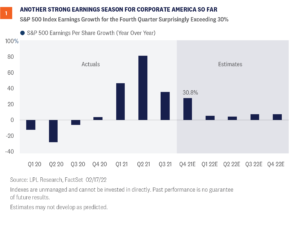
The numbers this earnings season have been great even without considering that the bar has been raised consistently throughout the pandemic. S&P 500 earnings per share are tracking to a 31% year-over-year increase, shown in [Figure 1], roughly 10 percentage points above the consensus estimate when earnings season began. That upside will likely fall a bit short of the 12 points of upside in the third quarter, but considering the long-term average upside is about five percentage points, and the fourth quarter was wrought with pandemic-related challenges, we’re quite impressed. In fact, in our earnings preview last month, we wrote, “Earnings growth approaching 30%, though slower than the third quarter’s near-40% clip, would be impressive given the challenging operating environment.”

How Have They Done It?

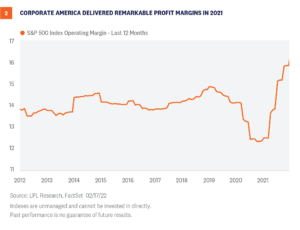
Though about 75 S&P 500 companies have yet to report, companies have generally beaten estimates soundly again with a combination of surprising revenue strength and resilient profit margins. Fourth quarter 2021 revenue came in about three percentage points above consensus estimates at more than 15.5%, bolstered by the strong economic growth in the quarter (6.9% real gross domestic product growth annualized), fueled by inventory restocking, as well as price increases. That 15.5% revenue growth is higher than any quarter during the previous economic expansion (2009-2020), but was bested by the second and third quarters of 2021 that saw growth inflated by base effects coming off 2020 lockdowns. This solid revenue upside, which is about twice the long-term average “beat”, came despite supply chain disruptions limiting what companies had available on the shelves to sell, labor shortages that cost companies sales they otherwise would have booked, and the COVID-19 Omicron wave in late November through December that constrained economic activity. The other part of the earnings story is the impressive profit margins. Due to rising costs of labor, materials, energy, and transportation, we had anticipated some meaningful profit margin compression in the quarter. It looks like we’ll end up with a slight downtick in margins quarter over quarter when all the results are in, but it won’t be as big of a drop as we had feared. That slight potential dip from the third quarter to the fourth doesn’t take away from the fact that margins last year were tremendous [Figure 2]. Companies are enjoying pricing power, which is helping them pass along higher costs, notably wages, and largely preserve those high margins that are well above pre-pandemic levels.

Carrying Earnings Momentum Into 2022

We remain concerned about higher wages and other inflation pressures crimping margins in 2022. Supply chain challenges will likely linger through the first half of the year based on commentary from a number of companies in recent weeks. Still, the impressive profitability displayed in the fourth quarter puts corporate America in a strong position to potentially deliver higher earnings in 2022 than we previously anticipated. On the revenue side, remember higher prices translate into more sales, as long as demand remains strong enough to pay those higher prices. Pricing power helped companies in the fourth quarter and should continue to help in 2022. If the U.S. economy grows near our 4% forecast in real terms this year, adjusted for inflation, and consumer inflation adds another five points (consensus forecast of economists according to Bloomberg), then we believe 9% revenue growth from S&P 500 companies is a reasonable expectation. For perspective, the best revenue growth years since the 2008-2009 financial crisis were 2011 (+12.5%) and 2021 (+16.9%). That means our 6-7% earnings growth forecast for 2022 could be attainable even with modest margin compression (with some help from share repurchases reducing the denominator in the earnings-per-share calculation). For now, we’ll maintain our forecast of $220 in S&P 500 EPS in 2022, but that number could be too low based on the earnings momentum evident this earnings season. The consensus estimate for 2022 S&P 500 EPS rose 0.5% during earnings season, much better than the average 2-3% reduction observed historically.

Macro Backdrop Still Supports 5,000 on the S&P 500 at Year End

Stocks have gotten off to a rough start this year. The adjustments to higher inflation and more Fed rate hikes have been difficult, while the Russia-Ukraine situation has added to market anxiety and volatility. While it may take more time for the market to shift its focus toward solid company fundamentals and get more comfortable with the inflation outlook, we expect stocks to recover early-year losses and rally back to new highs through year-end as that transition takes place. Mid-cycle years such as 2022 tend to see double-digit gains for stocks, even more optimistic than the high-single-digit gain we forecasted in our Outlook 2022: Passing the Baton. History shows that stocks tend to do well during the year after initial Fed rate hikes and that volatility related to geopolitical events has frequently been short-lived. The additional reopening of the economy that lies ahead makes solid growth in the U.S. economy and corporate profits, in our opinion, more likely this year and should help ease inflation pressures, solidifying a favorable backdrop for attractive stock market returns in 2022. The recent move higher in interest rates doesn’t change the calculus much for us in terms of stocks versus bonds. We continue to recommend an overweight allocation to equities and an underweight fixed income allocation relative to investors’ targets, as appropriate.   Jeff Buchbinder, CFA, Chief Equity Strategist, LPL Financial Ryan Detrick, CMT, Chief Market Strategist, LPL Financial ______________________________________________________________________________________________ IMPORTANT DISCLOSURES This material is for general information only and is not intended to provide specific advice or recommendations for any individual. There is no assurance that the views or strategies discussed are suitable for all investors or will yield positive outcomes. Investing involves risks including possible loss of principal. Any economic forecasts set forth may not develop as predicted and are subject to change. References to markets, asset classes, and sectors are generally regarding the corresponding market index. Indexes are unmanaged statistical composites and cannot be invested into directly. Index performance is not indicative of the performance of any investment and does not reflect fees, expenses, or sales charges. All performance referenced is historical and is no guarantee of future results. Any company names noted herein are for educational purposes only and not an indication of trading intent or a solicitation of their products or services. LPL Financial doesn’t provide research on individual equities. All information is believed to be from reliable sources; however, LPL Financial makes no representation as to its completeness or accuracy. U.S. Treasuries may be considered “safe haven” investments but do carry some degree of risk including interest rate, credit, and market risk. Bonds are subject to market and interest rate risk if sold prior to maturity. Bond values will decline as interest rates rise and bonds are subject to availability and change in price. The Standard & Poor’s 500 Index (S&P500) is a capitalization-weighted index of 500 stocks designed to measure performance of the broad domestic economy through changes in the aggregate market value of 500 stocks representing all major industries. The PE ratio (price-to-earnings ratio) is a measure of the price paid for a share relative to the annual net income or profit earned by the firm per share. It is a financial ratio used for valuation: a higher PE ratio means that investors are paying more for each unit of net income, so the stock is more expensive compared to one with lower PE ratio. Earnings per share (EPS) is the portion of a company’s profit allocated to each outstanding share of common stock. EPS serves as an indicator of a company’s profitability. Earnings per share is generally considered to be the single most important variable in determining a share’s price. It is also a major component used to calculate the price-to-earnings valuation ratio. All index data from FactSet. This research material has been prepared by LPL Financial LLC. Securities and advisory services offered through LPL Financial (LPL), a registered investment advisor and broker-dealer (member FINRA/SIPC). Insurance products are offered through LPL or its licensed affiliates. To the extent you are receiving investment advice from a separately registered independent investment advisor that is not an LPL affiliate, please note LPL makes no representation with respect to such entity. Not Insured by FDIC/NCUA or Any Other Government Agency | Not Bank/Credit Union Guaranteed | Not Bank/Credit Union Deposits or Obligations | May Lose Value RES-1056300-0222 | For Public Use | Tracking # 1-05246331 (Exp. 2/23)

LPL Research’s Stock Market Final Four

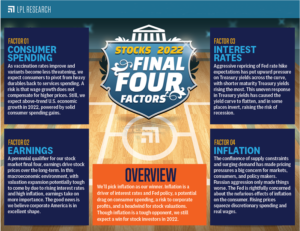
As the Final Four NCAA Basketball Tournament rolls on in New Orleans, we continue our tradition of picking a stock market final four. We have identified our four key factors for the stock market outlook: 1) Consumer spending, 2) Earnings, 3) Interest rates, and 4) Inflation. We also celebrate last year’s winner: COVID-19 vaccines. Below we discuss these four factors, how they may influence markets this year, and pick our winner. Good luck to Kansas and North Carolina in tonight’s final.

Factor #1: Consumer Spending

Consumer spending dynamics will likely play a key role for investors this year. Going into 2022, consumers were focusing on satiating their appetite for durable goods. Given pandemic-related precautions, consumers focused on e-commerce opportunities to order up large-ticket items such as furniture and recreational equipment and small items such as food and daily personal toiletries. As vaccination rates improve (see last year’s Final Four commentary) and variants become less threatening, we expect consumers to pivot from heavy durables back to services spending. In developed economies, services make up an outsized portion of total consumer spending. Even though some services spending has recovered since the onset of the pandemic, we have much more to go. A risk is that wage growth does not compensate for higher prices, but consumer finances are in good shape overall, with household checkable deposits the highest since the Federal Reserve Board started recording the data. We continue to expect above-trend U.S. economic growth in 2022, powered by solid consumer spending gains.

Factor #2: Earnings

A perennial qualifier for our stock market final four, over the long-term, earnings drive stock prices. In this environment, with valuation expansion potentially tough to come by due to rising interest rates and high inflation, earnings take on more importance. The good news is we believe Corporate America is in excellent shape—earnings estimates are higher in 2022 now than they were at the start of the year, which is no small feat. And high inflation has brought pricing power to many companies along with more revenue for commodity producers. This is evident in the double-digit revenue growth S&P 500 companies are expected to produce in first quarter 2022 earnings season (source: FactSet). Despite margin pressures related to supply chain disruptions and intense inflation pressures, we believe S&P 500 companies may deliver as much as 10% earnings per share (EPS) growth in the first quarter, compared to the current consensus estimate of about 5%. For 2022, we believe S&P 500 earnings are on track to potentially grow mid-to-high single digits. The roughly 2% year-to-date increase in the consensus S&P 500 EPS estimate for 2022 is an encouraging sign.

Factor #3: Interest Rates (and the federal reserve)

U.S. Treasury yields have moved meaningfully higher this year due to the increase in Federal Reserve (Fed) interest rate hike expectations. To start the year, bond markets were expecting two or three rate hikes in 2022, but due to broadening inflationary pressures, markets now expect the Fed to hike interest rates eight more times and bring the fed funds rate to nearly 2.5% by yearend. If the Fed does meet market expectations, it would be the most aggressive start to a rate hiking campaign since 1993/94. This aggressive repricing, however, has put upward pressure on Treasury yields across the curve, with shorter maturity Treasury yields rising the most. This uneven response in Treasury yields has caused the yield curve to flatten and, in some places, invert (yields on shorter maturity securities exceeding longer maturity yields). Yield curve inversion is often looked at as a reliable predictor of recessions. However, the more important maturities on the yield curve, at least in terms of presaging recessions, are the three-month and 10-year yields, which are still far from inversion. Rates are important not only because of their usefulness as an economic signal and as a driver of bond returns, but also because of their influence on stock valuations, as we wrote about here last week.

Factor #4: Inflation

The favorite heading into our tournament, inflation impacts will be top of mind throughout the year. The confluence of supply constraints and surging demand has made pricing pressures a big concern for markets, consumers, and policy makers. Russian aggression only made things worse as commodity markets tightened amid global sanctions against one of the largest exporters of natural gas, wheat, and precious metals. The tight labor market could play a factor in the persistence of inflation, as wages will likely rise as firms try to attract available workers off the sidelines. One corresponding risk in this historic environment is a potentially overly aggressive Fed. There are silver linings. For some, this year may hold a unique place in their life as some lucky car owners have sold their used car for more than they paid. Who has ever heard of a vehicle as an appreciated asset? Inflation and low interest rates have also been a boon to borrowers, with the real value of loans falling due to inflation while interest rates remain historically low. (And it’s not lost on us that the biggest borrower of all, the U.S. government, may be the biggest beneficiary.) Firms with pricing power can cope with rising input costs by passing on the cost to consumers without material impact on market share. The Fed is rightfully concerned about the nefarious effects of inflation on the consumer. Rising prices put a squeeze on discretionary spending and real wages. We are hopeful, but not optimistic, that the Fed’s forecast of 4.1% inflation at yearend will be reached.

Conclusion

This year’s winner wasn’t as easy to call as last year, when the vaccines won in a rout. We’re picking inflation as our winner because it’s tied so closely to the other key factors. Inflation is a driver of interest rates and Fed policy, a potential drag on consumer spending, a risk to corporate profits, and a headwind for stock valuations. Inflation is also difficult to predict due to the geopolitical uncertainty in Europe and the complexity of ongoing COVID-19 effects on supply chains and labor participation. When we put all of these factors together, our expectation that inflation pressures will soon start to abate, reducing the likelihood of an overly aggressive Fed, leads us to maintain our positive stock market view. We continue to recommend a modest overweight allocation to equities and an underweight to fixed income allocation relative to investors’ targets, as appropriate. However, we recognize that stocks are likely to garner less valuation support at higher interest rate levels, suggesting a slightly more cautious stance may be appropriate at this time. Our year-end 2022 fair value target for the S&P 500 is 4,800 – 4,900.   Jeff Buchbinder, CFA, Equity Strategist, LPL Financial Jeffrey Roach, PhD, Chief Economist, LPL Financial Lawrence Gillum, CFA, Fixed Income Strategist, LPL Financial ______________________________________________________________________________________________ IMPORTANT DISCLOSURES This material is for general information only and is not intended to provide specific advice or recommendations for any individual. There is no assurance that the views or strategies discussed are suitable for all investors or will yield positive outcomes. Investing involves risks including possible loss of principal. Any economic forecasts set forth may not develop as predicted and are subject to change. References to markets, asset classes, and sectors are generally regarding the corresponding market index. Indexes are unmanaged statistical composites and cannot be invested into directly. Index performance is not indicative of the performance of any investment and does not reflect fees, expenses, or sales charges. All performance referenced is historical and is no guarantee of future results. Any company names noted herein are for educational purposes only and not an indication of trading intent or a solicitation of their products or services. LPL Financial doesn’t provide research on individual equities. All information is believed to be from reliable sources; however, LPL Financial makes no representation as to its completeness or accuracy. U.S. Treasuries may be considered “safe haven” investments but do carry some degree of risk including interest rate, credit, and market risk. Bonds are subject to market and interest rate risk if sold prior to maturity. Bond values will decline as interest rates rise and bonds are subject to availability and change in price. The Standard & Poor’s 500 Index (S&P500) is a capitalization-weighted index of 500 stocks designed to measure performance of the broad domestic economy through changes in the aggregate market value of 500 stocks representing all major industries. The PE ratio (price-to-earnings ratio) is a measure of the price paid for a share relative to the annual net income or profit earned by the firm per share. It is a financial ratio used for valuation: a higher PE ratio means that investors are paying more for each unit of net income, so the stock is more expensive compared to one with lower PE ratio. Earnings per share (EPS) is the portion of a company’s profit allocated to each outstanding share of common stock. EPS serves as an indicator of a company’s profitability. Earnings per share is generally considered to be the single most important variable in determining a share’s price. It is also a major component used to calculate the price-to-earnings valuation ratio. All index data from FactSet. This research material has been prepared by LPL Financial LLC. Securities and advisory services offered through LPL Financial (LPL), a registered investment advisor and broker-dealer (member FINRA/SIPC). Insurance products are offered through LPL or its licensed affiliates. To the extent you are receiving investment advice from a separately registered independent investment advisor that is not an LPL affiliate, please note LPL makes no representation with respect to such entity. Not Insured by FDIC/NCUA or Any Other Government Agency | Not Bank/Credit Union Guaranteed | Not Bank/Credit Union Deposits or Obligations | May Lose Value RES-1113200-0322 | For Public Use | Tracking # 1-05263387 (Exp. 4/23)

Downshift in U.S. Market Growth But Still Above Trend

We currently expect the U.S. economy to grow 3.7% in 2022. The risks are to the downside since the Fed may err on tightening too fast, the recent commodity spike may trickle down to the U.S. consumer, and supply and demand imbalances may last longer than expected. This forecast is lowered from our previous 4-4.5% range originally published in Outlook 2022: Passing the Baton. The rest of this commentary explains the overall themes supporting the forecast.

From One Risk to Another

The U.S. economy grew 5.7% in 2021, exhibiting strength after an unprecedented global pandemic, but as the economy marched into 2022, the COVID-19 Omicron variant squelched some of the rebound in economic activity. Most saw this headwind to be temporary and mostly affecting the first quarter estimates. The LPL growth forecast for 2022 was initially developed in November 2021, and so the reality of a new COVID-19 variant stage was yet to emerge. As the data came out, we saw the need to revise down our forecast for the year. We currently expect the U.S. economy to grow 3.7% in 2022 with risks to the downside for multiple reasons. The rest of this commentary explains the overall themes supporting the forecast. We end this note with risks and alternative scenarios.

From Shuttered to Unshuttered

Vaccination rates, COVID-19 cases, and hospitalizations have all improved in recent months and the data proves it. Google mobility trends for everything from theme parks to movie theaters are higher now than last year. Even though remote work seems to be available for many white-collar jobs, Google mobility trends for places of work is also up since December. These stats bode well for consumer spending and business investment, two key components to economic growth and corporate profits. The speed at which federal, state, and local governments shuttered the economy gave rise to an unprecedented shift away from services spending and into goods spending. Now, the debate is centered on how fast this compositional shift will revert to more normal ratios.

Purchasing a New Washing Machine Happens Only So Many Times

At the height of the pandemic shutdowns, consumers spent discretionary funds on bikes, boats, beds, or books. Few spent on cruises and casinos. Even if people wanted those services, governmental authorities closed those doors. An unintended consequence of this massive shift in demand from services to goods created immense pressure on suppliers to get products to the market in a timely fashion. The toilet paper and N95 mask shortages of 2020 illustrate fundamental laws of economics. If prices and supply are fixed in the short run and consumer demand spikes, the market will experience shortages. In a freely functioning economy, the simple way to fix a shortage is for suppliers to raise prices and post COVID-19, these fundamental laws still hold true. Much of the lingering inflationary pressures come from these supply and demand imbalances. However, demand for durable goods will likely normalize soon. Most people do not buy a new washing machine on a regular or even semi-regular basis. Outside of the ratio of goods to services spending, suppliers are also dealing with demand that may be sustained longer than anticipated. For example, a new study by Global Industry Analysts report that the N95 mask market will reach $11.8 billion in a few years.1 For our forecast, we expect consumer goods spending to contribute to growth in 2022 but not at the same rate as 2021 (Figure 1). In previous years, consumer goods spending contributed less than 1% to overall GDP, and if domestic consumers normalize spending habits this year, we will have downside risk to our 2022 growth estimate. Consumers pulled forward demand, so goods consumption added an outsized amount to headline growth.

A Rebound in Services Spending Could Support Growth in Q3 and Q4

The base case for the forecast rests on a recovery in services spending as the year progresses. Real spending on goods will normalize as consumers pulled forward demand in recent quarters and as consumers had stimulus funds to spend while sheltered at home. Still, services spending is below trend (Figure 2).

Risks to the Forecast

Our baseline forecast expects the Federal Reserve to move at a measured pace and not likely “shock and awe” the markets with unexpected large rate hikes. We also expect that as demand and supply imbalances normalize, consumers will expect easing pricing pressures. Ripple effects from the Russian invasion of Ukraine will be mostly in Europe and will be minimal in the U.S. Russia only accounts for roughly 1% of U.S. goods imports (Figure 3). Our forecast does have risks to the downside as commodity prices have spiked and we do not know how OPEC+ and other systemically important entities will respond. 1 https://finance.yahoo.com/news/global-n95-masks-market-reach-162500512.html?guccounter=1&guce_referrer=aHR0cHM6Ly93d3cuZ29vZ2xlLmNvbS8&guce_referrer_sig=AQAAALc_1e4fyvnrereNnwWfvM3sCJzrFsFJDBtV4k3Ub9IrJBGtdjhRhb0_qf4hVVtz89WKpZfxZqpPeuwwbyHgK7eAewj7bENcPgkOT3n5NJU6psgyVuMj7ra2ER0GjwTNU0uP3BTfsLINfy2j7oz2mDgNdu3LuFQ9PGjT218l5qVs   Jeffrey Roach, PhD, Chief Economist, LPL Financial ______________________________________________________________________________________________ IMPORTANT DISCLOSURES This material is for general information only and is not intended to provide specific advice or recommendations for any individual. There is no assurance that the views or strategies discussed are suitable for all investors or will yield positive outcomes. Investing involves risks including possible loss of principal. Any economic forecasts set forth may not develop as predicted and are subject to change. References to markets, asset classes, and sectors are generally regarding the corresponding market index. Indexes are unmanaged statistical composites and cannot be invested into directly. Index performance is not indicative of the performance of any investment and does not reflect fees, expenses, or sales charges. All performance referenced is historical and is no guarantee of future results. Any company names noted herein are for educational purposes only and not an indication of trading intent or a solicitation of their products or services. LPL Financial doesn’t provide research on individual equities. All information is believed to be from reliable sources; however, LPL Financial makes no representation as to its completeness or accuracy. U.S. Treasuries may be considered “safe haven” investments but do carry some degree of risk including interest rate, credit, and market risk. Bonds are subject to market and interest rate risk if sold prior to maturity. Bond values will decline as interest rates rise and bonds are subject to availability and change in price. The Standard & Poor’s 500 Index (S&P500) is a capitalization-weighted index of 500 stocks designed to measure performance of the broad domestic economy through changes in the aggregate market value of 500 stocks representing all major industries. The PE ratio (price-to-earnings ratio) is a measure of the price paid for a share relative to the annual net income or profit earned by the firm per share. It is a financial ratio used for valuation: a higher PE ratio means that investors are paying more for each unit of net income, so the stock is more expensive compared to one with lower PE ratio. Earnings per share (EPS) is the portion of a company’s profit allocated to each outstanding share of common stock. EPS serves as an indicator of a company’s profitability. Earnings per share is generally considered to be the single most important variable in determining a share’s price. It is also a major component used to calculate the price-to-earnings valuation ratio. All index data from FactSet. This research material has been prepared by LPL Financial LLC. Securities and advisory services offered through LPL Financial (LPL), a registered investment advisor and broker-dealer (member FINRA/SIPC). Insurance products are offered through LPL or its licensed affiliates. To the extent you are receiving investment advice from a separately registered independent investment advisor that is not an LPL affiliate, please note LPL makes no representation with respect to such entity. Not Insured by FDIC/NCUA or Any Other Government Agency | Not Bank/Credit Union Guaranteed | Not Bank/Credit Union Deposits or Obligations | May Lose Value RES-1074500-0322 | For Public Use | Tracking # 1-05252116 (Exp. 3/23)

The Valentine’s Day Index

High inflation continues to cloud the economic outlook while its impact on the potential path of rate hikes has left markets unsettled. Inflation is a serious topic, but occasionally it’s useful to revisit it from a lighter perspective. Today is Valentine’s Day, and as we do every year, LPL Research takes a look at changing prices from the perspective of some popular ways to celebrate the day with our annual Valentine’s Day Index. Do you want to know what you might be paying this year for a night in, a night out, a special piece of jewelry, or even a vacation? LPL Research has you covered. Today is Valentine’s Day, a day when many celebrate romance, although the scope of the day has expanded to friendship and even just simple holiday fun. According to the National Retail Federation, Valentine’s Day ranks fourth in holiday spending, with average spending over the last three years well north of $150 per person. For those wondering what the holiday might cost compared to last year during this stretch of elevated inflation, LPL Research’s Valentine’s Day Inflation Index is the answer.

Give the Gift of Time…or Jewelry

We’ve divided our Valentine’s Day Index into four components [Figure 1], capturing four favorite ways to celebrate the day. When it comes to romance the best gift is time together, and that’s where three of the four components are focused. In fact, it’s probably not bad general life advice to make spending time with the people you care about at least three times as important as material wants. Our three components for spending time together are a night in (a home-cooked meal, wine, flowers, and candy), a night out (dinner out, a sitter, and theater tickets), and a vacation getaway (airfare, lodging, and meals). If for whatever reason none of those quite fits your circumstances, it’s hard to go wrong with jewelry, which includes watches (hint hint). Of course, these can all be mixed and matched and there are budget options for each, but you’ll still need to deal with rising prices.

Inflation Hasn't Hit Valentine's Day as Hard

Thankfully, inflation hasn’t hit Valentine’s Day as hard as the broad economy. Our Valentine’s Day Index looks at annual prices, and while the index matches 2021 Consumer Price Index (CPI) inflation, at 7%, it’s lower beneath the surface. Two of three components (Night In and Night Out) are materially lower. Vacation Getaway inflation is higher, but that’s after a sharp COVID-19-related decline in 2020, so the two-year price movement is just under 1% a year. But even so, the Valentine’s Index is relatively affordable compared to inflation in the broad economy, and each component is still at a 10-year high. The relative affordability of the Valentine’s Day Index is as much about what’s not in it as what is. Energy commodities (+49% in 2021) and used cars and trucks (+37%) are both noticeably absent. Some of the other categories that saw double- digit inflation in 2021 that you can avoid on Valentine’s Day: living room, kitchen and dining room furniture (+17%), washing machines (+12%), men’s suits (+11%), and new cars (+12%). Car rental (+36%) was also very high, so if you do travel choose an option where cabs or ride services will do.

A Night in and a Night Out Remain Relatively Affordable

Looking at the cost of an evening in, while prices for candy, a home cooked meal, and flowers were all roughly in line with core CPI inflation (which excludes food and energy), the fourth element, a glass of wine at home, has seen next to no price increase at all (In case you were wondering, the Bureau of Labor Statistics does specifically track the price of wine for home consumption). However, you may want to think about what you’re cooking since some food prices have climbed quite a lot. Prices for meat, poultry, fish, and eggs were up about 12% in 2021; fruits and vegetables were up about 5%; but your best option may be to skip dinner and go right to dessert sundaes, since dairy prices were only up about 2%. Prices for a dinner out, up almost 7%, have climbed more quickly than a dinner in, but childcare costs have remained relatively restrained so it won’t cost you that much more in 2021 to hire a sitter, if you can find one. Responsible older siblings are always a good budget option, but take years of advance planning. When it comes to a vacation getaway, hotel prices have picked up dramatically in the last year, up nearly 28% after falling 11% in 2020. Airfares also collapsed dramatically in 2020, falling almost 20%, but have barely budged in 2021, climbing a little over 1%. However, airfare costs are off to a soaring start in 2022, up over 2% in January alone, likely due to rising fuel costs. Jewelry is the component that saw the largest price gain in 2020 and 2021 combined, at 4.1% annualized, but from 2012 to 2019 jewelry prices actually fell slightly, compared to gains in all other categories, so it’s probably not a bad time to potentially buy something sparkly for your sweetheart if that’s how you’re inclined.

Time is Still the Greatest Gift

We have fun with Valentine’s Day and the opportunity to treat ourselves and our loved ones with small extravagances. After almost two years of navigating COVID-19 and the impact it’s had on our lives, this year we especially relish the opportunity to stare down inflation and restrictions and celebrate with loved ones. In the big picture, Valentine’s Day is the ultimate budget holiday since time spent together is really what it’s all about. Inflation can’t touch that. Happy Valentine’s Day.   Ryan Detrick, CMT, Chief Market Strategist, LPL Financial Barry Gilbert, PhD, CFA, Asset Allocation Strategist, LPL Financial ______________________________________________________________________________________________ IMPORTANT DISCLOSURES This material is for general information only and is not intended to provide specific advice or recommendations for any individual. There is no assurance that the views or strategies discussed are suitable for all investors or will yield positive outcomes. Investing involves risks including possible loss of principal. Any economic forecasts set forth may not develop as predicted and are subject to change. References to markets, asset classes, and sectors are generally regarding the corresponding market index. Indexes are unmanaged statistical composites and cannot be invested into directly. Index performance is not indicative of the performance of any investment and does not reflect fees, expenses, or sales charges. All performance referenced is historical and is no guarantee of future results. Any company names noted herein are for educational purposes only and not an indication of trading intent or a solicitation of their products or services. LPL Financial doesn’t provide research on individual equities. All information is believed to be from reliable sources; however, LPL Financial makes no representation as to its completeness or accuracy. U.S. Treasuries may be considered “safe haven” investments but do carry some degree of risk including interest rate, credit, and market risk. Bonds are subject to market and interest rate risk if sold prior to maturity. Bond values will decline as interest rates rise and bonds are subject to availability and change in price. The Standard & Poor’s 500 Index (S&P500) is a capitalization-weighted index of 500 stocks designed to measure performance of the broad domestic economy through changes in the aggregate market value of 500 stocks representing all major industries. The PE ratio (price-to-earnings ratio) is a measure of the price paid for a share relative to the annual net income or profit earned by the firm per share. It is a financial ratio used for valuation: a higher PE ratio means that investors are paying more for each unit of net income, so the stock is more expensive compared to one with lower PE ratio. Earnings per share (EPS) is the portion of a company’s profit allocated to each outstanding share of common stock. EPS serves as an indicator of a company’s profitability. Earnings per share is generally considered to be the single most important variable in determining a share’s price. It is also a major component used to calculate the price-to-earnings valuation ratio. All index data from FactSet. This research material has been prepared by LPL Financial LLC. Securities and advisory services offered through LPL Financial (LPL), a registered investment advisor and broker-dealer (member FINRA/SIPC). Insurance products are offered through LPL or its licensed affiliates. To the extent you are receiving investment advice from a separately registered independent investment advisor that is not an LPL affiliate, please note LPL makes no representation with respect to such entity. Not Insured by FDIC/NCUA or Any Other Government Agency | Not Bank/Credit Union Guaranteed | Not Bank/Credit Union Deposits or Obligations | May Lose Value RES-1043750-0222 | For Public Use | Tracking # 1-05243907 (Exp. 2/23)