The Search For Income
Interest rates have risen steadily over the past six months but remain low by historical standards. That means the traditional high-quality bonds that many of us owned for decades are not doing the job for investors looking for income, while the potential for interest rates have risen steadily in recent months brings more risk in the bond market than has been evident historically. Here we look at some income ideas that may help with these challenges. When investors think about income, or yield, they would normally think bonds first. More on that below. Next they might think about getting extra yield from their stock portfolios, maybe with a dividend strategy that might be heavy on real estate investment trusts (REITs) and utilities. While we don’t have anything against using those types of strategies for a portion of a portfolio to get some yield, they can also carry unwanted interest rate sensitivity if rates rise. We highlight some equity income ideas that we would expect to perform well in a rising rate environment for you to consider when building your portfolio.
While the actual yield bank loans may offer in the future is not certain, this analysis does show that bank loans provide an attractive income option relative to other fixed income alternatives for investors looking to limit interest rate risk at the beginning of a possible rising rate cycle. It’s important to understand the trade-off between interest risk and credit risk. We know there is no such thing as a free lunch. That additional income compensation comes with assuming credit risk (the risk of a default or credit downgrade) and the risk that prices drop sharply in a risk-off environment if demand suddenly dries up.
Income Idea #1: Energy
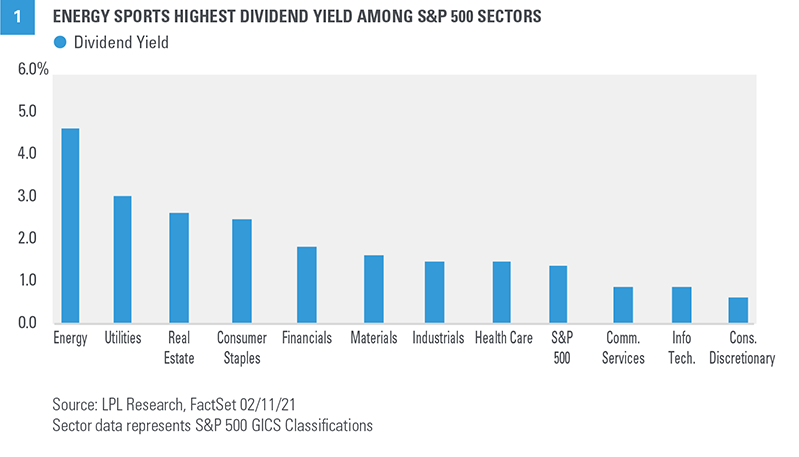
The first idea is energy stocks. You may be surprised to learn that the energy sector currently yields about 5% based on dividends paid in 2020, topping all S&P 500 sectors [FIGURE 1]. In this month’s Global Portfolio Strategy report, we upgraded our view of the energy sector to neutral. Our increased optimism was driven primarily by three factors. First, as we get closer to a fully reopened economy and travel activity picks up—potentially in the second half of this year—energy is likely to be a big beneficiary. Second, our technical analysis work revealed attractive upside potential based on recent price appreciation after an extended period of weakness. Third, we see the sector as attractively valued, especially when considering the income potential. Keep in mind that dividends can be cut, so this investment is not without risk. Oil prices can be volatile, and alternative energy is gaining market share. So this may be more of a medium-term trade than a long-term investment. That said, we believe the chances are good that oil prices at least hold steady in the $55--60 per barrel range this year, sufficient for the sector to maintain rich yields while potentially seeing some additional price appreciation—on top of the 17% year-to-date gain.Income Idea #2: Banks
You may be surprised to see banks on here as another income idea. The financials sector, which we upgraded in our January Global Portfolio Strategy report, carries a dividend yield of 1.9%, but banks yield 2.6%, based on the S&P 500 Bank Index. Although plenty of bond strategies carry yields in that range or higher, banks do not bring the interest rate risk that bonds do. Historically, bank stocks have exhibited positive correlation to interest rates (the stocks have tended to outperform as yields have risen). Bank stocks also tend to like a steepening yield curve—long-term interest rates rise faster than short-term rates—which we expect to see over the balance of 2021 as the economic recovery gains steam. We also expect bank dividend payouts to rise over the next year or two as the Federal Reserve eases up on payout restrictions. More progress on vaccine distribution should also enable a fully re-opened economy and drive stronger economic growth, which should bode well for the profitability and, therefore, dividend payout potential for the financials sector. Yields from banks may not look great on the surface—certainly not compared to the energy sector or some of the higher yielding segments of the bond market. But in a low rate environment with rates more likely to rise than fall, in our view, we think banks can make sense for income oriented investors with an eye toward total return.Income Idea #3: Bank Loans
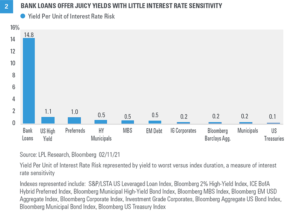
There are a number of fixed income options that may be suitable for income-oriented investors. For investors looking to limit interest rate risk, we believe bank loans, which we upgraded this month, may be an attractive option due to the improving economic environment and limited rate sensitivity (see our February Global Portfolio Strategy report for more details). [FIGURE 2] ranks the major fixed income sectors by income per unit of interest rate risk. Since fixed income indexes have different degrees of interest rate sensitivity, this exercise allows us to determine compensation for taking on interest rate risk. Bank loans are an obvious standout by this measure, offering potential yields in the 4% range with extremely low interest rate sensitivity.
While the actual yield bank loans may offer in the future is not certain, this analysis does show that bank loans provide an attractive income option relative to other fixed income alternatives for investors looking to limit interest rate risk at the beginning of a possible rising rate cycle. It’s important to understand the trade-off between interest risk and credit risk. We know there is no such thing as a free lunch. That additional income compensation comes with assuming credit risk (the risk of a default or credit downgrade) and the risk that prices drop sharply in a risk-off environment if demand suddenly dries up.
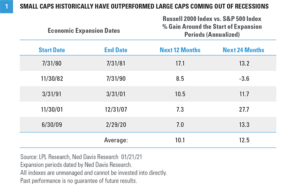
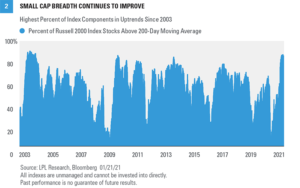

Performance has not be limited to the index level, either. Breadth continues to improve for small caps. (Breadth is the percentage of stocks in the category participating in the market.) The percent of index constituents trading above their 200-day moving average has surged to over 89%, the highest level since 2004. Not only is strong breadth a hallmark of a healthy market, but the levels of participation we are seeing now tend to be found almost exclusively at the beginning of bull markets, not the end. The election outcome, stimulus prospects, and progress toward fully reopening the economy as COVID-19 vaccines are distributed have triggered a leadership change from large caps to small caps. However, it has not triggered the sort of style rotation we have seen within the large cap space. Even as large cap value has outperformed large cap growth by more than 5 percentage points over the past three months, small cap growth and small cap value performance have been equally stellar, with both the Russell 2000 Growth and Russell 2000 Value indexes returning 34%.
Stimulus is the primary reason for the increase in our economic growth forecasts, though we are encouraged by the progress made toward ending the pandemic in recent weeks. The holiday surge in COVID-19 cases has largely passed, and new daily COVID-19 cases in the United States have fallen roughly 60% from the January 8 peak. Meanwhile, the total number of patients currently hospitalized with COVID-19 has fallen below 100,000 for the first time since early December. The vaccine rollout in the US has picked up speed—we are now averaging more than 1.3 million doses per day, according to the Centers for Disease Control and Prevention (CDC)—and additional vaccine candidates are likely coming soon that can help boost supply—in particular the Johnson & Johnson vaccine that is easier to transport and store. Prospects for better US growth should flow through to export-driven emerging market (EM) economies, so we have slightly increased our EM GDP growth outlook as well, in addition to our global GDP forecast.


While some pundits have been dismissive of growing debt concerns, we think the reasons for increased scrutiny are clear and grounded in common sense. You don’t get something for nothing, so at some point rising debt levels will have consequences. There are also concerns about the moral hazard that can come with unchecked spending. Increasing debt levels may be justified, but we should at least be wary enough about it to have a sense of a reasonable point for restraint. Finally, many view the debt not as the government’s but the people’s, and we naturally want our representatives to be careful with our dollars. Why have markets seemed indifferent to the rising national debt and when, and how, will it end? The answer to the first question is that we’re still well positioned right now for additional spending to have a reasonable positive impact on the economy with fewer of the usual risks. As to when the market indifference will end, at the very least, probably not in 2021 or even 2022. But eventually debt will likely weigh on growth, whether through periods of relative austerity or from economic consequences, but the impact can be spread out over time, especially if the political will comes around quickly enough.
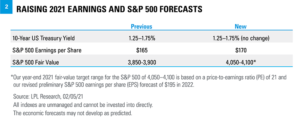
Stimulus matters. A historic recession required a historic policy response. Many speculated that the Federal Reserve (Fed) was out of ammunition, but policymakers proved doubters wrong. The Fed effectively lowered interest rates to zero, expanded its balance sheet by record amounts (15% of US GDP), and even ventured into purchasing corporate bonds—both investment grade and high yield—to restore function to markets and support corporate borrowing. Meanwhile, Congress passed record amounts of fiscal stimulus (totaling roughly 10% of US GDP in 2020), including small business lending and direct payments to households, to help lift the economy as it emerged from lockdowns. The path of returns typically isn’t a straight line. Ideally, the low-volatility/high-return environment of 2017 would have been the norm at this point of an economic cycle, but unfortunately it wasn’t. 2020 brought us the fastest bear market in history (down 20% from the highs), with the S&P 500 Index reaching that level in just 16 trading days on its way to a peak drawdown of roughly 34%. Supported by historic stimulus measures, stocks rebounded off the lows to climb back to new all-time highs in only 106 trading days. 2020 also was the only year when stocks experienced a 30% drawdown and managed to finish the year in positive territory. Markets can experience extraordinary short-term disruptions. At the height of the March volatility, we saw multiple Sundays when S&P 500 futures traded limit-down—when circuit-breaker mechanisms kicked in to prevent further losses. Then during regular trading sessions, stocks experienced trading halts triggered by large intraday losses. While the orderly operation of stock markets had returned by April, oil futures were not out of the woods. Global lockdowns caused energy demand to plummet and maxed out the capacity of supply tankers, sending the price of the April WTI crude oil contract into negative territory—implying someone literally would pay you to take delivery of their oil. Stock markets are forward looking. In late March, we upgraded our recommendation on equities to overweight. Though we admitted the timing of the recovery from the bear market was uncertain, we believed at that time that stocks would soon begin to price in the end of the pandemic, bolstered by the massive stimulus response. With the economy at a standstill, 2020 earnings forecasts plunged more than 25% (source: FactSet). Consensus earnings per share (EPS) estimates for the S&P 500 bottomed in late June, after the index had already rebounded 35% from the March 23 low. Stocks were well ahead of the economy and analysts’ earnings forecasts. Lower for longer. In 2020 the 10-year US Treasury yield plummeted to its lowest in history. We expect the 10-year Treasury yield will rise to a target range of 1.25–1.75% by year-end 2021 as the economy expands and inflation normalizes, but lower interest rates may be here to stay. The economic turmoil has prompted the Fed to lower interest rates and convey the intention to keep them low for an extended period of time. Few on Wall Street expect the Fed to raise interest rates before 2023, and only one member of the Fed expects a rate hike before then, according to the most recent dot-plot survey of Fed members’ policy rate projections. Stocks like election clarity. We have stressed the importance of not trying to time investment decisions based on political preferences, as we believe that stocks mainly want clarity from elections. Stocks put together another strong rally when more clarity arrived after the 2020 presidential election. They also benefited from the anticipation of a Congress likely split between Democrats and Republicans, an environment where stocks historically have delivered their strongest returns since 1950. The wonders of modern medicine. The Food and Drug Administration so far has granted emergency use authorization to two COVID-19 vaccines, and the first doses have been administered. While there is considerable uncertainty about the mass production and distribution of the vaccines, it is a remarkable feat of modern scientific medicine nonetheless. As the vaccine is distributed, we expect the hard-hit areas of the economy—particularly service industries—will begin to improve as life slowly begins to normalize. The power of human perseverance. Many sacrifices have been made in 2020, from holding off on visiting loved ones to helping children with virtual education, and the fight against COVID-19 is not quite over despite the discovery of new vaccines. Humanity has an incredible ability to find solutions to its problems, and 2020 showed our ability to persevere as a society.